LG LRFXS2503S Fridge Fan Not Working: How to Tell Which Fan Failed and Fix It
Somebody calls me up and says “the fan in my fridge quit.” Nine times out of ten, the first thing I have to do is slow them down, because an LG LRFXS2503S has two fans, they do completely different jobs, and the fix for one has nothing to do with the fix for the other. If you go buy the wrong motor you’re out the money and the fridge is still warm. So before you pick up a screwdriver, let’s figure out which fan we’re actually talking about. It takes about two minutes and it’s free.
I’m not a certified tech and I don’t pretend to be. I’ve just been pulling these things apart since I was a teenager, about 18 years of doing it for whoever asks, and the LG French doors follow a pattern once you’ve seen a few.
The Two Fans in an LRFXS2503S
The evaporator fan lives behind the rear panel inside the freezer compartment. Its job is to pull air across the cold evaporator coil and push it where it needs to go — some into the freezer, and some up through a duct and past a damper into the fresh food section. Everything the fridge side gets, it gets because that fan pushed it there.
The condenser fan lives at the bottom rear of the cabinet, behind the rear access panel, right next to the compressor. It blows ordinary room air across the condenser coil so the heat the fridge pulled out of your food has somewhere to go.
Different locations, different symptoms, different repairs.
Two-Minute Decision Block: Which Fan Is It?
- Freezer is still cold and still making ice, but the fresh food side is warm → evaporator fan. This split is the single most reliable tell there is. The coil is still cold, so the freezer stays cold-ish by sheer proximity, but nothing is moving air up to the fridge section.
- Both compartments are drifting warm together, the compressor is running constantly and the back of the fridge is very hot → condenser fan. Heat isn’t getting shed, so the compressor never catches up and never shuts off. Left long enough you may get a compressor-related fault; if a code shows on the display, cross-check it against the LRFXS2503S error codes guide.
- Everything is warm, and the compressor is silent and cool to the touch → this is not a fan problem at all. Go read up on linear compressor failure on the LRFXS2503S instead. No fan you buy will fix a compressor that isn’t running.
Get that sorted before you spend a dollar.
Diagnosing the Evaporator Fan
The door switch test
The evaporator fan on the LRFXS2503S is supposed to stop when you open the freezer door and run when it’s closed. So open the freezer door and press and hold the door switch — push it in with a finger, or tape it in so you have both hands free. Put your ear near the rear panel.
You should hear airflow start up. Not loud, but there. If you hear absolutely nothing with the switch held, that points at the fan motor, its wiring, or the control board. If you hear it running fine, your no-cool problem is somewhere else — a stuck damper, a blocked duct, or the defrost system.
Look for ice before you blame the motor
This is the one people get wrong constantly, and it’s the reason I keep repeating it. Ice buildup is the number one cause of a “dead” evaporator fan. A frost-blocked evaporator coil chokes off the airflow, and a fan blade frozen into ice will either stall the motor outright or make an awful screeching noise as it drags.
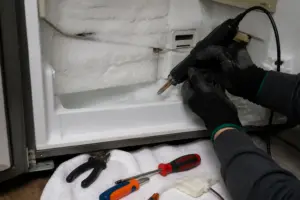
Before you condemn anything, pull the rear freezer panel and look at the coil. If it’s a solid white block of frost, the fan is a symptom, not the cause. The real problem is the defrost system — the defrost heater, the bimetal or thermistor, or the control board not running a proper defrost cycle. Replace the fan and you’ll be back inside that freezer in three weeks with the exact same symptom.
Use the noise as a clue
- Chirping, ticking, or grinding that changes when you open the freezer door — the blade is striking ice, or the motor bearing is worn out. Open the door, the fan stops, the noise stops. That’s your confirmation of where it’s coming from.
- Dead silent with the door switch held — no power reaching the motor, or an open winding inside it.
Testing the motor honestly
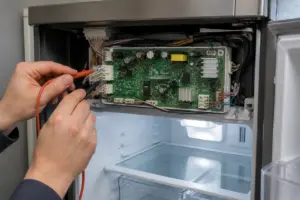
Unplug the fridge first. Not “turn it off at the panel” — unplug it. Then disconnect the fan’s connector and check resistance across the motor windings with a multimeter. Infinite or OL means an open winding and a dead motor.
Here’s the honest part, and it’s important: this model uses a BLDC (brushless DC) evaporator fan. A BLDC fan has control electronics built into it. That means a simple resistance check is a lot less conclusive than it would be on an old shaded-pole motor — the meter can give you a perfectly plausible reading on a fan that is stone dead. So on this fan, don’t buy on a resistance reading alone. Verify the board is actually supplying voltage to that connector before you order a motor. If there’s no voltage arriving, the fan isn’t your problem.
Check the wiring while you’re in there
Don’t skip this. The harness that runs through the freezer hinge area and the connector right at the fan are common failure spots — chafed insulation, corroded pins, a connector that’s backed halfway out. It’s free to inspect and free to fix, and I’ve found it enough times that I always look now.
Diagnosing the Condenser Fan
Unplug the LRFXS2503S, pull it away from the wall, and remove the lower rear access panel.
Clean first, diagnose second
I mean this. A real share of “condenser fan not working” calls on this model are just filth. The condenser coil and the fan blade pack solid with dust and pet hair, especially if you’ve got a shedding dog. A smothered coil makes the compressor run hot and long even with a perfectly healthy fan, and the symptoms look identical. Vacuum it out thoroughly, get a brush in the coil fins, then reassess.
Spin the blade by hand
With the fridge unplugged, turn the blade with a finger. It should spin freely and coast a little. If it’s stiff, dragging, or won’t move, you’re looking at debris jammed in it, a chunk of loose insulation, or a seized bearing.
Test and check for power
Check continuity across the motor terminals with your multimeter. Then, and this is the useful test, check whether the fan is getting power when the compressor is running. On the LRFXS2503S the condenser fan and the compressor are commanded together — if the compressor is humming away and the condenser fan never runs, the problem is the fan itself, the harness feeding it, or the inverter/main board.
Before You Buy a Fan Motor
Two things get mistaken for a bad fan on this fridge more than everything else combined:
- A frosted-over evaporator from a defrost system fault. The fan looks dead because it’s encased in ice or stalled against it. New fan, same ice, same problem.
- A filthy condenser coil. Compressor runs nonstop, cabinet warms up, everybody assumes the fan quit. It didn’t; it just can’t shed heat through a blanket of dust.
Both are free to check. Check them.
Replacing the Evaporator Fan
- Unplug the fridge.
- Empty the freezer and remove the drawer and baskets so you have clear access to the back wall.
- Remove the rear freezer panel. Some fasteners hide behind plastic caps, and depending on your configuration you may need to move the ice maker assembly out of the way first. Take your time — the plastic gets brittle when it’s cold.
- If there’s frost, thaw the compartment completely before going any further. A hair dryer on low, or just leave the doors open overnight with towels on the floor. Don’t chip at ice around the coil with anything metal; those tubes puncture easier than you’d think, and that turns a fan job into a sealed system job.
- Disconnect the fan connector.
- Release the fan housing or bracket and bring the assembly out.
- Transfer the blade to the new motor, and note which way the blade faces before you pull it off. A blade installed backwards moves air the wrong direction, and the fridge will still not cool. Take a photo first if you’re at all unsure.
- Mount the new fan, reconnect the plug, and confirm the harness is routed clear of the blade.
- Reinstall the panel, put the baskets back, plug the fridge in.
- Give it several hours to pull down to temperature. Don’t judge it after twenty minutes — you emptied a lot of cold out of that box.
Replacing the Condenser Fan
- Unplug the fridge and pull it out from the wall far enough to work comfortably behind it.
- Remove the lower rear access panel.
- Vacuum the coil and the whole compartment thoroughly while you have it open. You’re already here.
- Unplug the fan connector.
- Remove the fan bracket screws and lift the assembly out.
- Swap the motor and blade over to the new unit, again noting blade orientation.
- Reassemble, reinstall the panel, push the fridge back, plug it in.
This one’s the easier of the two by a good margin. No frost, no unloading the freezer, and you get a clean coil out of the deal.
Getting the Right Part
Open the fresh food compartment and find the sticker on the inside left wall. That’s your model and serial number. Match the fan using both, not just “LRFXS2503S,” because LG changed part numbers across production runs of this model and a fan that fits one build year may not fit another.
I’m not going to give you a part number here. Any number I quote could be wrong for your serial, and you’d be the one paying return shipping. Use a model-matched parts lookup with your serial and let it tell you.
When to Stop
There’s a line on this fridge and it’s worth knowing where it is.
- Anything involving refrigerant or the sealed system — not a DIY job. It needs equipment and handling you don’t have in the garage.
- Inverter board diagnosis beyond a basic voltage check — checking whether a connector has voltage is reasonable. Going deeper into that board is not, and the parts are expensive to guess at.
- If it turns out to be the compressor — stop and check your warranty first. The linear compressor in the LRFXS2503S carries a longer sealed-system warranty than the rest of the fridge does. People pay out of pocket for repairs that were covered, all the time, because nobody told them to look. Find your purchase date and check before you authorize anything.
And if your fan turns out to be fine and your actual complaint is on the ice side of things, that’s a different rabbit hole — see the ice maker not dispensing on this model, or if it’s the specialty ice, Craft Ice not working.
Frequently Asked Questions
Why is my LG freezer cold but the fridge warm?
That specific split almost always means the evaporator fan isn’t moving air. The evaporator coil sits in the freezer and stays cold on its own, so the freezer holds up reasonably well — but the fresh food compartment only gets cold because that fan pushes air up through a duct into it. No fan, no cold air upstairs. The two usual culprits are a failed evaporator fan motor or a coil frosted solid from a defrost fault. Pull the rear freezer panel and look before you buy anything.
How much does it cost to replace a refrigerator fan motor?
As a general ballpark, not a quote: the fan motor itself typically runs somewhere in the rough range of $40 to $150 depending on which fan and which production run, and doing it yourself is mostly an afternoon and a screwdriver. Having someone come out generally lands in the $200 to $450 range once you add the service call, labor and parts markup. The condenser fan is the easier DIY of the two. The evaporator fan means emptying the freezer and possibly a full thaw, so budget time more than money on that one.
Can I run the LRFXS2503S with a bad evaporator fan?
You can, but the fresh food side won’t hold safe temperatures, and if the cause is a frosted coil you’re also running the compressor against a choked evaporator. I’d move perishables out and get it fixed rather than limp along.
Why does my fridge fan get louder or start chirping?
Usually the blade clipping ice, or a worn bearing in the motor. The giveaway is that the noise stops the instant you open the freezer door, because the door switch cuts the fan. If opening the door silences it, that’s the evaporator fan. Check for ice first — that’s the more common of the two.
The condenser fan runs but the fridge is still warm. Now what?
Clean the condenser coil properly first; a dusty coil produces exactly this. If the coil is clean, the fan runs, and the compressor is running hot and continuously without cooling, you’re likely past the point of a fan repair on the LRFXS2503S and into sealed system or compressor territory. Check any error code against the error codes guide, and check your sealed-system warranty coverage before paying for a diagnosis.
The Tool You’ll Need
Digital Multimeter
Every test in this guide comes down to continuity and resistance readings, and a basic digital multimeter is the only tool that will give you them. If you’re going to guess at a part instead of testing it, you may as well buy the part twice.
About This Article

Written by Dave Holt. Dave Holt has been taking apart and fixing household appliances since he was a teenager who couldn't leave a broken one alone. Eighteen years later, after fixing things for neighbors, friends, and anyone who'd let him, he's seen almost every failure mode there is. When he writes a repair guide here, it's based on the actual job, not a manufacturer overview. More about this site.
Scope and limits. Dave is a self-taught repairer, not a certified appliance technician. Unplug before you open anything, and leave sealed refrigeration systems, gas connections, and hardwired circuits to a qualified technician.