What Is a Bullet Valve (Saddle Valve)?
Bullet valves are one of those parts that quietly cause trouble years after someone installed one, and I’ve replaced my share of them. Let’s dive into what a bullet valve — also known as a saddle valve — actually is and how it works.
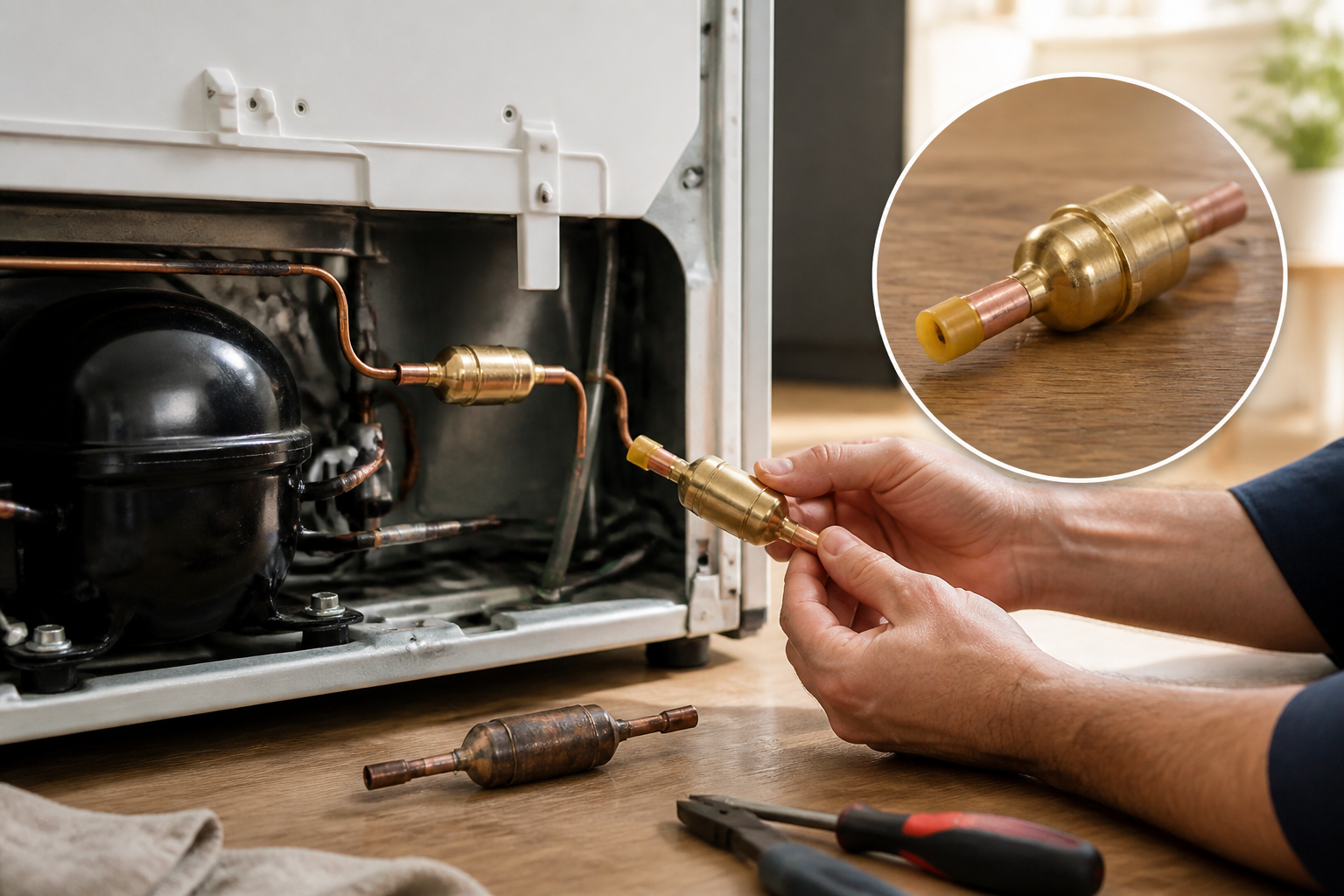
A bullet valve is a small, specialized valve designed to tap into an existing water supply line without cutting or permanently altering the pipe. It features a sharp piercing needle that punctures the copper water line when the valve body is tightened with clamps. This creates a connection point for your refrigerator’s water supply line—typically a 1/4-inch plastic tubing that feeds water to your ice maker and water dispenser.
The “bullet” nickname comes from its compact, cylindrical shape, typically made of brass or plastic with stainless steel clamp bands that wrap around the copper pipe. When properly installed, the needle creates a small hole while the valve body seals against the pipe surface, allowing water to flow through the valve into your refrigerator’s supply line.
Why Bullet Valves Are Problematic
Having worked with countless appliances, I can tell you that despite their convenience, bullet valves have earned a reputation among professionals as one of the least reliable components in residential plumbing. Understanding these issues is essential if you want to avoid headaches down the line.
Mineral Deposit Buildup and Clogging
The piercing needle creates a small, restrictive opening that becomes a prime location for mineral deposits. Hard water minerals like calcium and magnesium tend to accumulate around the needle seat, gradually choking off water flow. Over time, this can lead to slow or even nonexistent ice production. Bullet valves are particularly susceptible to this problem compared to standard shut-off valves with larger flow paths.
Corrosion and Material Degradation
As I’ve seen in my travels, brass components in saddle valves can corrode when exposed to certain water mineral compositions or pH levels. Meanwhile, plastic-bodied valves can become brittle over time, especially in colder environments. The stainless steel clamps can rust, and the seal between the valve body and copper pipe can degrade, potentially leading to leaks that aren’t immediately noticeable.
Slow and Hidden Leaks
One of the most frustrating aspects of failing saddle valves is their tendency to develop slow leaks that may go unnoticed for months. Water can seep from the seal point, traveling along the copper pipe or through walls, causing water damage and mold growth before you even realize there’s an issue. I’ve seen many homeowners discover these leaks only after significant damage has occurred.
Professional Recommendation
Having spoken with many professional plumbers and appliance repair technicians, the consensus is clear: removing saddle valves entirely and replacing them with proper 1/4-inch compression shut-off valves is the best course of action. These traditional valves feature larger internal flow paths and more reliable seals, making them far less prone to clogging and leaking. While saddle valves may still appear in some newer refrigerator installations, they should be viewed as a temporary fix at best.
Symptoms of a Failing Bullet Valve
Identifying the signs of a failing bullet valve can help prevent water damage. These symptoms usually develop gradually over time:
- Ice maker stops producing ice – If your ice maker stops working entirely or produces significantly fewer cubes, pay attention. You might notice it cycling on and off without producing ice, or only making small, incomplete cubes.
- Slow water dispensing – If water flows slowly or inconsistently from the refrigerator’s water dispenser, even though the main kitchen water pressure is normal, it’s a warning sign.
- Water leak under the refrigerator – Standing water or wet spots under or behind the refrigerator can indicate a problem, especially when you clean under the appliance.
- Water damage in walls or cabinets – Damp spots on cabinet walls or ceilings near the water line indicate a leak inside walls or enclosed spaces.
- Hissing or dripping sounds – If you hear water dripping or faint hissing sounds from under the sink or behind the refrigerator, especially when the ice maker is cycling, it’s time to investigate.
- Visible corrosion on the valve – Look for visible rust stains, white mineral deposits, or green corrosion (verdigris) on brass components.
- Refrigerator water filter replacement frequency increases – If your model has a water filter, it clogs much faster than normal due to mineral buildup forcing water through the filter more slowly.
Locating Your Bullet Valve
Finding the saddle valve is usually straightforward. It’s typically installed at the point where the water supply line branches off to feed your refrigerator. Depending on your home’s plumbing layout, here’s where you might look:
Under the Kitchen Sink
This is the most common location in residential kitchens. Look under the sink where the hot or cold water supply lines enter. You’ll likely find the saddle valve clamped to a copper line, with a 1/4-inch plastic or vinyl tubing running from the valve to the refrigerator. It will appear as a small cylindrical or bullet-shaped fitting with a clamp band around it.
Inside Kitchen Cabinets
Sometimes, the saddle valve may be located inside the base cabinet adjacent to or behind the refrigerator. Open the cabinet doors and look for the copper water line. You might need to remove items stored in the cabinet or disconnect shelving to gain access.
Basement or Crawlspace
In homes with basements or crawlspaces, the water supply could originate from a basement-level shut-off valve or water softener. In this case, look for the 1/4-inch tubing or small copper lines running upward through walls to the kitchen.
Behind or Inside the Refrigerator
In rare instances, particularly with older or unique refrigerator models, the saddle valve may be located directly at the refrigerator’s rear panel. Check around the ice maker and water dispenser connections.
Step-by-Step Bullet Valve Replacement
Replacing a saddle valve with a proper compression shut-off valve is a straightforward project that most homeowners can complete in 30-60 minutes. Here’s a complete guide covering preparation, removal of the old valve, and installation of the new one.
Tools and Materials Needed
- Adjustable wrench or open-end wrench set (7/16-inch and 1/2-inch sizes)
- Tubing cutter (specifically designed for copper pipe)
- 1/4-inch compression shut-off valve (brass, suitable for 1/4-inch copper line)
- Compression fittings or ferrules (if not included with valve)
- Teflon tape (plumber’s tape)
- Towels or bucket for water drips
- Flashlight for visibility
- Optional: deburring tool for smoothing cut pipe edges
Step 1: Turn Off the Main Water Supply
Before starting any work, shut off the main water supply to your home. Locate your main water shut-off valve, usually found where the water line enters your home. Turn the valve clockwise until it stops. If you can’t find it, contact your local water utility for assistance.
After shutting off the main water, open a faucet in your home to release pressure from the lines. Leave the faucet open while working to prevent excessive dripping when you cut the copper line.
Step 2: Disconnect the Refrigerator Water Line
Find the 1/4-inch vinyl or plastic tubing running from the saddle valve to your refrigerator. Follow the line carefully, as it may run through walls, cabinets, or along the floor. At the connection point to the saddle valve, you’ll find a small compression fitting or barbed connector.
If it’s a compression fitting, turn the nut counterclockwise with a wrench while holding the valve body steady. If the tubing is pushed over a barbed connector, gently twist and pull to disconnect it. Have a towel ready, as some water may drip from the line.
Step 3: Remove the Saddle Valve Clamps
The saddle valve is secured against the copper water line by two or three stainless steel clamp bands. Use an adjustable wrench or Phillips head screwdriver to loosen these fasteners. Turn counterclockwise to remove the clamp bolts or screws, then carefully pull the valve away from the copper line.
Inspect the copper line where the valve was mounted. You’ll likely see a small piercing hole and possibly some discoloration or corrosion around the area where the needle penetrated. This copper damage is normal and will be addressed in the next steps.
Step 4: Assess the Copper Pipe Condition
Examine the copper line at the point where the saddle valve was attached. Look for:
- The small hole created by the piercing needle
- Any cracks, splits, or corrosion damage in the copper
- Discoloration or mineral buildup
You have two options depending on the pipe condition:
Option A: Pipe is in good condition – If the pipe looks sound and the piercing hole is the only damage, proceed to Step 5 to cut the pipe cleanly above the damaged area.
Option B: Pipe is damaged or corroded – If you see cracks, splits, or significant corrosion extending beyond the piercing point, cut out the damaged section. See the “Repairing Damaged Copper Pipe” section below.
Step 5: Cut the Copper Line
Using a tubing cutter specifically designed for copper pipe, cut the water line at a clean section approximately 1-2 inches above where the saddle valve was attached. This removes the pierced section and ensures you’re working with undamaged copper.
Place the tubing cutter around the copper line and tighten the cutting wheel until it just touches the pipe. Rotate the cutter around the pipe, tightening the cutting wheel slightly with each rotation until it separates cleanly. Avoid using a hacksaw, as it creates rough cuts.
After cutting, you may see copper shavings inside the pipe. Hold it at an angle and gently tap the end to dislodge loose shavings. Use a deburring tool to smooth the cut edge if you have one.
Step 6: Install the Compression Shut-Off Valve
A 1/4-inch compression shut-off valve is the standard replacement for saddle valves. This valve features a compression fitting designed to seal against the copper pipe without requiring solder or permanent connections.
To install:
- Ensure the valve handle is in the OFF position (turned clockwise).
- Locate the compression nut and ferrule that came with the valve (or acquire them separately if not included).
- Slide the compression nut onto the end of the copper pipe.
- Slide the ferrule onto the copper pipe behind the nut.
- Insert the copper pipe into the compression fitting port of the shut-off valve.
- Hand-tighten the compression nut onto the valve fitting.
- Using an adjustable wrench, turn the nut an additional 1 to 1.5 turns clockwise, holding the valve body steady with another wrench to prevent rotation.
Be careful not to over-tighten the compression nut, as this can damage the ferrule and compromise the seal. The connection should be snug but not excessively tight.
Step 7: Reconnect the Refrigerator Water Line
Take the 1/4-inch vinyl tubing that was previously connected to the saddle valve and connect it to the outlet port of the new compression shut-off valve. If using a compression fitting with a nut, apply one wrap of Teflon tape to the male threads of the valve outlet, then hand-tighten the nut and finish with a wrench. If using a barbed connector, push the tubing firmly over the connector until it seats completely.
Ensure the tubing runs safely without kinks, sharp bends, or areas where it could be pinched or damaged. If the existing tubing looks worn or cracked, replace it with new 1/4-inch food-grade vinyl tubing.
Step 8: Restore Water Supply and Test
Close the faucet you opened in Step 1, then slowly turn on the main water shut-off valve by rotating it counterclockwise. Open it gradually to allow the system to refill slowly, reducing water hammer and allowing trapped air to escape.
Once the water is back on, check the new compression valve connection for leaks. Inspect both the connection between the valve and copper line, and the connection between the valve outlet and refrigerator water line for any dripping or moisture.
Turn on the refrigerator’s water dispenser and let it run for 30 seconds. The water should flow at normal pressure. If water pressure is low or slow, the saddle valve wasn’t the problem, or there’s blockage further in the line (see troubleshooting below).
Press the ice maker cycle button on your refrigerator, or check if it automatically begins its cycle. Remember, it may take several hours to notice ice production as the system cools and cycles through.
Repairing Damaged Copper Pipe from the Old Valve
If the copper pipe shows damage beyond the piercing hole—such as cracks, splits, or significant corrosion—there are repair options depending on severity and location.
Small Cracks or Corrosion Spots
If damage is limited to a small area within 2-3 inches of where you plan to cut, simply cut the pipe further up to remove the damaged section. This is the simplest and most reliable solution.
Extensive Damage Requiring Pipe Extension
If the damage extends more than a few inches along the copper line, or if it’s in a location where additional cutting would compromise the pipe layout, you can splice the line using a compression coupling. A 1/4-inch compression coupling allows you to join two pieces of copper pipe without soldering.
To use a compression coupling:
- Cut out the damaged section entirely using a tubing cutter.
- Measure the gap created by the removed section.
- Obtain a new piece of 1/4-inch copper tubing cut to the exact length needed to bridge the gap.
- Install compression fittings on both ends of the new copper section, then connect it to the existing pipe using compression couplings.
This method maintains the original water line without requiring solder and can be completed in 20-30 minutes.
When Professional Help Is Needed
If the copper pipe is severely corroded throughout a large section or has multiple cracks, or if water is leaking from areas other than the saddle valve connection, it’s time to call a licensed plumber. Extensive copper corrosion may indicate a water chemistry issue requiring professional assessment.
⚠️ Safety Warning: Water System Precautions
Working on your home’s water supply carries important safety considerations:
- Always shut off the main water supply before cutting or disconnecting water lines. This prevents potential water damage to your home.
- Ensure the water system is depressurized by opening a faucet before beginning work. This prevents water from spraying when you cut the line.
- Never work on water lines carrying hot water without allowing them to cool first. Hot water can cause burns.
- Don’t attempt to repair a water line with active leaks by yourself if you’re unsure of your abilities. Water damage can escalate rapidly.
- Use food-grade tubing only for any connections between the water supply and refrigerator. Standard vinyl tubing may leach chemicals into drinking water.
- After completing work, check all connections for leaks before leaving the area. Monitor for at least 30 minutes to ensure no slow leaks develop.
Troubleshooting After Valve Replacement
If problems persist after replacing the saddle valve, the issue may lie elsewhere in the water supply system:
Water Pressure Still Low
If the new valve isn’t solving low water pressure to the ice maker or dispenser, check:
- Refrigerator water filter: A clogged water filter is the most common cause of low pressure. Replace the filter according to your refrigerator’s manual.
- Water line blockage: Mineral deposits may have built up in the vinyl tubing between the valve and refrigerator. Disconnect and flush the tubing with water, or replace it entirely.
- Ice maker inlet valve: The solenoid valve inside the refrigerator that controls water flow to the ice maker may be faulty. This requires removing the refrigerator’s back panel.
- Main water pressure: Check water pressure at other faucets. If all faucets have low pressure, the issue is with your home’s main water supply, not the refrigerator line.
Leaks Continue
If water is still leaking after you’ve replaced the saddle valve,
Recommended Parts & Tools
Refrigerator Water Inlet Valve Replacement Kit
This universal water inlet valve kit is essential for replacing a faulty bullet valve in your refrigerator’s ice maker or water dispenser system. The kit includes the valve assembly along with necessary gaskets and seals to ensure a proper fit and prevent leaks after installation.
Adjustable Wrench Set for Appliance Repair
You’ll need reliable wrenches to disconnect the water lines and remove the old bullet valve from your refrigerator’s water supply connection. This adjustable wrench set provides multiple sizes in one tool, making it perfect for accessing tight spaces inside refrigerator compartments.
PTFE Thread Seal Tape for Water Lines
This thread seal tape is critical for wrapping around the water line connections when installing your new bullet valve, preventing leaks and ensuring a watertight seal. High-quality PTFE tape withstands the water pressure in refrigerator supply lines and is compatible with both plastic and metal fittings.
The Water Inlet Valve That Actually Stops Leaks from a Failed Bullet Valve
When a bullet valve fails—whether it’s leaking, clogged, or the piercing needle stripped—replacing it often means swapping out the entire water inlet valve assembly, not just the valve body itself. This kit gives you the complete replacement part most DIYers actually need when they discover the bullet valve is the culprit.
What works
- Comes with all necessary connectors and clamps, so you’re not hunting for matching fittings halfway through the repair.
- Eliminates the guesswork of trying to salvage just the valve itself—a full assembly swap is cleaner and more reliable than patching an old bullet valve.
- Compatible with most common refrigerator models, and the instructions account for both copper and plastic water line setups.
What doesn’t
- Overkill if your bullet valve is actually functional and the leak is coming from a cracked line elsewhere—you’ll want to diagnose the exact failure point first.
- Installation on some older fridge models can be tight, and you may still need to remove the fridge from the wall or access panels to reach the valve connection point.
I’ve seen plenty of DIYers order just a bullet valve cartridge and discover the real problem was a corroded inlet valve body, which then meant a second order and more downtime. Get the full assembly right the first time—Refrigerator Water Inlet Valve Replacement Kit.
About This Article

Written by Dave Holt. Dave Holt has been taking apart and fixing household appliances since he was a teenager who couldn't leave a broken one alone. Eighteen years later, after fixing things for neighbors, friends, and anyone who'd let him, he's seen almost every failure mode there is. When he writes a repair guide here, it's based on the actual job, not a manufacturer overview. More about this site.
Scope and limits. Dave is a self-taught repairer, not a certified appliance technician. Unplug before you open anything, and leave sealed refrigeration systems, gas connections, and hardwired circuits to a qualified technician.