Can You Plumb the GE Profile Opal 2.0 Into a Water Line?
Yes — but not out of the box. GE sells the Opal 2.0 as a manual-fill nugget ice maker: you lift the lid and pour water into the internal reservoir every day or two. There’s no built-in water line inlet on the unit itself, and GE doesn’t offer a factory plumb-in kit for it. What you’re actually looking for is a third-party permanent water line conversion kit, which replaces the reservoir lid with a fitting that connects to a standard 1/4″ water line, so the reservoir refills itself automatically instead of you topping it off by hand.
How the Conversion Actually Works
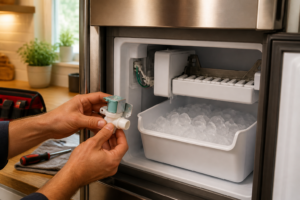
The Opal 2.0’s reservoir already has a float mechanism inside it — that’s what tells the machine when it’s full and when it’s getting low. A plumb-in conversion kit doesn’t rewire that logic; it just replaces the manual-fill lid with a sealed lid that has a barbed or push-fit inlet on top, plumbed to a 1/4″ line. Water trickles in continuously (or on-demand, depending on the kit’s internal valve), the float still does its job, and the reservoir simply never runs dry as long as your supply line has pressure. From the ice maker’s perspective, nothing about the ice-making cycle changes — you’ve only automated the refill step.
Most kits on the market are sized specifically for either the Opal 1.0 (1-gallon side tank) or the Opal 2.0’s larger built-in reservoir — they are not interchangeable, so confirm the kit is listed for the 2.0 specifically before ordering. Measuring your tank against the kit’s listed dimensions takes two minutes and saves you a return.
What You Need Before You Start
- The Opal 2.0-specific conversion kit (lid assembly, tubing, and fittings)
- A nearby cold water source to tap into — a refrigerator water line, a under-sink cold supply line, or a saddle valve on a standard supply line
- 1/4″ push-fit or compression fittings if your kit doesn’t already include enough line length to reach the source
- A basic inline water filter (optional but recommended — see below)
- Channel-lock pliers and a small bucket for the initial line purge
Pro tip: Household supply lines run at 40–80 PSI, and the Opal’s reservoir and float valve were never engineered for that kind of pressure hitting them directly. I’ve seen fittings pop and countertops flood because someone tapped a fridge line straight into the kit with no pressure regulation. If your kit doesn’t already include an inline pressure regulator, add one between the source and the reservoir — most conversion kits either bundle one or call out compatible ones in the instructions. Don’t skip this step to save $10.
Step-by-Step Installation
- Unplug the Opal 2.0 and empty the existing reservoir completely before opening anything up.
- Shut off the water supply at the source you’re tapping (fridge line valve, saddle valve, or under-sink shutoff) before cutting or connecting any tubing.
- Remove the stock manual-fill lid and set it aside — don’t throw it out, since some owners keep it as a backup in case the kit ever needs to come off for a move or a repair.
- Install the conversion kit’s lid assembly per the kit’s instructions, making sure the gasket seats fully so the reservoir stays sealed.
- Run the 1/4″ line from your water source to the kit’s inlet fitting, installing the pressure regulator inline if it isn’t already built into the kit.
- Turn the water supply back on slowly and check every fitting for drips before walking away — a paper towel run along each joint will show a slow leak faster than eyeballing it.
- Let the reservoir fill, plug the unit back in, and run one full ice cycle before trusting it unattended overnight.
Common Problems After Plumbing It In
The failures I get called out for on converted units are almost always installation issues, not the ice maker itself:
- Slow weeping leaks at the lid fitting — usually a gasket that didn’t seat flush, or a push-fit connector that wasn’t pushed in far enough to engage the collet fully.
- Water hammer or banging when the float valve shuts — a sign the pressure regulator is missing or set too high; the float valve is snapping shut against full house pressure instead of a moderated flow.
- Reservoir not refilling fast enough between cycles — check that the supply line isn’t kinked and that any inline filter you added isn’t already clogged, which restricts flow more than people expect.
- Nugget production drops off over a few months — this is usually unrelated to the plumb-in conversion itself and traces back to mineral scale buildup, which happens faster once the unit is running continuously instead of being manually refilled with filtered or bottled water. Descale on the same schedule you would with the manual-fill version.
Is Plumbing It In Worth It?
For a countertop unit in daily heavy use — a home bar, an office break room, anyone filling a cooler every weekend — the conversion kit pays for itself in convenience within a couple of months of not thinking about the reservoir. For occasional or seasonal use, manual refills are honestly less to think about than maintaining a permanent water line, a regulator, and one more set of fittings that can eventually fail. I plumb in the units I install for people who use them daily; I leave the reservoir manual on the ones that only come out for guests.
Frequently Asked Questions
Does GE make an official plumb-in kit for the Opal 2.0?
No. GE sells the Opal 2.0 as a manual-fill unit only. Every permanent water line conversion kit on the market for it is a third-party product, not a GE accessory.
Will plumbing it in void my warranty?
Modifying the lid assembly with a third-party kit can be treated by GE as an unauthorized modification if you need warranty service on the reservoir or lid area specifically. Keep the original manual-fill lid so you can swap it back on before any warranty claim.
Do I need a water filter on the line?
It’s not required, but it’s worth adding. Continuous line-fed operation means more total water volume passing through the reservoir over time than manual refills typically see, and an inline filter cuts down on the mineral scale that drives most of the descaling failures I see on converted units.
Can I convert an Opal 1.0 with the same kit?
No — the Opal 1.0 uses a smaller 1-gallon side tank with different dimensions. Kits are sized per model; check the listing before ordering.
What PSI should the line be running at the reservoir?
Keep it low — most kits and float valves are happiest in the 20–40 PSI range at the fitting, which is why a pressure regulator between a full-pressure household line and the kit is worth installing rather than skipping.
Once it’s plumbed correctly with a regulator in line, the GE Opal Nugget Ice Maker Conversion Kit for Opal 2.0 is a clean, low-maintenance upgrade — the leaks and banging noises I get called for almost always trace back to skipping the regulator, not the kit itself.
About This Article

Written by Dave Holt. Dave Holt has been taking apart and fixing household appliances since he was a teenager who couldn't leave a broken one alone. Eighteen years later, after fixing things for neighbors, friends, and anyone who'd let him, he's seen almost every failure mode there is. When he writes a repair guide here, it's based on the actual job, not a manufacturer overview. More about this site.
Scope and limits. Dave is a self-taught repairer, not a certified appliance technician. Unplug before you open anything, and leave sealed refrigeration systems, gas connections, and hardwired circuits to a qualified technician.