
🔧 Top 20 Refrigerator Models & Common Repair Issues Guide
💡 Don’t panic! Refrigerator problems are common, and many can be fixed by you. In this comprehensive guide, I’ll cover the most popular refrigerator models and their frequent repair issues based on my extensive experience.
🔨 Pro Tip from Dave
One crucial thing I’ve learned, especially with models like the LG LFXS26973S, is that the linear compressor (part number EAU61524011) can throw error codes that mimic other failures. So, don’t rush to replace your evaporator fan board before testing compressor resistance first. A common mistake is ignoring the extended warranty LG quietly provided for many serial number ranges, which could save you a hefty sum.
📋 What You’ll Need
- Multimeter
- Screwdriver set (Phillips and flathead)
- Refrigerant leak detector
- Condenser coil brush
- Replacement parts (as needed)
🔍 Filter By Appliance
- LG LFXS26973S (French Door)
- Samsung RF28R7351SR (French Door)
- Whirlpool WRF535SWHZ (French Door)
- GE GFE26JSMSS (French Door)
- Frigidaire FRSS2623AS (Side-by-Side)
- KitchenAid KRFC704FPS (French Door)
- Maytag MFI2570FEZ (French Door)
- Samsung RF23J9011SR (Counter-Depth French Door)
- LG LRMVS3006S (French Door)
- Bosch B36CL80ENS (French Door)
- GE GTE18GTHWW (Top Freezer)
- Whirlpool WRT318FZDW (Top Freezer)
- Frigidaire FFTR1821TS (Top Freezer)
- LG LRFVS3006S (French Door – InstaView)
- Samsung RT18M6215SG (Top Freezer)
- GE GSS25GSHSS (Side-by-Side)
- Whirlpool WRS325SDHZ (Side-by-Side)
- Kenmore 70343 (French Door)
- Electrolux EI23BC82SS (Counter-Depth French Door)
- Sub-Zero BI-36UFD/S/PH (Built-In French Door)
📖 Repair Guides
1. LG LFXS26973S (French Door)
2. Samsung RF28R7351SR (French Door)
3. Whirlpool WRF535SWHZ (French Door)
4. GE GFE26JSMSS (French Door)
5. Frigidaire FRSS2623AS (Side-by-Side)
6. KitchenAid KRFC704FPS (French Door)
7. Maytag MFI2570FEZ (French Door)
8. Samsung RF23J9011SR (Counter-Depth French Door)
9. LG LRMVS3006S (French Door)
10. Bosch B36CL80ENS (French Door)
11. GE GTE18GTHWW (Top Freezer)
12. Whirlpool WRT318FZDW (Top Freezer)
13. Frigidaire FFTR1821TS (Top Freezer)
14. LG LRFVS3006S (French Door – InstaView)
15. Samsung RT18M6215SG (Top Freezer)
16. GE GSS25GSHSS (Side-by-Side)
17. Whirlpool WRS325SDHZ (Side-by-Side)
18. Kenmore 70343 (French Door)
19. Electrolux EI23BC82SS (Counter-Depth French Door)
20. Sub-Zero BI-36UFD/S/PH (Built-In French Door)
💡 General Refrigerator Troubleshooting Tips
Before Calling Service:
- Check power supply – Verify the outlet, circuit breaker, and GFCI haven’t tripped.
- Temperature settings – Ensure they are set to manufacturer recommendations (typically 37°F for the fridge and 0°F for the freezer).
- Door seals – Test by closing the door on a dollar bill; you should feel resistance when pulling it out.
- Condenser coils – Clean the coils underneath or behind the unit every 6-12 months.
- Proper ventilation – Ensure adequate clearance around the unit per the manual specifications.
Common Issues Across All Models:
- Ice maker problems – Most common failure point; check the water supply, temperature, and module.
- Cooling issues – Usually related to the defrost system, evaporator fan, or sealed system (compressor/refrigerant).
- Water leaks – Typically due to defrost drain clogs or water line connections.
Maintenance Best Practices:
- Replace water filter – Every 6 months or as indicated by the light.
- Clean condenser coils – Vacuum coils annually; more often if you have pets in the home.
- Check door seals – Clean the gaskets with mild soap; replace them if they’re torn or loose.
- Level the unit – Ensure proper door closure and drainage.
- Don’t overload – Allow air circulation; avoid blocking vents.
- Temperature monitoring – Use a refrigerator thermometer to verify proper temperatures.
Safety Reminders:
- Unplug before service – Always disconnect power for electrical work.
- Sealed system – Requires an EPA-certified technician for refrigerant work.
- Heavy components – Use caution when accessing the compressor area.
- Sharp edges – Watch for sheet metal edges when removing panels.
When to Call a Professional:
- Sealed system leaks (refrigerant).
- Compressor replacement.
- Complex Control board issues.
- Repeated failures after attempted repairs.
How Much Does This Repair Cost?
| Repair route | Typical cost |
|---|---|
| Do it yourself | $15–$180 (parts) |
| Professional repair | $150–$400 (parts and labor) |
For most DIY refrigerator repairs, expect to spend anywhere from $15 to $180 on parts, depending on the component — a defrost thermostat runs about $15–$30, while an ice maker assembly can hit $80–$180. Hiring a professional technician typically costs $150–$400 total, including labor, and compressor replacements can push $500–$700 or more.
Recommended Products
These are the parts and tools I recommend for this repair, based on compatibility and customer reviews:
- Samsung DA97-15217D Refrigerator Ice Maker Assembly (Replaces DA97-15217A) Genuine Original Equipment Manufacturer (OEM) Part
- SAMSUNG DA97-15217B Refrigerator Ice Maker Assembly Genuine Original Equipment Manufacturer (OEM) Part
- DA97-21968A Ice Maker Assembly Replacement – Compatible with Samsung Refrigerators – Replaces DA97-13718C, DA97-15217D – Mechanical Ice Tray & Motor Unit
Why I Always Test with This Multimeter Before Ordering Any Refrigerator Parts
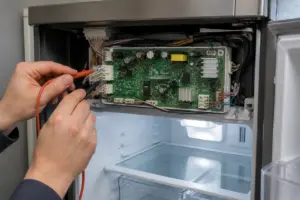
Before you order a compressor, control board, or ice maker assembly, I can’t stress enough the importance of knowing whether the problem is actually electrical or mechanical. A multimeter is the one tool that saves you from ordering the wrong $300 part when the real culprit is a $15 wire connection or a dead outlet.
What works
- Instantly tells you if power is actually reaching the compressor, evaporator fan, or control board — I can’t count how many “dead fridge” calls turned out to be tripped breakers or loose power connections.
- Tests door switches and defrost timers in seconds, cutting through guesswork about whether a component is actually failed or just disconnected.
- Confirms continuity on thermal fuses and heating elements before you assume the defrost cycle is broken — saves you from replacing a $40 part that’s actually fine.
What doesn’t
- Won’t diagnose refrigerant leaks or airflow problems — you need a leak detector and your hands on the coils for those calls.
- Takes a few minutes to learn the basic settings (DC vs. AC voltage, resistance ranges) if you’ve never used one before, but the payoff on your first repair is immediate.
I’ve mistakenly ordered more expensive parts than necessary because I skipped the multimeter test and assumed the symptom meant a specific failure — just because a compressor isn’t running doesn’t always mean the compressor is bad. A multimeter is the diagnostic bridge between “it’s broken” and “here’s exactly what failed.”
About This Article

Written by Dave Holt. I have been taking apart and fixing household appliances since I was a teenager who couldn't leave a broken one alone. Eighteen years later, after fixing things for neighbors, friends, and anyone who'd let me, I have seen almost every failure mode there is — and misdiagnosed my share along the way. I am self-taught, with no formal training or certifications. When I write a repair guide here, it is based on the actual job, not a manufacturer overview. More about this site.
Scope and limits. Dave is a self-taught repairer, not a certified appliance technician. Unplug before you open anything, and leave sealed refrigeration systems, gas connections, and hardwired circuits to a qualified technician.