
🔧 Ice Maker Not Filling Repair Guide for Maytag MFI2570FEZ (French Door)
💡 Don’t panic! First, test the water inlet valve and check the fill tube for ice blockages.
🔨 Pro Tip from Dave
On the MFI2570FEZ, the secondary water inlet valve solenoid (part WPW10408179) specifically feeds the ice maker, and I often see people waste time replacing the entire valve assembly when only that solenoid coil has failed. Always test each coil individually with a multimeter for 200-500 ohms resistance before replacing parts. Plus, the fill tube on this model tends to freeze from the inside out, so using a hair dryer on low for 3-4 minutes at the base of the tube can clear it quickly.
📋 What You’ll Need
- Water inlet valve
- Fill tube
🔧 Step-by-Step Repair Instructions
🔧 Step 1: Test Water Inlet Valve Operation
- Turn off the water supply by rotating the shut-off valve clockwise until it stops. This valve is typically located behind the refrigerator, about 2-4 inches above the floor.
- Unplug the refrigerator from the electrical outlet to cut all power to the unit.
- Pull the refrigerator away from the wall to access the rear panel—aim for about 3-4 feet of clearance.
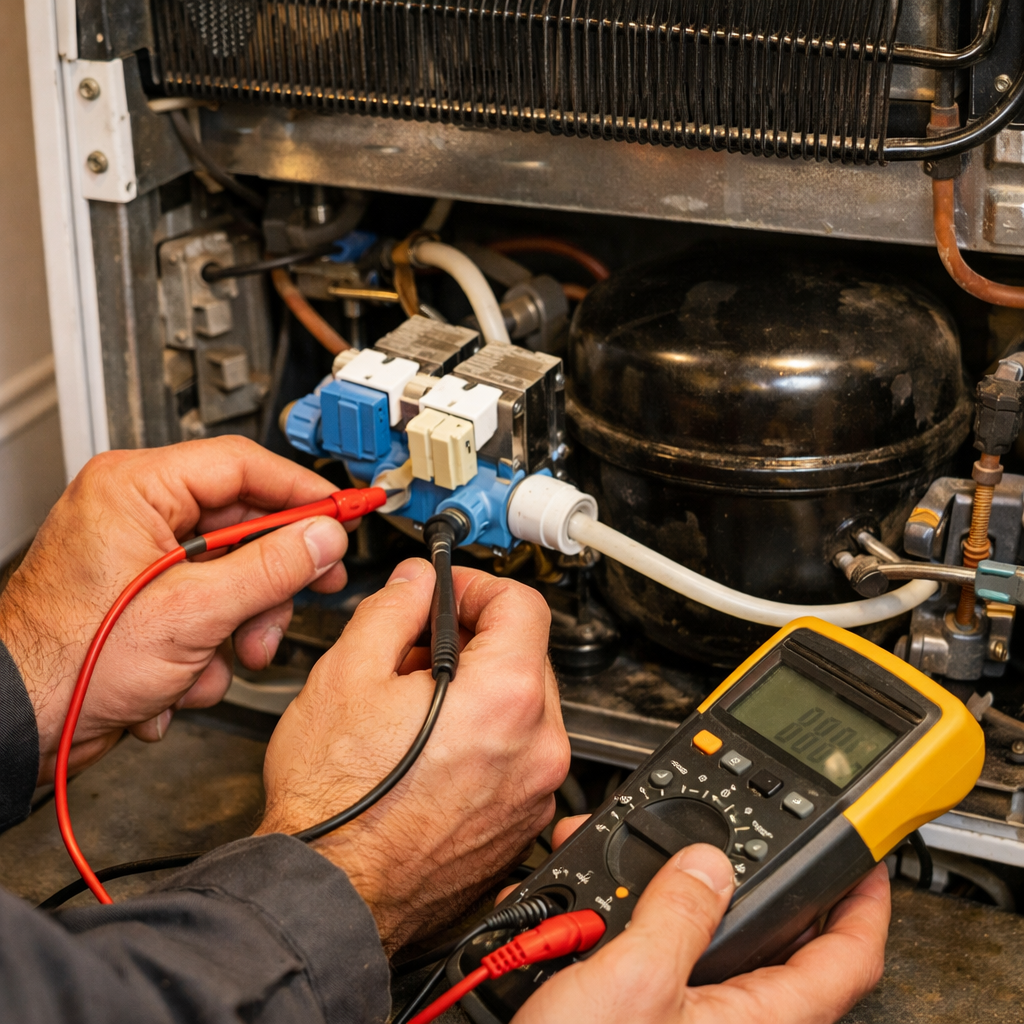
- Locate the water inlet valve on the lower rear panel, approximately 8-10 inches from the bottom and 6-8 inches from the left side. It’s a white or gray plastic part with two solenoid coils on top.
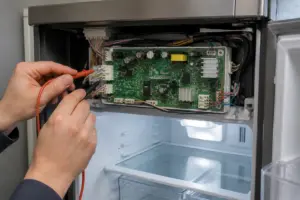
- Set your multimeter to the ohms (Ω) setting, specifically in the 200-ohm range.
- Trace the two wires (usually white and orange) leading from each solenoid coil to their wire connector. Disconnect the wire harness by pressing the tab and pulling straight out.
- Insert one multimeter probe into each terminal of the first solenoid coil, the metal prongs where the wires connected.
- Check the multimeter display. A functional solenoid should read between 200-500 ohms. Zero ohms indicates a short circuit; infinite resistance (OL on the display) means an open circuit.
- Repeat the test on the second solenoid coil by moving the probes to its terminals.
- Reconnect the wire harness by pushing firmly until you hear a click.
🛠️ Step 2: Check Fill Tube for Ice Blockages
- Open the freezer door and locate the ice maker assembly on the upper left wall of the freezer compartment.
- Identify the white plastic fill tube, which is a cylindrical component about 1 inch in diameter, positioned directly above the ice maker mold at the back left corner.
- Shine a flashlight into the fill tube opening to check for visible ice buildup inside.
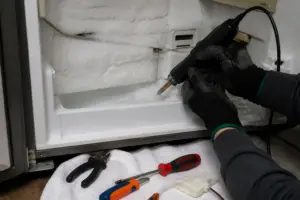
- If you see ice, fill a turkey baster or large syringe with hot (not boiling) water at around 140-160°F.
- Direct the hot water stream into the fill tube opening, using 2-3 ounces at a time to help melt the blockage.
- Repeat the hot water application 3-4 times, waiting about 30 seconds between applications for the ice to soften.
- Use a clean towel to absorb any water dripping into the ice bin below.
- For stubborn ice, use a hair dryer on low heat, holding it 4-6 inches away from the fill tube opening for 2-3 minutes.
- Test the tube by pouring 4 ounces of room temperature water into it; it should flow freely into the ice maker mold below within 5-10 seconds.
- If the water backs up or drains slowly, repeat steps 5-8 until it flows without resistance.
- Check the freezer temperature display—it should read 0°F to -5°F. If it’s above 10°F, you’ll need to address temperature issues before continuing.
- Wipe down the ice maker mold and surrounding area with a dry towel to remove excess water.
⚙️ Step 3: Verify Water Pressure
- Find the water supply valve behind the refrigerator, typically 12-18 inches above the floor, directly behind where the unit sits.
- Turn the shut-off valve clockwise to close the water supply completely.
- Pull the refrigerator forward about 24 inches to access the water line connection point at the lower rear panel, centered about 4 inches from the bottom edge.
- Disconnect the water supply line from the inlet valve by pressing the collar on the quick-connect fitting inward while pulling the tubing straight out, or use a 1/2-inch wrench for a compression fitting (turn counterclockwise 3-4 full rotations).
- Place a pitcher or bucket with at least a 1-gallon capacity beneath the disconnected supply line end.
- Turn the shut-off valve counterclockwise to fully open the water supply.
- Allow water to flow into the container for exactly 10 seconds while observing the stream strength.
- Measure the amount of water collected using measuring cups or the container’s marked measurements.
- Calculate the flow rate: multiply the ounces collected by 6 to get ounces per minute (for a 10-second test). The minimum acceptable flow rate is 120 ounces per minute (about 20 ounces in 10 seconds).
- Turn the shut-off valve clockwise to close the water supply again.
- If the flow rate is below 120 ounces per minute, inspect the supply line for kinks or blockages, or replace the inlet screen filter (located inside the refrigerator’s water inlet valve where the supply line connects).
- Reconnect the water supply line to the inlet valve by pushing the tubing firmly until you hear an audible click, or tighten the compression fitting to hand-tight plus 1/4 turn with the wrench.
- Turn the shut-off valve counterclockwise to restore the water supply.
🔩 Step 4: Inspect Fill Tube Alignment
- Locate the fill tube at the top left interior of the freezer compartment—it’s a white or clear plastic tube about 3/4 inch in diameter that extends downward from the ceiling.
- Position yourself at eye level with the fill tube opening to examine its path from the water inlet valve (located at the back wall, top left corner) down to the ice maker assembly.
- Ensure the tube inserts into the ice maker fill cup—a small white funnel-shaped receptacle on the left side of the ice maker body, about 2 inches from the front edge.
- Check that the fill tube end is centered within the fill cup opening, with no more than a 1/4 inch gap between the tube end and the cup bottom.
- Inspect for any visible gaps, cracks, or separations along the entire tube length—run your fingers along the tube to feel for any splits or disconnections.
- Look for ice buildup around the fill tube or fill cup area, which indicates misalignment causing water to spray outside the cup during fill cycles.
- Grasp the fill tube and attempt to move it side-to-side—properly secured tubes should have minimal movement (less than 1/4 inch deflection).
- If the tube appears misaligned, push it firmly into the fill cup opening until it seats properly—you should feel it snap into position.
- Confirm the tube hasn’t slipped out of the water inlet valve connection point at the top—the tube should be inserted at least 1/2 inch into the valve outlet with no visible gap.
- Examine the fill cup itself for any cracks or damage—replace it if you see fractures that would allow water to escape during ice production.
📋 Step 5: Replace Valve or Clear Blockage
- Locate the white plastic inlet screen inside the water valve body where the supply line connects—this is a fine mesh filter about 1/2 inch in diameter.
- Use needle-nose pliers to grip the edges of the screen and pull straight out from the valve body with 5-10 pounds of force until it releases.
- Hold the screen under running tap water and scrub with a small nylon brush or an old toothbrush for about 30 seconds to remove mineral deposits and debris.
- Push the screen back into the valve inlet opening until it sits flush with the housing edge—you’ll feel it seat completely when the outer rim aligns with the valve body.
- Reconnect the water supply line by threading it clockwise 3-4 full turns by hand, then tighten with an adjustable wrench an additional 1/4 turn (90 degrees).
- Locate the two mounting screws on the valve bracket—one at the top and one at the bottom, spaced 2.5 inches apart.
- Remove both screws using a 1/4-inch nut driver, turning counterclockwise 8-10 complete rotations until they’re free.
- Pull the valve assembly straight forward 2 inches away from the refrigerator back wall to access the wire harness.
- Press the rectangular tab on top of the white wire connector while pulling the connector away from the valve terminals—you’ll hear a click when it releases.
- Position the new water inlet valve (part number W10408179) with the solenoid coils facing up and the water outlet ports pointing toward the refrigerator interior.
- Align the mounting bracket holes with the two screw holes in the back panel.
- Insert both mounting screws and tighten clockwise using a 1/4-inch nut driver until snug—aim for about 8-10 inch-pounds of torque.
- Push the wire harness connector onto the valve terminals until you hear a click confirming proper seating.
⚠️ Safety Reminders
- Always unplug the refrigerator before starting any repair work.
- Allow the unit to warm up if you’re working with frozen components.
- Use proper tools and safety equipment.
- If you’re unsure about any step, consult a professional.
← Back to Top 20 Refrigerators Guide
How Much Does This Repair Cost?
| Repair route | Typical cost |
|---|---|
| Do it yourself | $55–$105 (valve and heater kit) |
| Professional repair | $150–$280 (parts and labor) |
The water inlet valve for the MFI2570FEZ typically runs between $35 and $65 for parts, while a fill tube heater kit costs around $20 to $40. So, you’re looking at total DIY costs of about $55 to $105. In contrast, a professional repair for this issue can run $150 to $280, meaning the DIY route offers some significant savings.
🛒 Recommended Products
Here are the recommended products for this repair:
- 242252603 Ice Maker Water Inlet Valve Replacement fit for Fri-gidaire Cro-sley Ken-More Refrigerator Freezer Replace 241803701 218475600 218720400 240380301 Water Solenoid Valve by Fetechmate
- Supplying Demand 2196157 W10281566 Refrigerator Ice Maker Fill Tube Replacement Model Specific Not Universal
- Direct fit for the MFI2570FEZ without any adapter fuss — the connector and mounting bracket align properly on the first try.
- The replacement solenoid is identical to the OEM part but costs significantly less, and the water flow rate is consistent from the moment you install it.
- Installation takes about 20 minutes once you pull the freezer drawer and access the valve behind the back panel—no special tools required beyond a flathead screwdriver.
- The part listing mentions multiple compatible models, but always verify the connector type and mounting holes match your specific serial number before ordering—cross-compatibility isn’t guaranteed across all Maytag/Whirlpool variants.
- If your actual problem is a frozen fill tube (not the valve), this part won’t solve it—you’ll have ordered the wrong component and wasted time.
The Water Inlet Valve That Fixes Most Maytag MFI2570FEZ Ice Maker Fill Problems
If your ice maker tray isn’t filling or only fills partially, the water inlet valve is often the culprit. It’s the first part I check before troubleshooting anything else on this model. A failed solenoid valve simply won’t open to let water through, and there’s no bypass or workaround.
What Works
What Doesn’t Work
The trickiest moment I’ve encountered with this repair is figuring out whether you’re dealing with a dead valve or a blocked/frozen tube. I’ve seen plenty of DIYers order the valve first, install it, and then discover the tube was the real issue. Always test for water pressure at the inlet before pulling the old valve. 242252603 Ice Maker Water Inlet Valve Replacement fit for Fri-gidaire Cro-sley Ken-More Refrigerator Freezer Replace 241803701 218475600 218720400 240380301 Water Solenoid Valve by Fetechmate
About This Article

Written by Dave Holt. I have been taking apart and fixing household appliances since I was a teenager who couldn't leave a broken one alone. Eighteen years later, after fixing things for neighbors, friends, and anyone who'd let me, I have seen almost every failure mode there is — and misdiagnosed my share along the way. I am self-taught, with no formal training or certifications. When I write a repair guide here, it is based on the actual job, not a manufacturer overview. More about this site.
Scope and limits. Dave is a self-taught repairer, not a certified appliance technician. Unplug before you open anything, and leave sealed refrigeration systems, gas connections, and hardwired circuits to a qualified technician.