KitchenAid Freezer Drawer Misalignment: Complete DIY Repair Guide
A misaligned freezer drawer on your KitchenAid refrigerator can lead to poor sealing, difficulty opening and closing, and compromised food preservation. Whether your drawer is drooping, rubbing against the cabinet frame, or sticking on one side, this comprehensive guide will walk you through diagnosis and repair. Most alignment issues can be resolved without professional service by adjusting drawer glides, inspecting roller systems, and re-leveling your refrigerator.
Understanding KitchenAid Freezer Drawer Misalignment Types
Drooping or Sagging Drawer
A drooping freezer drawer typically sags at the front or sits lower on one side than the other. This occurs most often in bottom-mounted freezer models like the KBFN402 and KRFC704 series, where the drawer carries significant weight. You’ll notice the top edge of the drawer frame sits below the adjacent cabinet panel, creating an uneven gap that worsens as you pull the drawer out fully.
Rubbing or Binding Drawer
When the drawer frame contacts the cabinet opening during operation, you’ll experience resistance during opening and closing. Rubbing typically occurs on the top corners or sides of the drawer frame. This misalignment prevents the drawer from sliding smoothly and can damage both the drawer and cabinet finish over time.
Improper Sealing and Frost Buildup
Misaligned drawers don’t close flush with the refrigerator cabinet, allowing warm air infiltration. You may notice frost accumulation around the drawer perimeter, condensation inside the drawer, or rising temperatures. The magnetic gasket cannot create a proper seal when the drawer frame isn’t level relative to the opening.
Drawer Stuck on One Rail
Single-side sticking indicates that one roller or glide is binding while the opposite side moves freely. The drawer may pull toward one side, making it difficult to center during closure. This often results from uneven wear between left and right rail systems or a single damaged roller.
Common Causes of Misalignment
Heavy Loading Patterns
Consistently loading frozen items on one side of the drawer causes uneven weight distribution. Over months of use, this asymmetrical loading stresses one roller system more than the other, causing premature wear and misalignment. The drawer gradually pulls down on the heavily-loaded side.
Worn or Damaged Rollers and Wheels
KitchenAid freezer drawers typically use plastic roller wheels or glides mounted on metal brackets at the front and rear of the drawer. These components wear from years of opening and closing cycles. Worn rollers develop flat spots, cracks, or chip damage that prevents smooth travel along the rail, causing the drawer to sit lower on the affected side.
Loose or Bent Rail Brackets
The metal brackets that hold rollers and glides to the refrigerator frame can loosen over time due to vibration and weight stress. Loose bracket bolts allow the drawer rail to shift position, creating misalignment. In some cases, the bracket itself bends from excessive impact or strain, permanently changing the drawer’s position.
Broken Glide or Friction Pad
Plastic glide components or felt friction pads wear thin or crack, reducing their height and allowing the drawer to sag. These components are designed to take the wear rather than the roller wheels themselves. When they fail, drawer height decreases on the affected side.
Refrigerator Not Level
If your entire refrigerator tilts forward or to one side, the drawer alignment will be compromised regardless of the drawer’s mechanical condition. KitchenAid refrigerators must be leveled with front feet slightly higher than rear feet for proper door sealing and drawer operation.
Inspecting Drawer Tracks and Rollers
Safety Precautions Before Inspection
⚠️ Before beginning any inspection or repair work, unplug your KitchenAid refrigerator from the electrical outlet. This prevents accidental activation of ice makers or water dispensers and eliminates electrical hazard during extended disassembly.
Initial Visual Assessment
With the freezer drawer fully removed (see removal steps below), examine the track systems on both the left and right sides of the refrigerator interior. Look for visible debris, ice buildup, or standing water that could impede roller movement. Wipe away any frost or ice with a clean cloth and allow the area to warm to room temperature.
Removing the Freezer Drawer
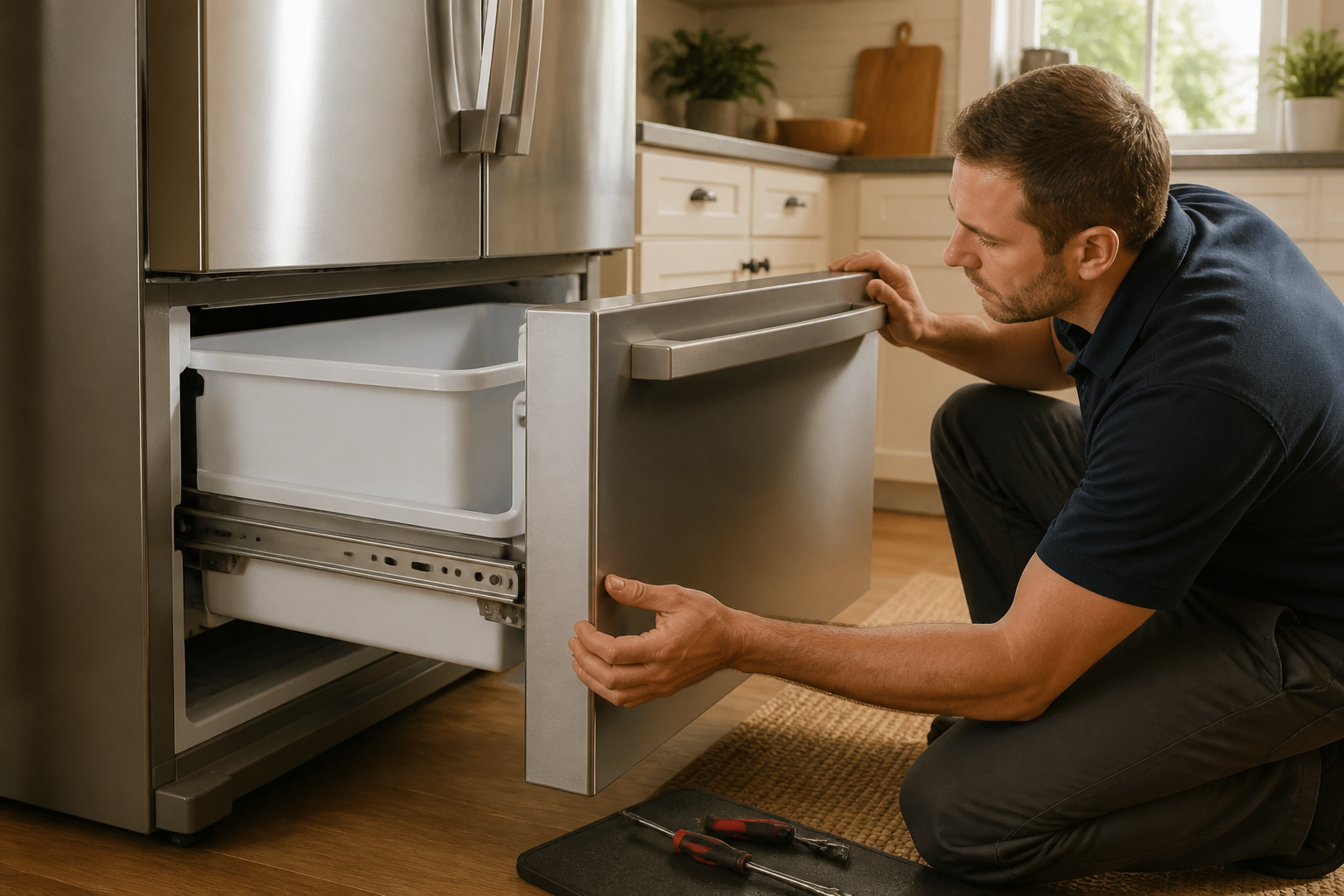
Open the freezer drawer fully and look for the small release tabs or clips typically located on both the left and right sides where the drawer meets the refrigerator frame. On KitchenAid models, these tabs are usually integrated into the roller bracket assembly. Gently lift the front of the drawer while pressing these release tabs inward simultaneously. The drawer should slide out smoothly. If it binds, do not force it—instead, inspect for ice blockages or visible obstructions and remove them first.
Examining the Roller Wheels
Once the drawer is removed, locate the roller wheels attached to the front and rear of the drawer. On most KitchenAid models, you’ll find plastic wheels mounted in metal brackets at four points: two at the front corners and two at the rear. Inspect each wheel for:
- Cracks or chunks missing from the wheel surface
- Flat spots where the wheel has worn unevenly
- Discoloration or deformation indicating freezing or material failure
- Buildup of frost, ice, or debris preventing rotation
Manually spin each wheel between your fingers. It should rotate freely without grinding, squeaking, or binding. If a wheel doesn’t spin freely or feels rough, that roller is likely damaged and requires replacement.
Inspecting the Rails
With the drawer removed, examine the aluminum or plastic rails mounted on the refrigerator frame itself. Look for:
- Bent or warped rails that deviate from a straight line
- Cracks or splits in plastic rails
- Rough spots, corrosion, or damage to the rail surface where rollers travel
- Loose bracket bolts connecting the rail to the refrigerator frame
Use a straightedge or level placed along the rail to identify bending. If the rail is bent, it typically requires replacement rather than straightening.
Checking Bracket Tightness
Locate all bolts or screws connecting the roller brackets and rails to the refrigerator frame. Using the appropriate wrench or screwdriver, attempt to tighten each fastener. KitchenAid typically uses Phillips head screws or hex bolts in the 6mm to 8mm range. Do not over-tighten, as this can strip threads or crack plastic brackets. The bolt should feel snug with moderate hand pressure on the tool.
Adjusting Freezer Drawer Glides and Rollers
Locating Adjustment Screws
KitchenAid freezer drawers feature adjustment mechanisms on the front roller bracket assembly. These adjustment screws are typically Phillips head fasteners located on the side or underside of the front roller bracket. On most models, you’ll find two adjustment screws per side: one for left-right alignment and one for up-down (height) adjustment.
The vertical adjustment screw is usually positioned directly above or below the roller wheel itself. Looking at the bracket from the side, this screw may thread directly into the bracket arm that holds the wheel, or it may work through a slotted hole design. Consult your specific model’s service manual for exact screw locations, as positioning varies between KitchenAid refrigerator generations.
Measuring Drawer Height Differential
Before making adjustments, measure the gap between the top edge of the drawer frame and the refrigerator cabinet opening at multiple points. Use a ruler or caliper to measure at the left front corner, right front corner, left rear area, and right rear area. Record these measurements. Ideally, the gaps should be equal (typically 0.5 to 1 inch) all around the drawer perimeter. A difference of more than 0.25 inch indicates misalignment requiring adjustment.
Adjusting Drawer Height
The adjustment screws that control drawer height typically raise or lower the entire roller bracket assembly. To raise one side of the drawer:
- Locate the vertical adjustment screw on the affected roller bracket
- Turn the screw clockwise (when viewed from the outside of the bracket) to raise that corner, or counterclockwise to lower it
- Make small quarter-turn adjustments, checking the drawer position after each turn
- Reinstall the drawer and check the gap alignment
- Repeat in small increments until the drawer sits level
Most adjustment screws provide movement of approximately 0.125 inch per complete 360-degree rotation. Make conservative adjustments to avoid over-correcting.
Left-Right Centering Adjustments
If the drawer pulls to one side or doesn’t center properly in the opening, locate the horizontal adjustment screws (usually positioned on the sides of the front roller bracket). These screws typically work through a slotted hole that allows side-to-side bracket movement:
- Loosen the horizontal adjustment screw by one-half turn
- Gently tap the roller bracket sideways using a rubber mallet to shift the bracket position
- Re-tighten the adjustment screw
- Test drawer alignment by reinstalling and checking centering
Adjust in small increments. If the drawer still pulls to one side after adjustment, the issue may involve worn rollers rather than bracket position.
Checking Adjustment Progress
After each adjustment, fully reinstall the freezer drawer and test the fit. The drawer should:
- Open and close with smooth, even resistance on both sides
- Sit with equal gaps on left and right sides
- Close flush with even contact across the entire front face
- Not bind or catch at any point during extension or retraction
If resistance or binding persists after height and centering adjustments, proceed to roller replacement.
Replacing Worn Rollers and Glides
Identifying Your KitchenAid Model Series
Roller and glide part numbers vary significantly by model. Identify your refrigerator’s exact model number, typically found on a label inside the freezer compartment on the wall or ceiling. Common KitchenAid freezer drawer models include:
- KBFN402 (bottom freezer French door)
- KRFC704 (bottom freezer with ice and water)
- KBSS602 (side-by-side with bottom freezer drawer)
- KHBS2081 (high-capacity bottom freezer)
Write down this model number before ordering replacement parts.
Sourcing Replacement Roller Kits
KitchenAid offers complete freezer drawer roller and glide kits for most models. These kits typically include four roller wheels, two front bracket assemblies, and sometimes rear glide components. Kits are more economical than purchasing individual parts. Common kit part numbers include W10181127 (universal lower drawer roller assembly) and model-specific variants like W10287957 for KRFC704 series units.
Contact KitchenAid customer service with your model number to confirm the correct part. Alternatively, authorized KitchenAid parts retailers can supply the correct kit for your specific refrigerator generation.
Removing the Old Roller Bracket Assembly
With the freezer drawer removed from the refrigerator, locate the bolts or screws securing the front roller bracket to the refrigerator frame. Typically, you’ll find 2-4 fasteners per bracket. Using the appropriate wrench or screwdriver, remove these fasteners completely and set them aside in a safe location. Some brackets may have additional clips or pins—note their position before removal.
Carefully slide the old roller bracket assembly outward and downward, taking care not to scratch the refrigerator interior. If the bracket is frozen in place due to ice buildup, allow it to thaw partially or carefully apply heat with a warm cloth.
Installing the Replacement Roller Assembly
Examine your new roller kit for any protective plastic caps or shipping materials, and remove them. Position the new bracket assembly into the mounting location, aligning the bolt holes with the refrigerator frame. Hand-start all bolts before tightening:
- Insert bolts through the bracket holes into the frame
- Hand-tighten each bolt to seat it in the threaded hole
- Using a wrench, tighten all bolts in a cross-pattern (like tightening wheel lugs) to ensure even pressure
- Verify that the bracket sits level and parallel to the refrigerator frame
- Do not over-tighten, which can crack plastic or strip threads
Repeat this process for the rear roller assembly if your kit includes one.
Testing the New Rollers
Reinstall the freezer drawer into its track system. It should slide smoothly with even resistance throughout the opening and closing motion. If one side still binds or feels rough, verify that:
- All bracket bolts are properly tightened
- Brackets are seated evenly with no gaps between bracket and frame
- Roller wheels spin freely without restriction
- No debris or ice is obstructing the rail system
If the new rollers don’t resolve binding issues, inspect the rails themselves for bending or damage, which may require rail replacement.
Bottom-Freezer vs. Side-by-Side Drawer Models
Bottom-Freezer Models (KBFN, KRFC Series)
Bottom-freezer KitchenAid models like the KBFN402 and KRFC704 feature a full-width drawer that supports substantial weight. These drawers typically employ heavier-duty roller systems with thicker gauge steel brackets and larger diameter wheels. Alignment issues in these models often stem from the cumulative weight of frozen items. When adjusting or replacing components, ensure bolts are torqued adequately to support the load, typically using medium-hand pressure on the wrench (not maximum force).
Bottom-freezer models often include rear glide systems separate from the front rollers. These glides may be simple plastic components or more sophisticated ball-bearing systems. Inspect both front and rear systems when diagnosing misalignment.
Side-by-Side Freezer Drawer Models
Side-by-side KitchenAid refrigerators (KBSS, KHBS series) feature narrower freezer compartments, often configured as a drawer on one side. These models typically use lighter-duty roller systems with smaller brackets and wheels. The freezer drawer in side-by-side models may share its rail system with the adjacent fresh food drawer, creating interdependencies in alignment.
When working on side-by-side models, ensure that adjusting the freezer drawer doesn’t compromise the fresh food drawer alignment. Test both drawers during and after any adjustment work.
Re-Leveling Your KitchenAid Refrigerator
Understanding Proper Refrigerator Leveling
KitchenAid refrigerators must be slightly tilted forward to ensure proper door sealing and drainage. The front of the refrigerator should be 0.25 to 0.5 inch higher than the rear. This forward tilt allows gravity to pull closed doors tightly against magnetic gaskets and directs water toward floor drains rather than into interior components.
If your freezer drawer misalignment persists after roller and bracket adjustments, improper refrigerator leveling may be the underlying cause.
Measuring Current Level
Use a long straight edge (a level tool or straight board at least 2-3 feet long) placed across the top of your refrigerator. Place a torpedo level on top of the straight edge. The bubble should indicate a very slight forward tilt—not level, but noticeably forward. If the refrigerator is level or tilts backward, adjustment is required.
As an alternative measurement, place a rolling object (marble or small ball) on the top of the refrigerator and observe if it rolls toward the front or back. It should roll slowly forward.
Locating and Adjusting Front Leveling Feet
⚠️ Before adjusting leveling feet, ensure the refrigerator is unplugged and empty of perishable items. You’ll be tilting the refrigerator, which can shift contents and potentially damage items if left inside.
Access the front leveling feet from beneath the refrigerator. You may need to remove the lower kickplate or grille panel (typically secured by a clip or two fasteners). The front feet are usually large plastic adjustment screws or leveling nuts positioned at the bottom front corners.
To raise the front of the refrigerator (creating forward tilt):
- Locate both front leveling feet
- Using an adjustable wrench or the appropriate wrench, turn the leveling foot clockwise to raise that side
- Work both feet evenly—adjust one side, then the other, to maintain balance
- Make quarter-turn adjustments, checking level after each turn
- Stop when you achieve the desired forward tilt (approximately 0.
Recommended Parts & Tools
Magnetic Adjustable Drawer Slides and Alignment Tool Kit
When realigning your KitchenAid freezer drawer, having proper drawer slides and an alignment tool ensures the drawer tracks are perfectly straight and level. This kit includes alignment gauges that help you position the drawer frame correctly relative to the refrigerator cabinet, preventing future misalignment issues. Check current pricing on Amazon.
Appliance Repair Tool Set with Plastic Pry Tools and Screwdrivers
This specialized tool set includes the plastic pry tools needed to safely remove the drawer front panel and access the mounting brackets without damaging your refrigerator’s finish. The precision screwdrivers make it easy to loosen and retighten the alignment bolts during the realignment process. Check current pricing on Amazon.
Stainless Steel Cleaner and Polish for Appliances
After completing the realignment work, this cleaner removes fingerprints, dust, and debris that accumulate during the repair process, restoring your refrigerator’s appearance. It’s specifically formulated for stainless steel appliances and helps protect against streaking. Check current pricing on Amazon.
The Alignment Tool That Actually Fixes Drooping KitchenAid Freezer Drawers
If your drawer is sagging on one side or rubbing unevenly against the frame, you need a way to adjust the slides themselves—not just force the drawer shut. This kit gives you the precision adjustment points and visual reference you need to dial in the drawer until it runs level and true.
What works
- The magnetic guide actually holds screws in place while you’re working inside tight spaces—saves you from dropping fasteners into the cavity behind the drawer housing.
- The included adjustment shims let you fine-tune height on each side of the slide independently, so you can correct that droop without replacing the whole slide assembly.
- The alignment tool gives you a straight-edge reference to confirm the drawer is actually running parallel to the cabinet opening, not just “close enough.”
What doesn’t
- If your slides are bent or damaged (not just misaligned), shims and adjustments won’t restore smooth operation—you’ll end up replacing the slides anyway.
- The tool kit assumes you’re comfortable working with the drawer partially removed and accessing the mounting hardware; if you’re not comfortable with basic appliance disassembly, this adds an extra learning curve.
I’ve seen too many homeowners order new drawer slides first, only to realize the originals just needed adjustment—which turns a 30-minute fix into a part replacement. Before you go down that road, grab Magnetic Adjustable Drawer Slides and Alignment Tool Kit and verify whether adjustment alone will solve the problem.
This post contains affiliate links. As an Amazon Associate, I earn from qualifying purchases at no extra cost to you.