LG LFXS26973S Freezer Frosting Up: Complete Diagnostic and Repair Guide
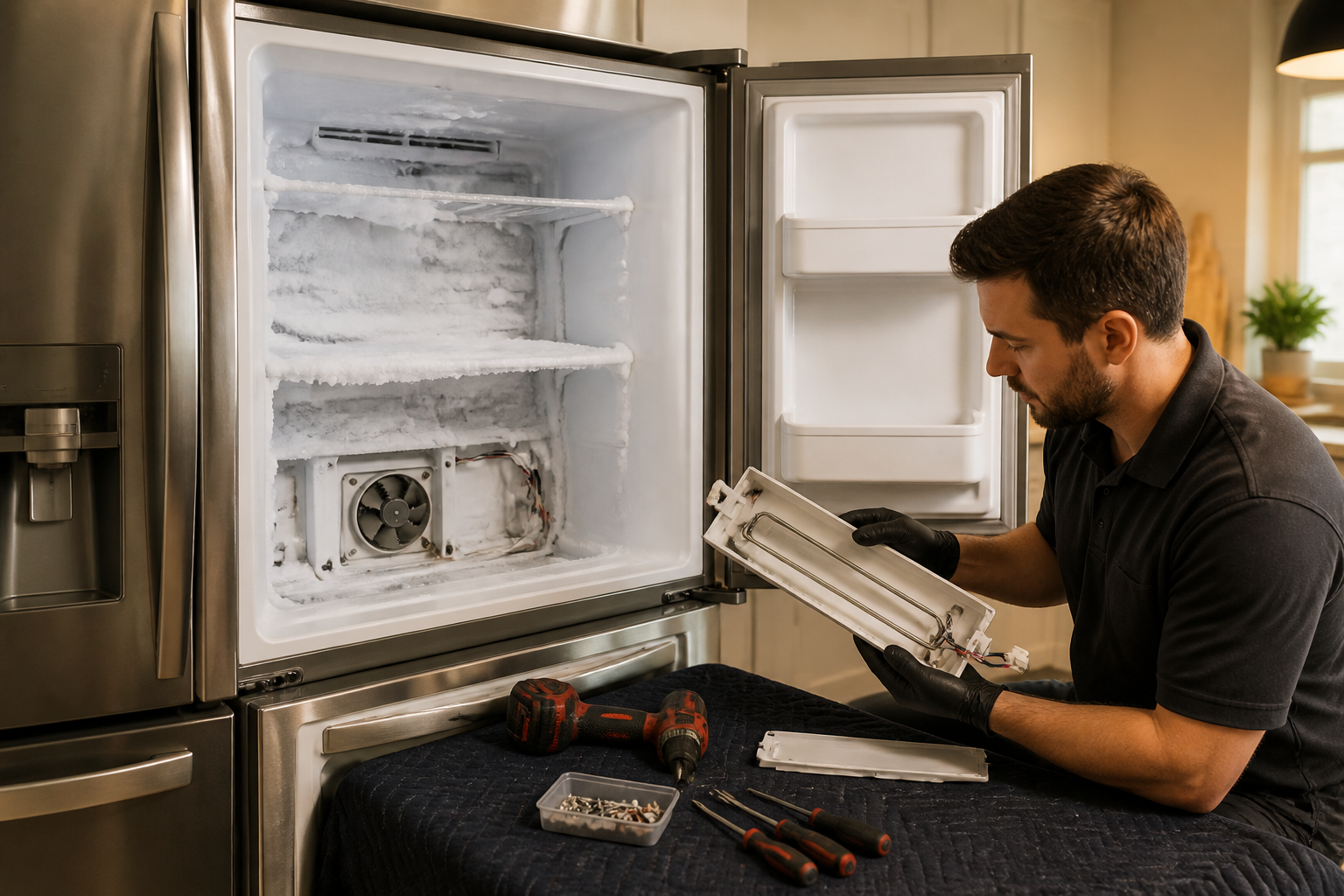
Excessive frost buildup in the freezer compartment of your LG LFXS26973S French door refrigerator is a frustrating problem, but it’s one of the most common issues this model experiences. When you open the freezer drawer and find ice coating the walls, back panel, and drawer slides, the culprit is almost always one of four components: the defrost heater, defrost thermostat, defrost timer/control board, or a faulty door gasket. This comprehensive guide will walk you through identifying which component has failed and how to repair it yourself, saving you several hundred dollars in service calls.
Understanding the Defrost System in the LG LFXS26973S
Your LG LFXS26973S uses an automatic defrost system that cycles on approximately every 8-12 hours. During a defrost cycle, the defrost heater element melts ice that accumulates on the evaporator coil. Water from the melted ice drains through the defrost drain pan and out of the refrigerator. If any component in this system fails, frost will accumulate rapidly—sometimes covering the entire back wall of the freezer within 24-48 hours.
Common Causes of Frosting in the LFXS26973S Freezer
Defrost Heater Failure
The defrost heater is a heating element that warms the evaporator coil to melt accumulated ice. In the LG LFXS26973S, this heater is located behind the freezer back panel, wrapped around the evaporator coil. When the heater burns out (which happens frequently in this model), ice builds up continuously because no melting occurs. The heater typically burns out due to power surges, manufacturing defects, or simply age-related wear. Most LFXS26973S units experience defrost heater failure between 3-7 years of operation.
Defrost Thermostat (Thermal Limiter) Failure
The defrost thermostat, also called a thermal limiter, is a temperature-sensitive switch that tells the defrost heater when to turn on and off. In the LFXS26973S, this component is mounted directly on the evaporator coil. When the thermostat fails, it either won’t signal the heater to turn on, or it gets stuck in the “on” position. If stuck in the “off” position, ice accumulates; if stuck in the “on” position, you may see frost on only one side of the freezer or notice the freezer running unusually cold.
Defrost Timer or Control Board Issue
The defrost timer/control board in the LFXS26973S orchestrates the entire defrost cycle. Newer LFXS26973S models use a solid-state control board rather than a mechanical timer. If this board malfunctions or becomes stuck, it won’t initiate the defrost cycle, causing continuous frost accumulation. Control board failures are less common than heater failures but are more difficult to diagnose.
Door Gasket Leak
The French door design of the LFXS26973S means you have two door gaskets on the refrigerator section, plus one gasket on the freezer drawer. A compromised door seal allows warm, humid air to enter the freezer. This moisture freezes on the coils and walls, creating excessive frost. This is one of the most commonly overlooked causes of frost in the LFXS26973S because homeowners focus only on the defrost system.
Evaporator Fan Motor Failure
The evaporator fan circulates cold air throughout the freezer and refrigerator compartments. If this fan stops working in the LFXS26973S, the defrost heater may function correctly, but the melted water won’t evaporate properly, and frost can still accumulate. Additionally, without proper air circulation, cold spots develop, making the system work harder.
Step 1: Visual Inspection to Identify the Problem
Before ordering any parts for your LFXS26973S, perform a visual inspection to narrow down the cause.
- Open the freezer drawer completely and examine where the frost is concentrated. Frost covering the entire back wall and sides suggests a defrost heater or thermostat failure. Frost primarily on the drawer slides and lower areas suggests a door gasket problem.
- Check the freezer drawer rails and slides. If they’re heavily frosted but the back wall is relatively clear, warm air is leaking in from the door seal rather than the defrost system failing.
- Feel the back panel of the freezer. In a working LFXS26973S, the back panel should be cold but not rock solid with ice. Thick ice buildup that feels like a solid block indicates defrost system failure.
- Unplug the refrigerator and allow it to sit for 30 minutes. If frost melts significantly during this idle period, the defrost heater is likely working (though inefficiently), pointing to a thermostat or timer issue. If frost remains solid and doesn’t weep any water, the heater is definitely not functioning.
Step 2: Remove the Freezer Back Panel on the LFXS26973S
To properly diagnose your LFXS26973S freezer frosting issue, you need to access the evaporator coil behind the back panel.
- Unplug the refrigerator from the electrical outlet.
- Remove the freezer drawer by pulling it straight out toward you until it stops, then lifting the front edge up and pulling again.
- The back panel is typically held in place by 2-4 plastic clips or screws. On most LFXS26973S models, you’ll find clips on the top corners. Push inward on these clips while pulling the panel toward you.
- Once the panel is loose, gently pull it away from the refrigerator. Be careful—there’s often a defrost drain tube attached to the back of this panel. On the LFXS26973S, this tube may be held with a small clip or simply pressed into place. Disconnect it carefully.
- With the back panel removed, you now have a clear view of the evaporator coil and the defrost heater element.
Step 3: Testing the Defrost Heater on the LFXS26973S
The defrost heater in the LFXS26973S is the most frequently failing component. It’s a thin metallic heating element wrapped around the evaporator coil, typically located in the center-back area of the freezer cavity.
Locating the Defrost Heater
With the back panel removed on your LFXS26973S, look for a thin metal tube or wire element spiraling around the evaporator coil. It will be approximately 3-4 feet long and roughly 1/4 inch in diameter. The heater terminals connect to wires that lead to the control board (usually located on the back exterior of the refrigerator). The defrost heater assembly part number for most LFXS26973S models is 4391960 or 5300609262, though you should verify this before ordering.
Testing with a Multimeter
You’ll need a digital multimeter to test the defrost heater on your LFXS26973S. Here’s the procedure:
- Ensure the refrigerator is unplugged and has been disconnected for at least 5 minutes.
- Locate the two heater terminals on the defrost heater element. These are usually held in push-on style connectors.
- Gently pull the connector wires away from the terminals to expose the metal spades.
- Set your multimeter to the ohms (resistance) setting, typically marked with an Ω symbol.
- Touch the multimeter probes to the two heater terminals.
- A properly functioning defrost heater in the LFXS26973S should read between 40-60 ohms of resistance. Some models show 30-100 ohms depending on the specific heater design.
- If the multimeter reads “OL” (open line) or shows infinite resistance, the heater element has burned out and must be replaced.
- If the reading is within the normal range but your freezer is still frosting up heavily, the heater may have internal corrosion or the thermostat is preventing it from activating. Proceed to Step 4.
Replacing the Defrost Heater in the LFXS26973S
If your multimeter confirmed the heater is burned out, replacement is the only solution. The defrost heater assembly for the LFXS26973S costs between $80-150 depending on the exact part number.
- With the refrigerator unplugged, disconnect the wire connectors from the heater terminals by gently pulling them straight off.
- The heater element is typically clipped or held in place by a metal bracket. Locate the clips or fasteners and release them. On the LFXS26973S, these are usually small plastic or metal clips near the evaporator coil.
- Carefully unwrap the old heater element from around the coil and remove it.
- Position the new heater element in the same location, wrapping it around the evaporator coil in the same pattern as the original. The element should spiral smoothly without sharp bends.
- Secure the heater with its clips or brackets.
- Reconnect the wire connectors to the heater terminals, ensuring they’re fully seated.
- Reinstall the back panel and freezer drawer, reconnect the defrost drain tube, and plug the refrigerator back in.
- Run a manual defrost cycle (see Step 5) to verify the heater is functioning properly.
Step 4: Testing the Defrost Thermostat on the LFXS26973S
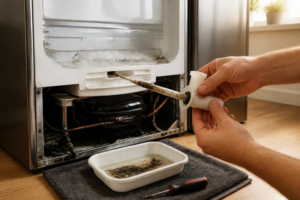
If your heater resistance reading was normal but frost is still accumulating, the defrost thermostat (thermal limiter) is likely the culprit. This component is mounted on the evaporator coil and looks like a small cylindrical device with a temperature dial.
Locating the Defrost Thermostat
On the LFXS26973S, the defrost thermostat is typically found clipped directly to the evaporator coil, usually on the lowest horizontal section. It’s a small component, approximately 1 inch long and 1/2 inch in diameter, with two wire terminals.
Testing Procedure
- Unplug the LFXS26973S and allow it to sit for at least 10 minutes to ensure all power is discharged.
- Locate the two wires connected to the thermostat terminals and gently pull them free.
- Set your multimeter to the ohms (resistance) setting.
- Touch the multimeter probes to the thermostat terminals.
- A working defrost thermostat will show approximately 0 ohms of resistance (a complete circuit) when the coil temperature is above approximately 32°F. If the coil is very cold (below 32°F), the thermostat should show infinite resistance (open circuit).
- If the thermostat shows infinite resistance when the coil is at room temperature or above, it’s stuck in the open position and not allowing the heater to run. It must be replaced.
- If it shows 0 ohms resistance even when the coil is very cold, it’s stuck closed, causing the heater to run continuously or not cycle properly.
Replacing the Defrost Thermostat
The defrost thermostat (thermal limiter) for the LFXS26973S typically costs $35-60 and is part number 2149107 or 6502JJ702 depending on your exact model variant.
- With the refrigerator unplugged, disconnect the wire terminals from the thermostat.
- Remove the clip or fastener holding the thermostat to the evaporator coil. On the LFXS26973S, this is usually a simple clip that slides or pops off.
- Position the new thermostat in the exact same location, ensuring it’s in direct contact with the coil. Poor contact with the coil surface will prevent proper temperature sensing.
- Secure the thermostat with its clip.
- Reconnect the wire terminals, ensuring they’re fully seated.
- Plug the refrigerator back in and monitor the freezer temperature over 24 hours to verify frost reduction.
Step 5: Performing a Manual Defrost Cycle on the LFXS26973S
After replacing either the heater or thermostat, you can force a defrost cycle to verify the repair worked before reassembling everything.
- Plug the LFXS26973S back in after your repairs.
- Locate the defrost timer or control board. On most LFXS26973S models, the control board is mounted on the back of the refrigerator, near the compressor area. Some models have an accessible defrost cycle button on the control board labeled “Test” or “Defrost.”
- If your LFXS26973S has a test button, press and hold it for 3-5 seconds. You should hear a relay click, indicating the defrost heater has been activated.
- If there’s no test button, you can manually advance the defrost timer by removing the control board and rotating the timer wheel. This requires more technical skill and may void warranties—only attempt this if you’re confident in your abilities.
- Once the defrost cycle starts, you should feel heat coming from the back panel area if the heater is functioning. The temperature inside the freezer may rise slightly as the heater melts ice.
- Allow the cycle to run for 15-20 minutes, then check if water is draining from the defrost drain opening at the bottom of the back panel.
- If water drains and the coil defrosts, your repair was successful. If no water appears or the heater doesn’t produce heat, you may have a different problem—see the troubleshooting section below.
Step 6: Checking the Door Gasket on the LFXS26973S
The French door design of the LFXS26973S means you have two refrigerator door gaskets plus one freezer drawer gasket. A compromised seal on any of these allows warm, humid outside air into the freezer, where it condenses and freezes on cold surfaces. This is especially problematic in humid climates and is frequently the overlooked cause of freezer frosting.
Inspecting the Door Gaskets
- Remove all items from the freezer drawer to get a clear view.
- Visually inspect the entire perimeter of the freezer drawer gasket where it contacts the refrigerator frame. On the LFXS26973S, look for cracks, tears, hardening, or deformation of the rubber seal.
- Pay special attention to the bottom corners and the area where the gasket folds at the hinge side. These areas experience the most wear.
- Also inspect the lower edges of the two refrigerator door gaskets, as these sometimes compress or deform from the weight of the doors.
Dollar Bill Test for Air Leaks
A simple but effective test for gasket integrity on the LFXS26973S:
- Close the freezer drawer with a dollar bill (or a piece of paper) positioned at various points along the gasket—top center, bottom center, left edge, right edge.
- Try to pull the dollar bill out. It should require significant force to remove. If it slides out easily, that section of the gasket is not sealing properly.
- Repeat this test along the entire perimeter of the door gasket, paying special attention to the bottom edge and corners.
- Also test the bottom edges of the refrigerator doors in the same manner, as these can contribute to freezer humidity problems in the LFXS26973S.
Gasket Replacement
If the gasket fails the dollar bill test, it needs replacement. The freezer drawer gasket for the LFXS26973S is part number 3550JJ701 and costs approximately $60-90. Refrigerator door gaskets are part numbers 3550JJ700 (left door) and 3550JJ703 (right door), each costing $80-120.
- Unplug the refrigerator.
- For the freezer drawer gasket, remove the drawer completely by pulling it out until it stops, lifting the front edge, and pulling again.
- The gasket is held in place by a channel or groove running around the perimeter of the drawer. On the LFXS26973S, gently pry up the gasket from this channel starting at one corner.
- Once the old gasket is removed, clean the channel thoroughly with warm water and mild soap to remove any debris or hardened adhesive.
- Position the new gasket into the channel, starting at the top center and working your way around. Ensure the gasket sits evenly in the channel all the way around.
- Reinstall the freezer drawer, plug the refrigerator back in, and monitor for improvement in frost accumulation over several days.
Step 7: Checking the Evaporator Fan Motor on the LFXS26973S
The evaporator fan motor circulates cold air throughout your LFXS26973S. Even if your defrost heater and thermostat are working correctly, a non-functional fan can lead to ice accumulation because melted water won’t circulate out of the freezer compartment properly.
Locating the Evaporator Fan
On the LFXS26973S, the evaporator fan is located behind the back panel you removed earlier, usually positioned above or to the side of the evaporator coil. It’s a small electric motor with a fan
Recommended Parts & Tools
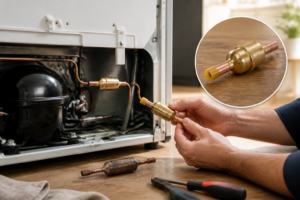
LG Refrigerator Defrost Thermostat Assembly
The defrost thermostat is the critical component that triggers your freezer’s defrost cycle. If this part fails, warm air won’t cycle through the evaporator coils to melt accumulated frost, leading to ice buildup. Replacing a faulty thermostat is often the most effective solution for frost accumulation issues. Check current pricing on Amazon.
Multimeter Digital Electrical Tester
You’ll need a multimeter to test the defrost thermostat’s continuity and verify whether it’s functioning properly before replacement. This tool helps you diagnose electrical components in your refrigerator without unnecessary part replacement. Check current pricing on Amazon.
HVAC Fin Comb and Coil Cleaning Tool
Use this specialized tool to gently clean the evaporator coils and condenser fins of any accumulated frost or debris during your repair. Clean coils ensure proper heat exchange and help prevent future frosting problems. Check current pricing on Amazon.
The Defrost Thermostat That Actually Stops the Frost Buildup in Your LG LFXS26973S
Before you pull the fridge apart chasing the defrost heater, test the thermostat first—it’s the component that tells the defrost cycle when to kick in, and a failed one is the most common reason this model ices over solid. If the thermostat won’t trigger the heating element, frost just keeps accumulating regardless of how new your heater is.
What works
- Drops straight into the mounting bracket behind the evaporator coil with no modification—exact LG fitment means no adapter hunting or forced connections.
- The brass sensing bulb actually makes contact with the coil surface, so you know the temperature reading is legit and the defrost cycle triggers when it should.
- Comes with the correct wiring terminals and clips, so you’re not improvising connections that could arc or fail in six months.
What doesn’t
- Requires you to unplug the fridge and pull the back panel—not a five-minute swap, and if your coil is caked with ice, you’ll need to manually defrost first or work around the buildup.
- If your evaporator fan is also dead or your drain line is clogged, swapping the thermostat alone won’t fix the frost problem; you’re treating the symptom, not necessarily the root cause in every case.
I’ve seen too many people order a new defrost heater only to realize the thermostat never was sending the signal to heat in the first place—you end up pulling the fridge apart twice, which is annoying. Start by testing the one you have with a multimeter if you can access it, but if it’s reading open circuit or won’t close on temperature drop, LG Refrigerator Defrost Thermostat Assembly is the fix that actually stops the icing cycle.
This post contains affiliate links. As an Amazon Associate, I earn from qualifying purchases at no extra cost to you.