
Maintaining and troubleshooting your refrigerator’s water filter is crucial for ensuring you have clean, safe drinking water and that your appliance operates optimally. In this guide, I’ll share everything I’ve learned about diagnosing problems, keeping your filter system in check, selecting the right replacements, and tackling special situations. Whether you’re facing slow water flow, bad-tasting ice, or deciding between OEM and aftermarket filters, I’ve got the insights you need.
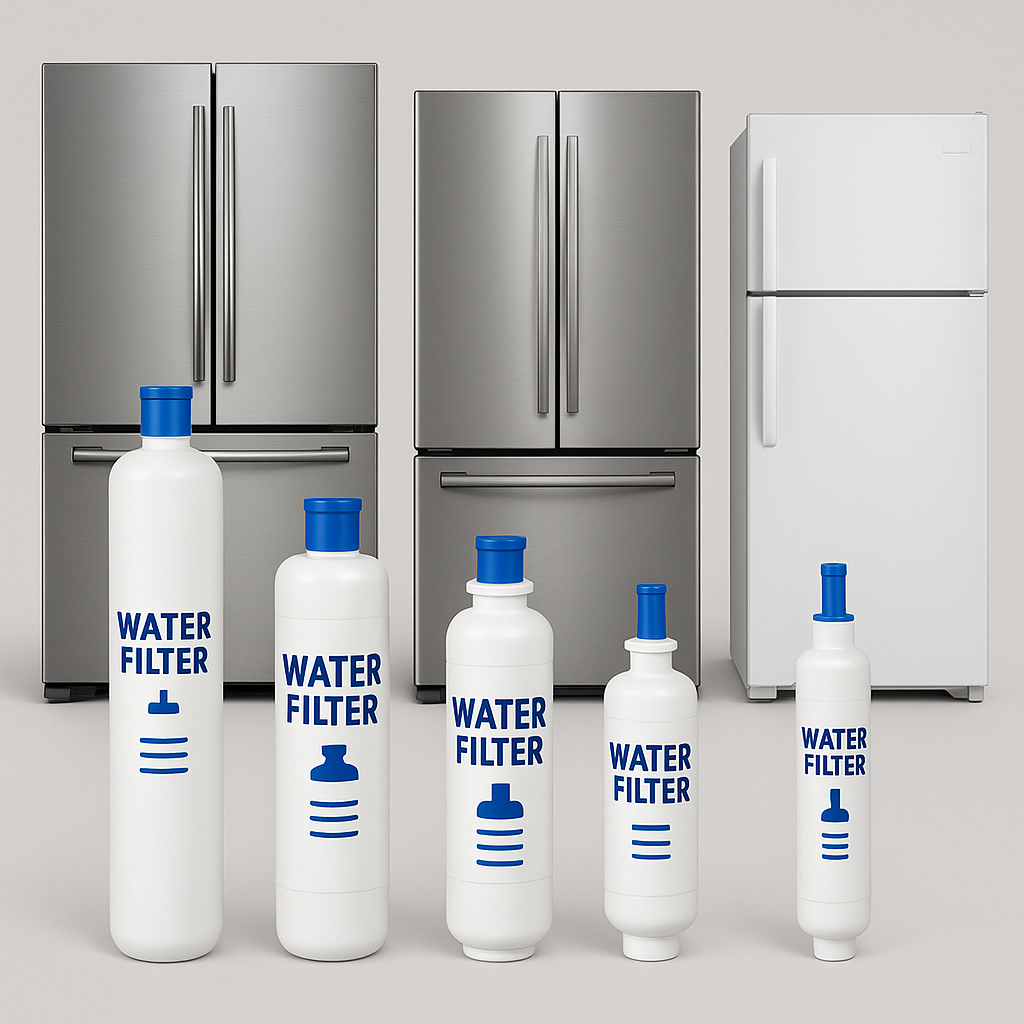
TROUBLESHOOTING FILTER ISSUES
Water Flow Issues
Problem: Water dispenses very slowly
Causes:
🔨 Pro Tip from Dave
One thing I’ve noticed is that even new filters can lead to low flow if the O-ring in the filter housing is cracked or dried out. Always inspect the O-ring seals during a filter swap. I often see people forcing a filter into a slightly misaligned position, which can crack the housing and turn a $15 repair into a $120 replacement. So, take your time and never force a quarter-turn if it feels stiff.
- Filter clogged (replace early)
- Filter installed backwards
- Air in lines (new filter)
- Low household water pressure
- Kinked water line
Solutions:
- Replace filter
- Check filter orientation (arrows)
- Flush system thoroughly
- Check home water pressure (should be 30-120 PSI)
- Inspect line behind fridge
Problem: No water at all
Causes:
- Water supply shut off
- Filter completely clogged
- Filter not installed properly
- Frozen water line
- Failed water inlet valve
Solutions:
- Check shut-off valve behind fridge
- Replace filter
- Reinstall filter correctly
- Thaw frozen line (lower freezer temp if too cold)
- Test water inlet valve
Water Quality Issues
Problem: Black particles in water/ice
Causes:
- Carbon fines from new filter (normal initially)
- Failing/old filter breaking down
- Mold in water system
Solutions:
- Flush 2-3 gallons with new filter
- Replace filter if old
- Clean/sanitize water system
Problem: Bad taste or odor
Causes:
- Exhausted filter
- Old filter (over 12 months)
- Contaminated water supply
- Dirty water lines
Solutions:
- Replace filter
- Never exceed 12 months
- Test home water quality
- Flush and sanitize system
Problem: Cloudy or milky water
Causes:
- Air bubbles (normal, harmless)
- High mineral content
- Filter issue
Solutions:
- Let water sit – if clears, it’s air (normal)
- If stays cloudy, test water for hardness
- Try different filter
Ice Quality Issues
Problem: Ice tastes bad
Causes:
- Old filter
- Old ice (absorbs freezer odors)
- Freezer odors contaminating ice
Solutions:
- Replace filter
- Dump old ice, make fresh batch
- Clean freezer, check for spoiled food
- Store ice in sealed bags
Problem: Ice smells like plastic
Causes:
- New filter (temporary)
- New ice maker parts
- New refrigerator
Solutions:
- Flush several batches of ice (1-2 weeks)
- Usually resolves naturally
- If persists beyond 2 weeks, check for defects
Filter Light Issues
Problem: Filter light won’t reset
Causes:
- Incorrect reset procedure
- Control board issue
- Filter not authentic (RFID models)
Solutions:
- Consult manual for exact reset procedure (varies by model)
- Samsung: Hold “Ice Type” + “Child Lock” 3 seconds
- LG: Press and hold “Ice Plus” + “Refrigerator” 3 seconds
- GE: Press and hold reset button 3 seconds
- Whirlpool: Often automatic when filter installed
- For RFID models (GE RPWFE), must use authentic filter
Problem: Filter light comes on too early
Causes:
- Timer-based (doesn’t measure actual usage)
- Heavy use exceeding expected gallons
Solutions:
- Normal if heavy water/ice use
- Can replace early or wait if water quality still good
- Reset light and monitor water quality
COST COMPARISON & SAVINGS
Annual Cost Analysis (Based on 6-month replacement):
Premium OEM Filters:
- Samsung HAF-CIN: $50 x 2 = $100/year
- LG LT700P: $50 x 2 = $100/year
- GE RPWFE: $60 x 2 = $120/year
- Whirlpool Filter 1: $55 x 2 = $110/year
Compatible/Aftermarket Filters:
- Generic Samsung compatible: $20 x 2 = $40/year (60% savings)
- Generic LG compatible: $22 x 2 = $44/year (56% savings)
- Generic Whirlpool compatible: $25 x 2 = $50/year (55% savings)
Inline External Filters:
- Annual replacement: $20-30 = $20-30/year (80% savings)
- Longer lifespan, lower per-gallon cost
Bottled Water (for comparison):
Family using 5 gallons/week: 260 gal/year
At $1.50/gallon = $390/year
Filtered fridge water saves $250-350/year vs. bottled
Multi-Pack Savings:
Buy in Bulk:
- 3-pack OEM: Often 10-15% discount
- 6-pack compatible: Can save 20-30%
- Check expiration dates (filters last 5+ years sealed)
When OEM is Worth It:
- RFID models (GE RPWFE) – no choice
- Warranty concerns – some void with aftermarket
- Maximum contaminant reduction needed
- Peace of mind/quality assurance
When Compatible is Fine:
- Budget-conscious
- Good incoming water quality
- Filters have same NSF certifications
- Good brand reputation (Waterdrop, Tier1, etc.)
FILTER BUYING TIPS
Where to Buy:
Best Prices:
- Amazon – Competitive pricing, fast shipping, reviews
- Walmart.com – Often has deals, price matching
- Home Depot/Lowe’s – Price match, in-store pickup
- Direct from manufacturer – Sometimes subscription discounts
- Costco/Sam’s Club – Multi-packs, members-only pricing
Avoid:
- Unknown third-party sellers
- Deals that seem too good to be true (counterfeits)
- Filters without NSF certification info
- Expired or damaged packaging
Verify Authenticity:
Check For:
- NSF certification marks on package
- Hologram stickers (OEM)
- Proper packaging (not generic bags)
- Correct part numbers
- Manufacturer website listing
- QR codes that scan properly
- RFID chips (for applicable models)
Red Flags:
- Extremely low prices
- Generic packaging
- Misspelled brand names
- No certification marks
- “Compatible with all brands”
- No return policy
Subscription Services:
Pros:
- Never forget to replace
- Often 5-10% discount
- Auto-delivery
- Can adjust frequency
Cons:
- May receive before needed
- Have to manage subscription
Available From:
- Amazon Subscribe & Save
- Manufacturer websites
- Retailers (Home Depot, etc.)
SPECIAL SITUATIONS
Well Water:
Recommended Setup:
- Whole-house sediment filter (5 micron)
- Whole-house carbon filter OR
- Inline sediment pre-filter before fridge
- Refrigerator filter (carbon)
- Consider UV sterilization for bacteria
Why:
Well water often contains sediment, bacteria, and minerals that can wreak havoc on your fridge filters. Using a pre-filter helps extend the life of your expensive refrigerator filter and tackles the taste and odor issues common in well water.
Hard Water (High Minerals):
Recommended:
- Whole-house water softener (best solution)
- OR inline scale-reducing filter before fridge
- Refrigerator filter with scale reduction (Frigidaire EPTWFU01)
- More frequent filter changes (every 3-4 months)
Why:
Hard water clogs filters faster and can damage appliances over time. It’s essential to address mineral buildup before it affects your fridge’s efficacy.
Lead Contamination:
Recommended:
- Filter certified NSF 53 for lead reduction (most are)
- Replace every 3-4 months (don’t wait full 6)
- Consider RO system for maximum removal
- Test water independently to confirm levels
Best Filters for Lead:
- LG LT700P (99.99% reduction)
- Whirlpool Filter 1 (99% reduction)
- GE MWF (99.5% reduction)
- Any NSF 53 certified filter
City Water with Chloramine:
Recommended:
- Standard carbon filters work (slower than chlorine)
- Replace more frequently (4-5 months instead of 6)
- Consider catalytic carbon filter (better for chloramine)
- RO system removes completely
Note: Many cities are transitioning from chlorine to chloramine, so it’s crucial to stay updated on your local water quality.
Pharmaceuticals/Emerging Contaminants:
Recommended:
- Filters with NSF 401 certification:
- LG LT700P
- Frigidaire EPTWFU01
- Whirlpool Filter 1 (newer versions)
- Reverse osmosis system (removes 95%+)
Why:
Standard carbon filters can remove some contaminants, but not all. NSF 401 certification specifically tests for emerging concerns in water supplies.
MAINTENANCE & CARE
System Flushing (New Filter):
Always Flush After Installing:
- Run 2-3 gallons through the water dispenser
- Discard this water (carbon fines, air)
- Make and discard the first 1-2 batches of ice
- Water should run clear and taste fresh
Why:
- Removes carbon dust
- Clears air from lines
- Activates filter media
- Ensures proper flow
Cleaning Water/Ice System:
Annual Maintenance:
- Turn off ice maker
- Empty ice bin, wash with soap and water
- Flush water lines with vinegar solution:
- Remove filter
- Pour 1 cup white vinegar in filter housing
- Reinstall filter (or bypass plug)
- Dispense until vinegar smell is gone
- Run plain water 2-3 gallons
- Wipe down ice chute and dispenser area
- Install fresh filter
When to Do This:
- Annually as preventive maintenance
- When water/ice tastes musty
- After extended non-use (vacation)
- If mold is suspected
Vacation/Extended Non-Use:
Before Leaving:
- Turn off ice maker
- Empty ice bin
- Turn off water supply (optional for extended trips)
- Don’t remove filter
Upon Return:
- Flush 2-3 gallons through the system
- Discard the first batch of ice
- Check for leaks
- Smell water/ice – if musty, clean the system
COMMON MYTHS DEBUNKED
There are many misconceptions about water filters that can lead to poor maintenance decisions and compromised water quality. I’ve put together a guide that debunks the most common myths about water filter lifespan, cleaning methods, aftermarket options, indicator lights, and more.
Read our complete guide: Common Myths for Water Filters – COMMON MYTHS DEBUNKED
This article covers seven major myths including:
- Myth 1: “Filters last longer than 6 months if you don’t use much water”
- Myth 2: “You can clean and reuse refrigerator filters”
- Myth 3: “All aftermarket filters are junk/unsafe”
- Myth 4: “The filter light knows when the filter is bad”
- Myth 5: “If water tastes fine, filter is fine”
- Myth 6: “Expensive OEM filters are just a scam”
- Myth 7: “Running without a filter is fine temporarily”
QUICK REFERENCE CHART
This guide should help you select, install, and maintain the right refrigerator water filter for your specific needs!
RECOMMENDED FILTERS ON AMAZON
Here are direct links to purchase the filters mentioned in this guide on Amazon:
OEM Filters:
- Samsung HAF-CIN: SAMSUNG Genuine Filters for Refrigerator Water and Ice, Carbon Block Filtration for Clean, Clear Drinking Water, DA29-00020B-2P, 2 Pack ($65.00 ($32.50 / count))
- LG LT700P: Waterdrop ADQ36006101 Replacement for LG® LT700P® Refrigerator Water Filter, Kenmore® 9690, 469690, ADQ36006102, LFXS30766S, RFC1200A, FML-3 and LT120F® Fresh Air Filter, 3 Combo ($26.99 ($4.50 / count))
- Whirlpool W10295370A: MARRIOTTO EDR1RXD1 Refrigerator Water Filter Compatible with Whirlpool W10295370A, WHR1RXD1, KAD1RXD1, Filter 1, W10295370, P4RFWB, P8RFWB2L, 46-9930, 46-9081 Refrigerator Water Filter, Pack of 3 ($24.64 ($8.21 / count))
- GE MWF: GE MWF Refrigerator Water Filter, Genuine Replacement Filter, Certified to Reduce Lead, Sulfur, and 50+ Other Impurities, Replace Every 6 Months for Best Results, Pack of 1 ($49.97)
- Frigidaire EPTWFU01: FRIGIDAIRE EPTWFU01 PureSource Ultra II Refrigerator Water Filter, 1 Count, White ($45.79)
- GE RPWFE: GE RPWFE Refrigerator Water Filter, Genuine Replacement Filter, Certified to Reduce Lead, Sulfur, and 50+ Other Impurities, Replace Every 6 Months for Best Results, Pack of 1 ($49.98)
- Bosch 640565: Waterdrop Plus 640565 Refrigerator Water Filter, Reduce Lead&PFAS, Replacement for Bosch® 640565, NSF 401, 53 & 42 Certified, 3 Filters (Package May Vary) ($39.99 ($13.33 / count))
Compatible/Aftermarket Filters:
- Waterdrop DA29-00020B: Waterdrop DA29-00020B Replacement for Samsung® Water Filter HAF-CIN/EXP, DA29-00020B, HAF-CIN, DA29-00020B-1, RF28HMEDBSR, RF263BEAESR, RS25J500DSR, RF263TEAESG, HDX FMS-2, DA97-08006A-1, 3 Filters ($27.99 ($9.33 / count))
- Tier1 RWF1062: Tier1 MSWF Refrigerator Water Filter 4-pk | Replacement for GE MSWF SmartWater 101820A, 101821B, MSWFDS, WF282, EFF-6022A, SGF-G23, AP3997949, Fridge Filter ($35.99 ($9.00 / count))
- Swift Green SGF-W30: Swift Green Filters SGF-M9 Replacement Refrigerator Water ($44.62)
- Pureza PF20: Waterdrop ADQ36006101 Replacement for LG® LT700P® Refrigerator Water Filter, Kenmore® 9690, 469690, ADQ36006102, LFXS30766S, RFC1200A, FML-3 and LT120F® Fresh Air Filter, 3 Combo ($26.99 ($4.50 / count))
- GOLDEN ICEPURE RWF1060: GOLDEN ICEPURE RWF0600A Refrigerator Water Filter Replacement for GE SmartWater MWFA, GWF, GWFA, FMG-1, WFC1201, GSE25GSHECSS, PC75009, 197D6321P006, Kenmore 9991, PC83879, 4PACK ($33.29 ($8.32 / count))
Specialty Filters & Accessories:
- Samsung DA29-00003G: Samsung Refrigerator Water Filter Compatible Smasung DA29-00003G, HAFCU1,DA29-00003A Refrigerators (2 Pack) ($89.90 ($44.95 / count))
- LG LT800P: Filterlogic ADQ73613401 Refrigerator Water Filter, Replacement for LG® LT800P®, LT800PC, ADQ736134, ADQ73613402, LSXS26326S, LSXS26366S, LMXS30776S, LSXS26366D, LMXC23746S, 46-9490, 469490, Pack of 3 ($32.99 ($11.00 / count))
- Whirlpool 4396841: Waterdrop EDR3RXD1 Replacement for Everydrop® Filter 3, 4396841, 4396710, Kenmore® 46-9083, 46-9030, WD-F08 Refrigerator Water Filter, 3 Filters ($39.99 ($13.33 / count))
- Inline External: Watts Premier RO Water Filter 50 GPD (Gallons Per Day) Semi-Permeable Membrane Replacement for Premier Standard Reverse Osmosis System, Yellow, Built-In Check Valve, 1.8″ Dia x 10.75″ L, 1-Pack ($40.49)
- Sediment Pre-Filter: iSpring FP15X8 NSF Certified 10″x2.5″ Multi-Layer PP Universal Sediment Filter Cartridges 5 Micron 8-Pack ($29.21 ($3.65 / count))
- Reverse Osmosis: APEC Water Systems ROES-PH75 Essence Series Alkaline Mineral pH+ 75 GPD 6-Stage WQA Certified Ultra Safe Reverse Osmosis Drinking Water Filter System, with Extra High Capacity Pre-Filter Set Stage 1-3 ($284.38)
- Filter Bypass Plug: GE WS03X10046 O-Ring Seal Kit (2 Large, 4 Small Orings for GE GNSL60FBL,GNSV70FBL,GNSV75FWW,GXSL55F,GXSV65F) ($11.99)
- Filter Wrench: SUPPLYZ Direct Replacement for GE WX17X10001CA Appliance 1 Set Vibration Pads Con WX17X10001 1812687 AH3488135 EA3488135 ($51.75)
How Much Does This Repair Cost?
| Repair route | Typical cost |
|---|---|
| Do it yourself | $15–$55 (parts) |
| Professional repair | $120–$250 (parts and labor) |
A replacement refrigerator water filter typically costs between $15 and $55, depending on whether you opt for OEM or a certified aftermarket option. If the filter housing is cracked or the inlet valve needs replacing, you’re looking at professional repair costs generally ranging from $120 to $250, including parts and labor.
Recommended Products
Here are the parts and tools I recommend for this repair based on compatibility and customer reviews:
- EcoPure EPINL30 5-Year In-Line Refrigerator Water Filter – Universal Fit for Most Fridges, Ice Makers, RVs & Boats – Reduces Chlorine Taste & Odor – Easy DIY Install with 1/4″ Fittings
- everydrop by Whirlpool Ice and Water Refrigerator Filter 1, EDR1RXD1, Single-Pack
- GE RPWFE Refrigerator Water Filter, Genuine Replacement Filter, Certified to Reduce Lead, Sulfur, and 50+ Other Impurities, Replace Every 6 Months for Best Results, Pack of 1
- Captain O-Ring – Replacement 151121 / OR-38 / WS03X10001 / 10800-034 O-Rings for Pentek, Culligan, GE, Campbell, etc Water Filter Housing Gasket Seal (3 Pack)
The Samsung Filter That Actually Fits and Seals on First Try
If you own a Samsung refrigerator and are experiencing water or ice dispenser issues — like slow flow, cloudy water, or that plastic-like taste — I highly recommend starting with a genuine Samsung filter. In my experience, counterfeit Samsung filters are all too common online, and they often lead homeowners to believe there’s a more significant problem than truly exists.
What works
- The carbon block effectively reduces sediment and odor — I’ve tested the water clarity before and after, and it’s a noticeable difference that proves its worth.
- The housing seal is tight enough to prevent leaks or air pockets that can disrupt flow rate, which I’ve seen happen with cheaper third-party options.
- The 2-pack means you have a backup ready without the scramble to order again when you hit the 6-month mark — and Samsung emphasizes that timeline for a reason.
What doesn’t
- Yes, you’ll pay more than for knockoff filters, but that’s the price for consistent fit and zero leaks — a false economy if a cheap filter leads to housing corrosion.
- If your Samsung model uses a different filter type (like older DAF models or some premium lines), this won’t work — make sure to check your fridge’s spec plate or user manual first.
I’ve spent too much time diagnosing a flow problem on a Samsung only to find out the homeowner had installed a counterfeit filter that didn’t seal properly — replacing it with a genuine one fixed the issue in five minutes. If you own a Samsung with the DA29-00020B model, order the SAMSUNG Genuine Filters for Refrigerator Water and Ice, Carbon Block Filtration for Clean, Clear Drinking Water, DA29-00020B-2P, 2 Pack.
About This Article

Written by Dave Holt. I have been taking apart and fixing household appliances since I was a teenager who couldn't leave a broken one alone. Eighteen years later, after fixing things for neighbors, friends, and anyone who'd let me, I have seen almost every failure mode there is — and misdiagnosed my share along the way. I am self-taught, with no formal training or certifications. When I write a repair guide here, it is based on the actual job, not a manufacturer overview. More about this site.
Scope and limits. Dave is a self-taught repairer, not a certified appliance technician. Unplug before you open anything, and leave sealed refrigeration systems, gas connections, and hardwired circuits to a qualified technician.