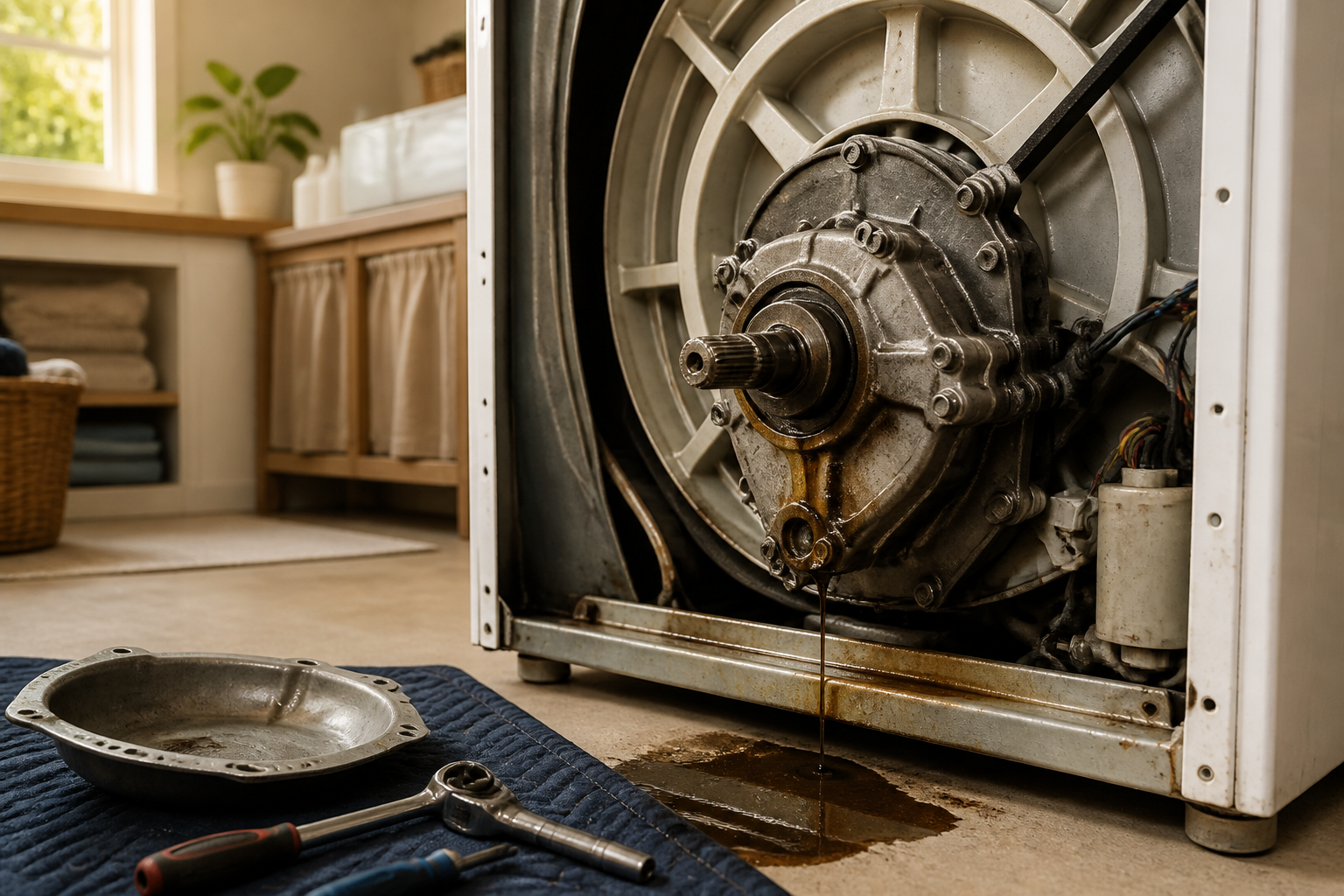
Speed Queen Top-Load Washer Transmission Oil Leak Repair Guide
Today I’ll guide you through diagnosing and repairing transmission oil leaks in Speed Queen washers. These machines are built for durability, but like any machine with moving parts the transmission can develop oil leaks over time. We’ll also touch on motor capacitor issues, which can sometimes be mistaken for transmission problems since both affect washer startup and operation.
⚠️ Safety Warning
Before diving into any repair work on your Speed Queen washer, it’s crucial to prioritize safety:
- Disconnect the washer from electrical power at the outlet or circuit breaker.
- Allow the machine to cool for at least 30 minutes if it has been running.
- The transmission fluid may be hot — handle with care.
- Motor capacitors can store electrical charge even when disconnected, so you must discharge them before handling (see discharge procedure below).
- If you smell gas or identify a natural gas connection, avoid repairs and contact a qualified service technician.
- Never work on internal components while the machine is plugged in.
Identifying a Speed Queen Transmission Oil Leak
Visual Signs of Transmission Oil Leaks
When it comes to spotting a transmission oil leak in a Speed Queen washer, there are a few telltale signs. The most noticeable indicator is dark brown or black oil beneath the machine. When new, Speed Queen transmission fluid is typically a reddish-brown color, darkening to nearly black as it ages. Check the floor under the washer, especially beneath the transmission housing at the bottom center of the machine.
You might also notice oily residue on the cabinet exterior near the bottom front or sides. A distinct petroleum smell coming from the washer, particularly after a wash cycle, is often an early warning sign before any visible pooling occurs.
Drips or small puddles that appear after 10-15 minutes of running indicate an active leak. Mark the location of these drips with a piece of tape on the floor, noting the time to help identify the source later.
Differentiating Transmission Oil from Other Fluids
It’s important to distinguish Speed Queen transmission oil from other fluids like coolant, detergent residue, or water. Real transmission oil will:
- Feel noticeably slippery between your fingers.
- Not mix readily with water (it will bead up on wet surfaces).
- Have a strong petroleum smell.
- Leave a dark stain on paper or fabric that persists over time.
- Not come from the drain hose or water inlet areas.
Common Transmission Oil Leak Locations in Speed Queen Washers
Output Shaft Seal Leaks
The output shaft seal is often the primary culprit behind transmission oil leaks in Speed Queen washers. This seal is located where the transmission output shaft exits the housing to connect to the drive pulley. While some minor weeping is acceptable under normal conditions, active dripping is a sign of failure.
Typically, this seal has a double-lip design with a spring tension component. When it wears or gets damaged, transmission fluid escapes around the rotating shaft, leaving oil on the exterior of the transmission case below the pulley area.
This seal is the easiest one to replace on Speed Queen top-load models, as it’s conveniently located at the bottom front of the transmission assembly.
Transmission Fill Plug Leaks
The transmission fill plug is another potential leak source. Speed Queen transmissions are sealed units with a fill plug located on the top or side of the case, usually a hex-head bolt with a rubber or cork gasket. Over time, this gasket can deteriorate, leading to slow seepage of fluid.
If you notice oil pooling at the bottom of the washer cabinet but can’t pinpoint it to the shaft seal area, the fill plug gasket may be the issue. Replacing this is a straightforward task that requires just a new gasket and a wrench.
Transmission Case Cracks
Less common but more serious are small cracks that can develop in the transmission case casting. These can occur due to impact, vibration stress over the years, or manufacturing defects. Cracks usually appear along the bottom seam or near mounting points. Unfortunately, a cracked transmission case cannot be repaired, and complete transmission replacement is necessary, which goes beyond DIY scope and should be managed by a certified technician.
To check for cracks, clean the transmission exterior with a dry cloth, run the washer for one cycle, and inspect immediately. A crack will show oil seeping from a specific line or point rather than from a gasket junction.
Is a Minor Speed Queen Transmission Oil Leak Normal?
While Speed Queen commercial equipment is designed with tighter tolerances than residential models, minor transmission fluid weeping is generally acceptable. Here’s how to discern if your leak is something to address:
Normal Weeping vs. Problem Leak
Normal Weeping (No Repair Required):
- A barely visible mist of oil around the output shaft seal after 8+ hours of operation.
- Very minor accumulation (less than 1 tablespoon per week) on the cabinet floor.
- Only visible after extended use cycles, not present after a single wash.
- No oil present on the drive belts.
- Transmission fluid level remains adequate when checked via dipstick (refer to your owner’s manual for location).
Problem Leak (Repair Required Immediately):
- Visible drops forming and falling within 30 minutes of washer startup.
- More than 1 tablespoon of oil accumulation per wash cycle.
- Oil present on the drive belts (indicating significant leakage).
- Noticeable petroleum smell during operation.
- Transmission fluid level dropping between uses (requiring regular topping off).
- Oil visible from multiple leak points on the transmission case.
Understanding this distinction is crucial. Addressing a minor weep prematurely may lead to unnecessary transmission replacement when a simple seal recoating or gasket refresh would suffice. However, a problem leak requires immediate attention to avoid transmission damage from fluid loss and belt contamination.
Output Shaft Seal Replacement Procedure
Tools and Materials Required
- Socket set (including 10mm, 12mm, and 14mm sockets)
- Adjustable wrench
- Screwdrivers (Phillips and flathead)
- Small pry bar or flathead screwdriver for seal removal
- Seal driver tool (specific to your model — check part numbers below)
- Needle-nose pliers
- Clean shop towels
- Small container for fasteners
- New output shaft seal assembly (model-specific)
- Optional: seal installation kit with driver ring
Accessing the Transmission
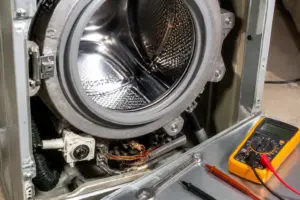
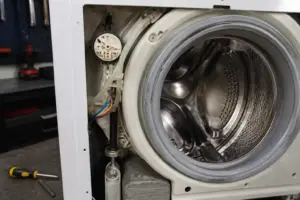
The transmission in Speed Queen top-load washers is located beneath the washing tub. To access it, you’ll need to remove the front panel and drain hose assembly:
- Unplug the washer from the electrical outlet.
- Close the water inlet shutoff valves on the wall behind the machine.
- Locate the front access panel, typically held by four Phillips-head screws along the bottom edge.
- Remove the screws and carefully pull the panel away from the machine.
- The transmission will be visible at the bottom center, directly beneath the tub.
- Take note of the position of all hoses and electrical connections before proceeding.
If your Speed Queen model has a side access panel instead of front access, locate the panel opposite the motor and follow the same removal steps.
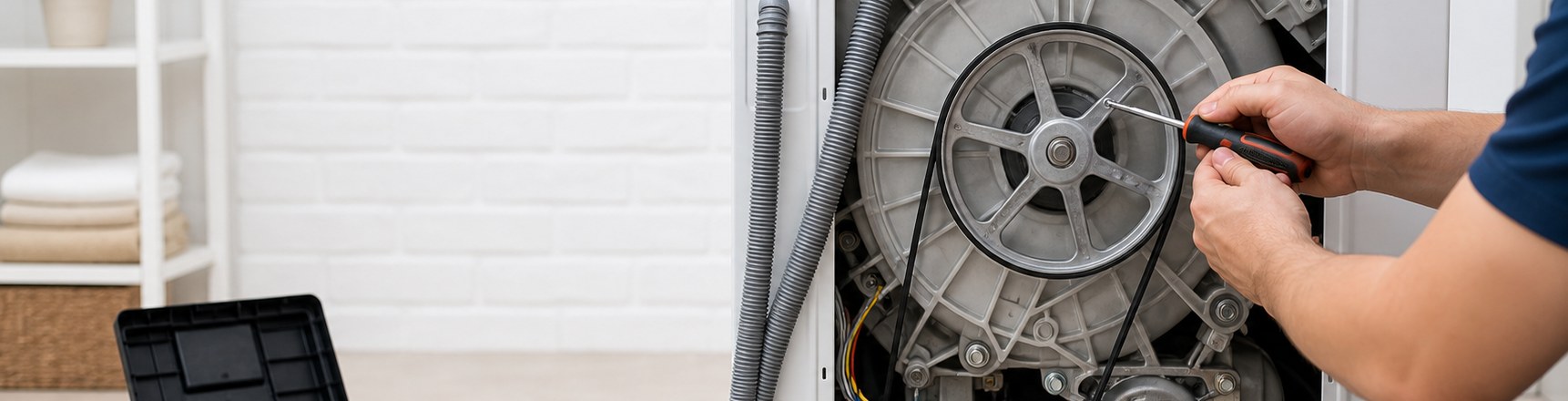
Removing the Drive Belt
Before accessing the output shaft seal, it’s essential to remove the drive belt to avoid accidental rotation:
- Find the belt tensioner bracket (usually mounted on the motor frame).
- Using an adjustable wrench, loosen the tensioner bolt counterclockwise until slack appears.
- Slide the belt off the pulley on the transmission output shaft.
- If the belt is cracked, frayed, or shows signs of oil contamination, replace it with a new one — oil exposure degrades rubber quickly.
- Set the belt aside on a clean surface.
Removing the Old Seal
The output shaft seal is a pressed component seated in a groove where the shaft exits the transmission case:
- Position your small pry bar at the edge of the old seal (avoiding contact with the rotating shaft itself).
- Gently pry the seal outward — it may take several attempts if it’s corroded.
- Do not apply excessive force that could damage the shaft or case bore.
- Once the seal is loose, carefully extract it by hand.
- Inspect the shaft surface where the seal made contact — it should be smooth and free of scoring.
- If the shaft is scored or pitted, the seal won’t hold, and transmission replacement is necessary.
- Wipe away all old oil and seal debris with a clean cloth.
Installing the New Seal
Speed Queen output shaft seals are typically available as complete assemblies with the spring tension already installed. Here’s how to install the new seal:
- Inspect the new seal before installation — it should have a spring coil visible on the inner lip.
- Apply a very light coat of clean transmission fluid to the shaft where the seal will contact.
- Position the seal squarely over the shaft opening.
- Using a seal driver tool (specific to your model), press the seal straight into the bore until it seats flush with the case.
- Do not tap with a hammer — use steady, even pressure from the driver tool.
- The seal should seat with slight resistance, and once properly installed, it won’t move when you attempt to wiggle it by hand.
Note on Seal Driver Tools: Speed Queen seals require specific driver tools to avoid damage. Common driver sizes for Speed Queen transmissions are 1.750 inches (44.45mm) and 2.000 inches (50.8mm) in diameter. Verify your model’s requirement in the service manual before purchasing or fabricating a driver.
Reinstalling the Belt and Testing
- Reinstall the drive belt over the transmission output pulley.
- Adjust the tensioner until the belt is snug but not over-tight — proper tension is about 1/2 inch deflection when you press the belt midway between pulleys.
- Secure all fasteners before reconnecting power.
- Reconnect the washer to power and run a test cycle without water to check belt tracking and listen for any unusual sounds.
- After 5-10 test cycles, check for any leaks around the newly installed seal.
- Minor weeping during initial operation is normal as the seal breaks in — monitor over the first week of use.
Common Output Shaft Seal Part Numbers
Speed Queen transmissions use different seals depending on the model year and type. Research your specific machine using the model number plate (typically located on the back panel or inside the door area):
- Speed Queen 30-series (LWN, WWN models): Output shaft seal assembly M095070, secondary part number 090207.
- Speed Queen 40-series commercial (LWN40, WWN40): Seal assembly M098765 with spring tension component.
- Speed Queen 50-series (LWN50, WWN50): Heavy-duty seal M099450.
- Older Speed Queen models (pre-2000): Consult service documentation as seal designs vary significantly.
If you can’t locate your exact part number, reach out to Speed Queen customer service with your machine’s serial number — they provide detailed service documentation at no cost.
Speed Queen Motor Capacitor: Location, Function, and Failure Symptoms
What the Motor Capacitor Does
The motor capacitor in a Speed Queen washer is an electrical component that stores and releases energy to start the main drive motor. Unlike the transmission, which is mechanical, the capacitor is purely electrical. Speed Queen washers typically use a motor run capacitor rated between 7.5 and 15 microfarads (µF), depending on the motor horsepower.
The capacitor serves two critical functions: first, it provides the initial electrical phase shift needed to start the motor from a standstill. Second, it maintains optimal electrical conditions while the motor runs, allowing it to operate at full speed and efficiency. When the capacitor fails, the motor cannot receive the electrical signal needed to start or maintain speed.
Locating the Motor Capacitor
The motor capacitor on Speed Queen top-load washers is mounted directly to the motor frame, typically at the rear or side of the motor housing. To locate it:
- Access the rear of the machine by pulling it away from the wall (ensure water and electrical connections remain intact).
- Look for a cylindrical component approximately 2-3 inches tall attached to the motor with metal clips or a mounting bracket.
- The capacitor will have two wire terminals at the top and a label showing microfarad (µF) and voltage ratings (typically 370-440V).
- You may also find the capacitor mounted on the side of the motor frame, visible when the access panel is removed.
The exact location may vary by model year — consult your service manual for a diagram specific to your machine.
Motor Capacitor Failure Symptoms
Motor hums but won’t start: This is a classic symptom of capacitor failure. When you initiate a wash cycle, the motor makes a low humming sound but the drum does not rotate. The hum indicates the motor is receiving electrical power but cannot generate the initial torque to start. This almost always points to a failed capacitor.
Very slow start: If the motor takes 5-10 seconds to begin rotating and then accelerates, that’s a sign of partial capacitor failure — it provides some starting assistance but not at full efficiency.
Motor runs but shuts off intermittently: If the motor starts but cuts out during the cycle, a failing capacitor (especially one with internal arcing or shorts) may be the cause. This is less common than complete failure but still possible.
Burning smell from the motor area: A capacitor failure can produce a distinct burning or popcorn-like smell from the motor area. This indicates internal arcing within the capacitor, requiring immediate replacement — don’t operate the machine further.
Visible capacitor damage: Look for bulging on the top of the cylindrical capacitor case or a split/crack in the casing. These are definite signs of failure, meaning the capacitor must be replaced.
Motor Capacitor vs. Transmission Problems: How to Tell the Difference
Many homeowners confuse motor capacitor failure with transmission issues because both prevent the drum from rotating. Here’s how to distinguish them:
Capacitor Failure: The motor hums, but the drum doesn’t move, and the belt is loose or stationary. The problem is electrical — the motor isn’t generating torque. Check for a burning smell near the motor.
Transmission Failure: The motor runs and makes normal operating noise, the belt turns, but the drum rotates very slowly or not at all. The problem is mechanical — the transmission isn’t transferring power correctly.
To test: Start a wash cycle and listen near the motor (not the transmission). If the motor hums without engaging, it’s likely the capacitor. If the motor runs normally but the drum doesn’t move, the issue is in the transmission or drive belt.
How to Safely Test and Replace the Motor Capacitor
Critical Safety: Capacitor Discharge Procedure
⚠️ Motor capacitors store electrical charge that can cause serious shock or burns even when the appliance is unplugged. You must discharge the capacitor before touching it:
- Unplug the washer from the electrical outlet.
- Wait 5 minutes for residual charge to dissipate.
- Using an insulated screwdriver (handle with plastic insulation), touch one terminal to the other terminal, allowing any remaining charge to ground safely.
- Repeat this discharge procedure 2-3 times to ensure complete discharge.
- You should not see or hear any spark — if you do, wait another 5 minutes and repeat.
- After discharge, the capacitor is safe to handle.
Never skip this step. Capacitor discharge accidents can cause burns, muscle spasms, and involuntary movements that could lead to further injury. Treat the capacitor as live until you have personally discharged it.
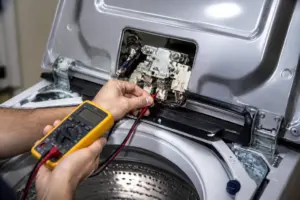
Testing the Capacitor with a Multimeter
Before replacing the capacitor, you can confirm it’s actually failed using a multimeter with capacitance measurement capability (not all multimeters have this feature):
- After discharging the capacitor, set your multimeter to the capacitance measurement mode (symbol µF).
- Touch one probe to each terminal of the capacitor.
- The multimeter will display a capacitance reading in microfarads.
- Compare this reading to the rated capacitance on the capacitor label (e.g., 10µF).
- If the reading is zero or significantly lower, the capacitor is faulty and needs replacing.
Recommended Parts & Tools
Automatic Transmission Fluid (ATF) – Dexron III
When dealing with transmission oil leaks in Speed Queen washers, it’s essential to use the proper replacement fluid to restore hydraulic function after repairs. This Dexron III ATF matches the correct viscosity and specification for Speed Queen transmission systems, ensuring smooth operation after seal replacement.
Disposable Gasket Scraper Set
During your repair, you’ll need to remove old gasket material without damaging metal surfaces. This scraper set provides both plastic and metal options for safely removing residue before installing replacement seals and gaskets.
Oil Absorbent Spill Kit
It’s crucial to clean up any spills promptly during the repair process to prevent slip hazards and protect your flooring. This absorbent kit quickly contains and cleans transmission oil leaks, making the repair area safe to work in and easier to restore.
The Right Fluid Makes the Difference When Refilling After a Speed Queen Transmission Seal Repair
Once you’ve replaced the leaking seal or gasket, you’ll need to refill the transmission with the correct fluid. Using the wrong spec is one of the easiest ways to undo all your hard work. Dexron III ATF is what Speed Queen specifies for their commercial-grade top-loaders, and it’s the only fluid I’ve trusted on these machines after the mistake of grabbing a generic “universal” ATF on my first transmission job.
What works
- Matches OEM viscosity and friction modifiers exactly—no slippage or erratic spin speeds after refill.
- Widely available and costs less than ordering direct from Speed Queen’s parts supplier.
- Stable in older Speed Queen transmissions that have seen years of heavy commercial use.
What doesn’t
- If you mistakenly grab a synthetic blend or full synthetic ATF, you may see foam in the transmission and slight torque loss during the spin cycle.
- Won’t solve a leak on its own—you still need to find and seal the source, or you’ll be refilling every few months.
Learning the hard way, I discovered that ordering fluid is often the step most DIYers skip until they’ve already torn into the transmission pan and realize they don’t have any on hand. Automatic Transmission Fluid (ATF) – Dexron III is cheap insurance—grab it before you start the repair so you’re not scrambling halfway through.
About This Article

Written by Dave Holt. Dave Holt has been taking apart and fixing household appliances since he was a teenager who couldn't leave a broken one alone. Eighteen years later, after fixing things for neighbors, friends, and anyone who'd let him, he's seen almost every failure mode there is. When he writes a repair guide here, it's based on the actual job, not a manufacturer overview. More about this site.
Scope and limits. Dave is a self-taught repairer, not a certified appliance technician. Unplug before you open anything, and leave sealed refrigeration systems, gas connections, and hardwired circuits to a qualified technician.