Samsung Dryer Thermal Fuse Replacement: Full Guide for the DVE45R6100W
I’ve lost count of how many dryers I’ve had the back off of over the last eighteen years, and the thermal fuse is far and away the part I’ve replaced most. It’s a cheap little thing, it’s not hard to swap, and about ninety percent of the time it isn’t really the problem at all — it’s the symptom. So this guide covers the swap on a Samsung DVE45R6100W, but it spends just as much time on why the fuse blew in the first place, because if you skip that part you’ll be doing this again in a fortnight. The DVG45R6100W is the gas version and everything here applies apart from the heat source itself, plus you’ll want the gas shut off before you start.
Do Samsung Dryers Have Fuses? Yes — Here’s What It Does
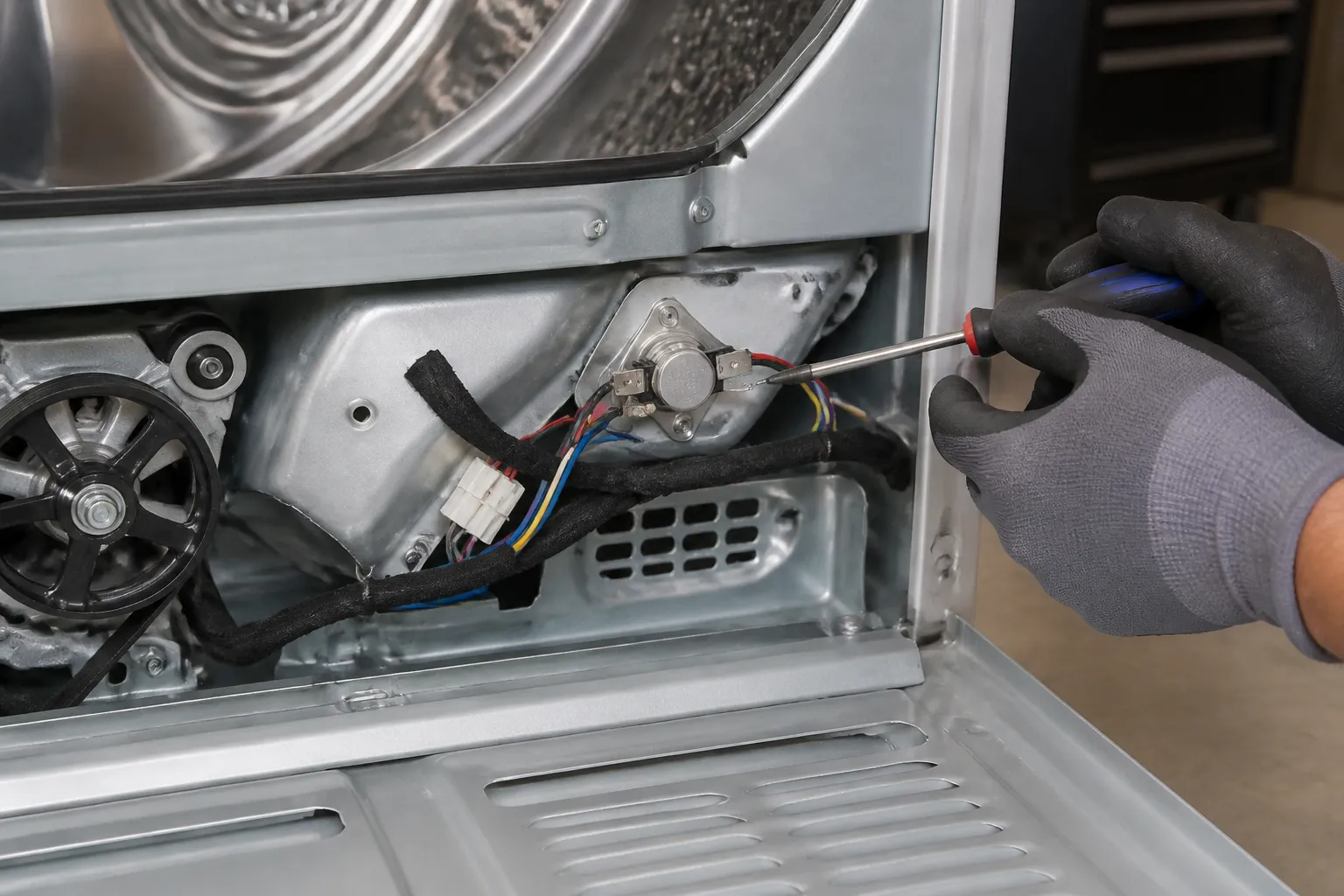
Short answer: yes. Every Samsung dryer I’ve ever opened up, including the DVE45R6100W, has a thermal fuse. It’s a small plastic or ceramic body with two spade terminals, mounted on the blower housing where it can feel the air temperature coming off the drum.
It is a one-time safety device. Not a breaker, not a resettable button, not something you push and carry on with. It’s wired in series so that when the dryer gets hotter than it should, the fuse opens permanently and kills that circuit. Depending on how a particular model is wired, that means one of two things:
- The drum turns fine, the cycle counts down, but there’s no heat at all — clothes come out damp and cold.
- Or the dryer won’t start at all — lights come on, press start, nothing happens.
Those are the classic two symptoms. If either one describes what your dryer is doing, the thermal fuse is the first thing to check. It’s also worth reading up on where the thermal fuse is located on other Samsung dryers if you’ve got a different machine in the house, because the mounting position moves around a bit across the range.
Read This Before You Buy Anything: A Thermal Fuse Never Fails On Its Own
This is the most important section in this article, so I’m putting it near the top.
A thermal fuse does not wear out. It does not “go bad” with age. It blows because the dryer got too hot, and it did exactly the job it was designed to do. More than nine times out of ten, the reason the dryer got too hot is restricted airflow. Hot air couldn’t get out fast enough, heat backed up inside the cabinet, and the fuse sacrificed itself.
So if you replace the fuse and change nothing else, the new fuse will blow again. Sometimes within a few loads. I’ve had neighbours call me back three days later genuinely baffled, and it’s always the same thing — nobody cleared the vent.
Clear the whole airflow path, in this order, from the machine outward:
- The lint screen. Obviously. But also wash it if it’s got fabric softener film on it — hold it under a tap and if water pools on the mesh instead of running through, it’s clogged even though it looks clean.
- The lint screen housing below it. This is the one everybody misses. The slot the screen drops into packs solid with lint over the years, down out of sight. A vacuum crevice tool or a long flexible brush gets it out.
- The internal ducting from the blower to the exhaust port on the back of the cabinet. You’ll have access to this during the fuse job, which is why I tell people to do both at once.
- The transition hose behind the dryer. Pull the machine out and actually look at it. If the dryer has been shoved back against the wall and the hose is crushed flat or kinked into an S, that alone is enough to cook a fuse.
- The entire wall duct run to the outside. Every foot of it. A brush kit on a flexible rod, or a shop vac from both ends.
- The exterior vent flap. This is where the real horrors live — compacted dead lint, bird nests, and in winter, snow and ice packing the louvres shut. Go outside while the dryer is running and put your hand in front of it. You should feel a strong, warm push of air. If it’s a weak breath, you’ve found your problem.
Two more things that cook fuses over and over even when everything is “clean”:
- A vent run that’s too long or has too many elbows. Every bend costs you airflow. A dryer venting fifteen feet with four ninety-degree turns is fighting for its life every single load.
- Vinyl or foil accordion hose. That ribbed flexible stuff traps lint in every ridge and restricts flow badly. Swap it for smooth rigid or semi-rigid metal. It’s the single cheapest reliability upgrade you can make to a dryer.
What Else Is On That Blower Housing
When you get the back off the DVE45R6100W you’ll see several small round or rectangular parts bolted near each other, and people mix them up constantly. Here’s what’s what:
- Thermal fuse — one-time, non-resettable. Opens permanently on overheat and stays open. This is the part this guide is about.
- Thermal cut-off fuse — on models that have one, this is also a one-time device, and it’s usually paired with a high-limit thermostat sitting right beside it. If yours has one and it’s open, it gets replaced too, not reset.
- High-limit thermostat — resettable. It cycles open and closed to protect against overheating, and it’s a backstop rather than a one-shot.
- Cycling thermostat — this one regulates normal running temperature. It opens and closes constantly in normal use; that’s its job.
Honest note: when a thermal fuse blows, it’s very common to find a thermostat has failed at the same time — they’ve both been sitting in the same overheated air. That’s exactly why most parts suppliers sell the fuse and thermostat together as a kit. If you’re already back there with the panel off, buying the kit saves you doing this twice.
How to Test a Samsung Dryer Fuse
Testing takes about two minutes and tells you definitively whether the fuse is the culprit.
- Unplug the dryer at the wall. Not the control panel — the wall. On a 240V electric dryer this is not optional and I’m not going to pretend otherwise. On a gas DVG45R6100W, shut the gas off as well.
- Set a digital multimeter to continuity mode, or to the lowest ohms range if it doesn’t have a continuity beeper.
- Disconnect at least one wire from the fuse. This is the step people skip, and skipping it means you’re reading through the rest of the circuit and getting a false result. Pull one terminal off.
- Touch one probe to each terminal of the fuse.
Continuity — a beep, or a reading close to zero ohms — means the fuse is intact and good. Your no-heat problem is somewhere else, and the heating element is the next place I’d look. No continuity — OL, infinity, no beep — means the fuse is blown and needs replacing. There’s no in-between and no judgement call to make.
And I’ll say this plainly because it needs saying: there is no resetting a blown thermal fuse. You cannot push a button, you cannot cool it down, you cannot bring it back. If you find advice online telling you to jumper across the fuse terminals with a bit of wire to “test” it or to get one more load done — that person is telling you to remove the only thing standing between a lint-packed dryer cabinet and a house fire. Don’t do it. Not once, not temporarily.
Replacing the Thermal Fuse on the DVE45R6100W
On this Samsung design the fuse is reached from the rear, which is good news — no wrestling the front panel or the drum out.
- Unplug the dryer at the wall and pull it out far enough to work behind it comfortably. Disconnect the exhaust hose from the exhaust port. Gas model: shut the gas off at the valve first.
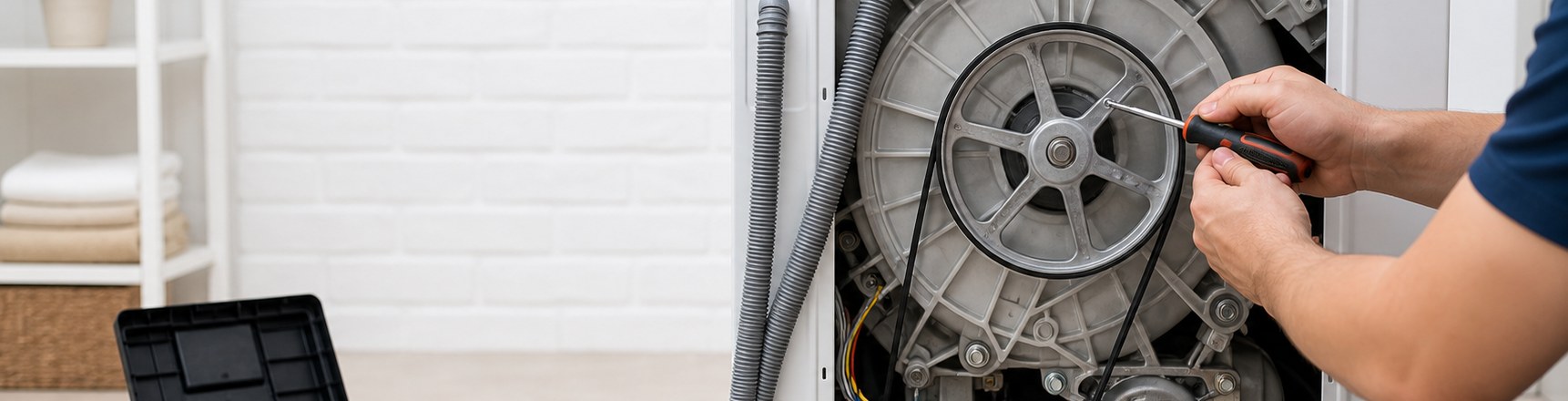
- Remove the rear access panel screws to expose the blower housing area. I’m not going to give you a screw count because it varies and you’ll see them clearly enough — they’re around the perimeter of the panel. Before you disconnect a single wire, take photographs of the wiring with your phone. Several, from different angles. You will thank yourself.
- Locate the fuse on the blower housing. Two spade terminals, small body, screwed flat against the metal so it reads the air temperature. Photograph the wire positions specifically.
- Remove the mounting screw or screws and disconnect the wire terminals. Pull on the connector body, not the wire itself — yanking the wire will pull the crimp apart and turn a twenty-minute job into an afternoon with a crimping tool.
- Fit the new fuse the same way round, push the terminals fully home until they click or seat firmly, and reinstall the mounting screw. Don’t overtighten it — you’re clamping a plastic body against sheet metal.
- Before you close up, clean out the blower housing and internal ducting. This is the one and only time you’ll have easy access. Vacuum every bit of lint you can reach. Given why the fuse blew, doing this now is genuinely half the repair.
- Reassemble. Rear panel back on, exhaust hose reconnected (and if it’s the ribbed vinyl stuff, now is when you replace it), push the dryer back leaving room so the hose isn’t crushed, plug in, and run a heated cycle with a few damp towels to confirm you’ve got heat.
If you get heat and then no heat again after ten minutes, stop and go back to the airflow section. That’s a classic sign the vent run is still restricted.
Buying the Right Thermal Fuse for a Samsung Dryer
Match the part to the full model number from the rating label, not to the model name on the front of the machine. On the DVE45R6100W the label is inside the door opening on the frame, or on the rear of the cabinet. Read the whole string including any suffix letters and type it into a model-matched parts lookup.
This matters more than with most parts, because thermal fuses are specific by temperature rating. They look near enough identical from the outside. Fit one rated higher than the dryer calls for and you’ve built yourself a fuse that lets the machine get hotter than the designers ever intended before it trips — which defeats the entire point of having one. Fit one rated lower and it’ll nuisance-trip on normal loads. I’m not going to quote you a rating or a part number here, because getting that from me instead of from a lookup matched to your exact model is how people end up with the wrong part. Use the label.
If you’re working on a close relative of this machine, I’ve written up a blown thermal fuse on the DVE45R6100C separately.
A Note on Ventless and Heat Pump Samsung Dryers
Samsung also sells ventless and heat-pump dryers — the DV80F5E5HGW is one people ask about a lot. The fuse diagnosis on those is the same: unplug, isolate a terminal, test for continuity, replace if open.
What’s different is the airflow fix. There’s no wall duct to clear because there’s no wall duct. The restriction is instead in the lint filters and the condenser or heat exchanger, both of which need cleaning far more regularly than people expect. If a fuse has blown on a ventless machine, that’s where you look. I won’t guess at the internal layout of a model I haven’t had apart — check your manual for the condenser access on your specific machine.
The Fuse Blew Again — Now What?
If your new fuse dies within a few loads, there are three suspects, and I’d check them in this order:
- The airflow problem was never actually fixed. This is the answer the overwhelming majority of the time. Go back through the full path — screen, screen housing, internal duct, transition hose, wall run, exterior flap. Something is still blocked, or the run is too long, or the hose is crushed behind the machine.
- The high-limit thermostat has failed closed. If it’s stuck shut it can’t do its job of cutting the heat, so the only thing left to stop the overheat is the thermal fuse — and it will keep dying.
- The heating element has shorted to the drum housing. When an element cracks and touches the metal around it, it heats continuously regardless of what the controls are telling it to do. The dryer just gets hotter and hotter until the fuse gives up. If you’re at this point, have a look at replacing the heating element on this dryer.
Safety
Unplug at the wall, not just at the control panel. A 240V dryer circuit will hurt you badly and it does not care how careful you’re being. Gas models: shut the gas off too, and if you’re not confident reconnecting a gas line, that’s a perfectly reasonable point to call someone in.
And one thing I want you to take seriously: if you smell burning, or see scorching, melted insulation or discolouration on the wiring or the blower housing, stop. Put the panel back on and get a professional out. Scorched wiring means something got hot enough to damage itself, and that is a symptom of a problem bigger than a blown fuse. That’s not me being cautious for the sake of it — that’s the difference between a repair and a fire.
Frequently Asked Questions
Do Samsung dryers have a thermal fuse?
Yes. Samsung dryers, including the DVE45R6100W and the gas DVG45R6100W, have a thermal fuse mounted on the blower housing. It’s a one-time safety device wired in series, and when it opens the dryer either loses heat entirely or won’t start at all, depending on the model’s wiring.
Can you reset a thermal fuse on a Samsung dryer?
No, and there’s no trick to it. A thermal fuse is a one-time device — an internal link melts open permanently when it gets too hot, and nothing brings it back. There’s no button, no cool-down period, no reset. It must be replaced. The high-limit thermostat sitting near it is resettable, which is where some of the confusion comes from, but the fuse itself is not.
Why does my Samsung dryer keep blowing thermal fuses?
Because the underlying overheat has never been fixed. In order of likelihood: the airflow path is still restricted somewhere (lint screen housing, internal duct, crushed transition hose, wall duct, exterior flap), the high-limit thermostat has failed closed and isn’t cutting the heat, or the heating element has shorted to the drum housing and is running continuously. A fuse that blows repeatedly is a message, not a fault.
How do I test the thermal fuse on my DVE45R6100W?
Unplug the dryer at the wall, remove the rear access panel, and disconnect at least one wire from the fuse so you’re not reading through the rest of the circuit. Set a multimeter to continuity, touch a probe to each terminal. A beep or a reading near zero ohms means it’s good. OL or no beep means it’s blown.
Can I just bypass the thermal fuse to get a load done?
Don’t. Jumpering across a thermal fuse removes the last protection between an overheating, lint-filled dryer cabinet and a fire in your house. The fuse blew because something is genuinely wrong. Fix the airflow and fit the correct fuse for your model.
The Tool You’ll Need
Digital Multimeter
Every test in this guide comes down to continuity and resistance readings, and a basic digital multimeter is the only tool that will give you them. If you’re going to guess at a part instead of testing it, you may as well buy the part twice.
About This Article

Written by Dave Holt. Dave Holt has been taking apart and fixing household appliances since he was a teenager who couldn't leave a broken one alone. Eighteen years later, after fixing things for neighbors, friends, and anyone who'd let him, he's seen almost every failure mode there is. When he writes a repair guide here, it's based on the actual job, not a manufacturer overview. More about this site.
Scope and limits. Dave is a self-taught repairer, not a certified appliance technician. Unplug before you open anything, and leave sealed refrigeration systems, gas connections, and hardwired circuits to a qualified technician.