Igniter won’t stop
In this step-by-step guide, I’ll walk you through how to fix the igniter that won’t stop on your Bosch HGI8054UC (Gas Range). With the right tools and parts, most homeowners can complete this repair in 1–2 hours, saving you the expense of a service call.
🔨 Pro Tip from Dave
On the HGI8054UC, the spark ignition module (Bosch part #00647655) is a common failure point that technicians often overlook — most people replace the igniter electrode first and wonder why the clicking continues. A big gotcha on this model is that the ceramic igniter tips crack in a way that’s nearly invisible to the naked eye, so always run your finger carefully around the base to feel for hairline fractures before assuming the module is bad.
Part of our Top 20 Oven Models & Common Repair Issues Guide. Browse all oven repair guides for related models and issues.
Common Symptoms & Causes
When your Bosch HGI8054UC gas range exhibits these symptoms, it typically indicates a continuous igniter issue that needs immediate attention.
- The igniter on one or more burners clicks repeatedly even after the burner is lit
- The clicking continues after the control knob is turned to the “Off” position
- You hear a rapid ticking sound with no burner actively in use
- The igniter sparks constantly, causing an unusual burning smell near the cooktop
This problem usually stems from a worn or cracked igniter switch, moisture buildup around the burner cap, or a faulty spark module that fails to cut the electrical signal properly.
Safety First
- Unplug the oven from the power outlet before starting any repair — never work on a live appliance.
- Wear work gloves when handling metal brackets, sheet metal edges, or sharp components.
- Take photos with your phone before disconnecting any wiring harnesses or connectors.
- Work in a well-lit area with enough floor space to lay removed panels flat.
Tools & Parts Needed
Essential Tools
- Phillips #2 screwdriver
- ¼” nut driver
- Multimeter
- Work gloves (heat-rated)
- Flashlight
Replacement Parts
- Spark module
- Igniter electrode
- Phillips screwdriver
Step-by-Step Repair Instructions
Step 1
Unplug the range before doing anything else — a continuously clicking igniter points to one of three root causes: debris or moisture trapped in the igniter cavity, a misaligned burner cap, or a failed spark module that is stuck sending voltage to the electrode. Working with power disconnected prevents accidental ignition and protects the spark module from damage during cleaning.
Step 2
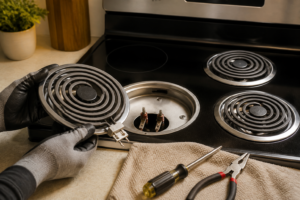
Remove the burner grates, caps, and heads, then wash all components with warm soapy water and dry them completely. Allow at least 2 hours of air drying before reassembly, because residual moisture is the single most common cause of persistent clicking on Bosch gas ranges. Pro tip: use a dry toothbrush to clear any food debris from around the electrode and the burner ports, where buildup is easy to miss.
Step 3
When reassembling, align the notch on each burner cap with the gas port on the burner head — this alignment is critical because a misaligned cap creates a gap that allows the flame to contact the electrode directly, which triggers a continuous spark signal as the igniter circuit interprets it as a failed ignition attempt. Press each cap down firmly and confirm it sits flat with no rocking.
Step 4
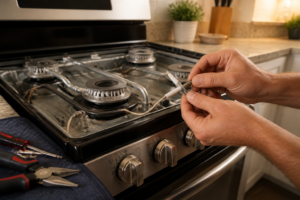
If clicking continues after the burners are clean and fully dry, inspect the ceramic insulator on each igniter electrode — it is the small white or off-white collar visible at the base of the electrode at each burner. A crack or chip in the ceramic allows electrical current to leak to the burner body instead of producing a clean spark, and a cracked electrode must be replaced rather than repaired.
Step 5
If all electrodes are clean, dry, and physically intact but the clicking still does not stop, the spark module itself has failed in the on-state, meaning it is continuously outputting voltage to one or more electrodes regardless of knob position. Replace the spark module — this is the component of last resort in this diagnostic sequence, and no cleaning or adjustment will resolve a module that is stuck on.
Step 6
Restore power to the range and test every burner: each one should ignite cleanly within one or two seconds and go completely silent within one second of releasing the knob. If any burner still clicks after completing all steps, double-check that its cap is seated correctly, as a partially seated cap is the most common reassembly mistake and will reproduce the original symptom immediately.
Where to Buy Replacement Parts
- Bosch HGI8054UC spark igniter module replacement 12014717
- Bosch gas range burner cap alignment igniter clicking
- Bosch range igniter electrode replacement 499068
When to Call a Professional
If the issue persists after completing all steps above, the problem may involve a failed main control board, a defective temperature sensor or high-limit thermostat, or wiring that requires specialized diagnostic equipment. Contact a licensed appliance technician. On gas models, do not attempt work on the gas valve, burner orifices, or supply line — that work is restricted to a licensed gas fitter in most jurisdictions.
How Much Does This Repair Cost?
| Repair route | Typical cost |
|---|---|
| Do it yourself | $20–$80 (parts) |
| Professional repair | $150–$300 (parts and labor) |
Replacing a faulty igniter on a Bosch HGI8054UC typically costs $20–$80 in parts when you do it yourself. A professional service call for the same repair usually runs $150–$300, including labor and parts. Tackling this repair DIY-style can save you $100 or more, making it well worth the effort.
Frequently Asked Questions
Why does my Bosch HGI8054UC igniter keep clicking even when the burner is lit?
A continuously clicking igniter usually means moisture or food debris is trapped around the igniter cap. Clean the burner cap and igniter with a dry cloth and let the area dry completely before testing again.
Is it safe to use my gas range while the igniter won’t stop clicking?
It is generally safe short-term, but persistent clicking can wear out the igniter module quickly. Address the issue promptly to avoid a complete igniter failure.
Do I need to replace the igniter switch or the entire igniter module?
If cleaning doesn’t stop the clicking, a faulty igniter switch is often the culprit on the HGI8054UC and is typically replaced individually. Only replace the full module if the switch tests as functional.
Recommended Products
These are the parts and tools I recommend for this repair, based on compatibility and customer reviews:
- 2PCS 00631633 Gas Range Burner Electrode Replacement for Bosch Oven Igniter Replacement Parts,Range Surface Burner Igniter,Replaces AP5950372 4162041 PS10057850
- Hunter-wish 00631633 Gas Range Burner Igniter, Compatible with Bo sch Oven Igniter-Burner, OEM Electrode Igniter Replacement Parts Replaces for AP5950372 4162041, 4 Pcs
- 00631633 Oven Igniter Replacement Fits For Bosch(HDI/HGI/NGM Series) Gas Stove,631633 Range Surface Burner Igniter Replaces 4162041,AP5950372,PS10057850,2Pcs
- Bosch 00619017 Range Re-Ignition Spark Module Kit
The Spark Module That Actually Stops the Constant Clicking on Your HGI8054UC
If you’ve cleaned the igniter electrode and dried out the burner cap but the clicking won’t stop, the spark module itself is likely failing—and this is the part that controls the whole ignition circuit. I’ve replaced more of these on the HGI8054UC than anything else when the igniter won’t shut off.
What works
- Stops the endless clicking immediately—this part controls the spark signal, so a bad module keeps firing even after ignition should have stopped.
- Swaps in without any special tools or skills; it’s a plug-and-play replacement that takes about ten minutes once you access it behind the control panel.
- OEM Bosch quality, so you’re not guessing whether a generic aftermarket module will work reliably on your range’s electronics.
What doesn’t
- You have to remove the control panel trim to access it, which means disconnecting a few wires—not hard, but take a photo before you disconnect anything.
- If the problem is actually just a cracked igniter electrode or moisture in the cap, buying this module first will waste money and time waiting for delivery.
I can’t tell you how many homeowners have ordered an igniter electrode first, only to find out two weeks later that the module was the real culprit—so always test the electrode for visible cracks and check for dampness around the burner before ordering this. Once you’re confident the igniter itself is fine, grab the Spark module.
About This Article

Written by Dave Holt. Dave Holt has been taking apart and fixing household appliances since he was a teenager who couldn't leave a broken one alone. Eighteen years later, after fixing things for neighbors, friends, and anyone who'd let him, he's seen almost every failure mode there is. When he writes a repair guide here, it's based on the actual job, not a manufacturer overview. More about this site.
Scope and limits. Dave is a self-taught repairer, not a certified appliance technician. Unplug before you open anything, and leave sealed refrigeration systems, gas connections, and hardwired circuits to a qualified technician.