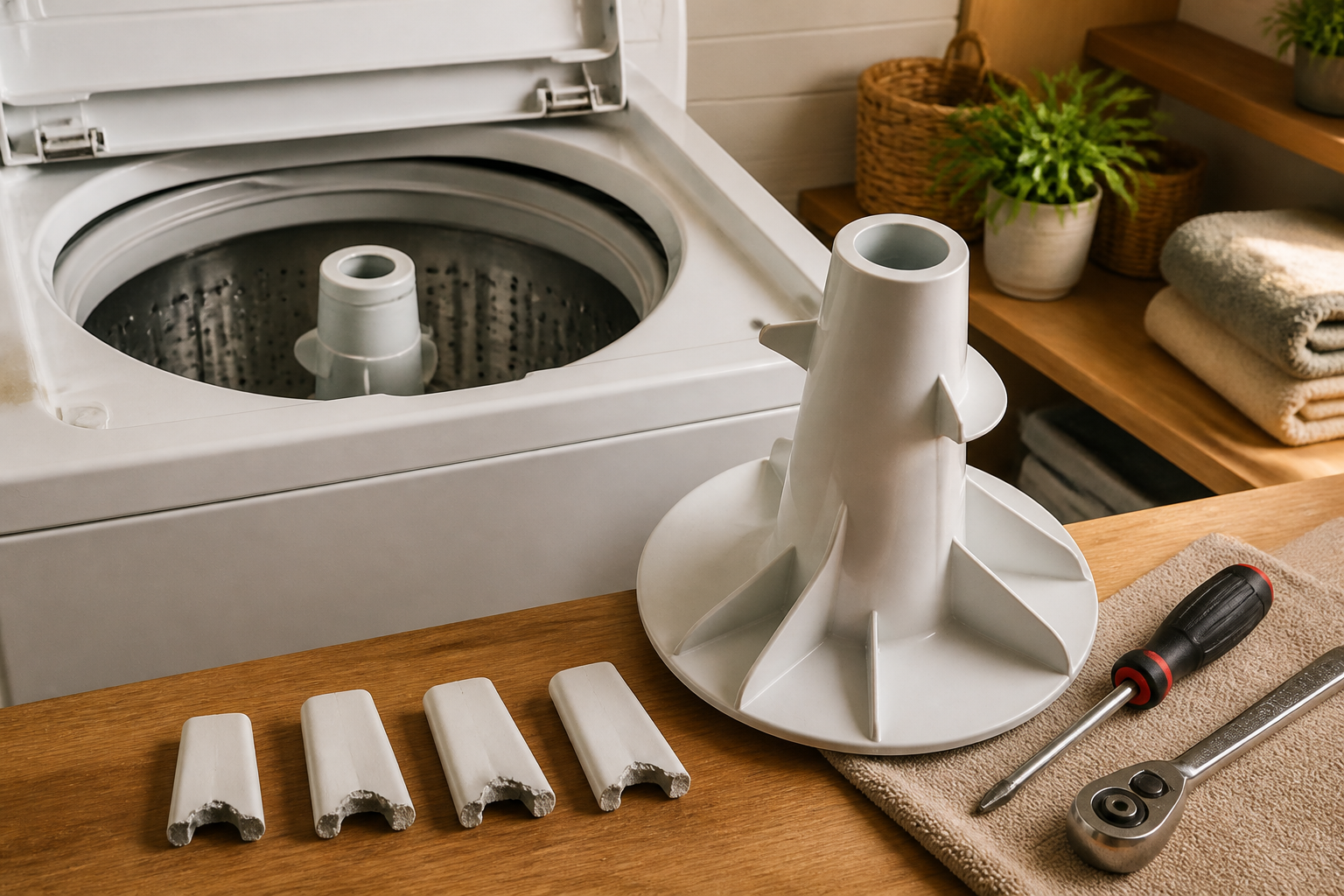
Agitator Dogs Worn Out — Full Family Repair Guide for GE GTW465 / GTW485 / GTW490 / GTW720 Top-Load Washer
Eighteen years of fixing appliances for friends and neighbours has shown me how frustrating it is when a washer stops agitating properly. In this guide I’ll walk you through replacing the worn agitator dogs in your GE GTW465, GTW485, GTW490, or GTW720 washer. These small components, often overlooked, can lead to big problems if left unattended. Let’s dive in.
The agitator dogs (also known as cogs or drive dogs) are essential plastic or composite pieces inside the agitator assembly that work with the drive shaft to rotate the agitator during wash and spin cycles. Over time, normal wear and tear will cause these dogs to degrade, leading to issues like the agitator slipping or failing to move altogether. If your washer is not agitating clothes properly, resulting in dirty or tangled laundry, it’s likely time to replace those dogs. This repair is common and usually occurs after 3–7 years of regular use. Difficulty Level: MODERATE. While you’ll need to partially disassemble the agitator assembly to access the internal components, there’s no special electrical work required.
Symptoms
- Agitator does not rotate during the wash cycle, or rotates very slowly and inconsistently
- Grinding, squealing, or clicking sounds coming from inside the agitator during operation
- Clothes remain unwashed or tangled around a stationary or weak-moving agitator
- Agitator moves only in one direction or only during specific cycle phases
- Visible plastic debris or fragments in the bottom of the wash tub after a cycle
- Drive shaft spins but agitator does not respond; no mechanical connection between them
⚠️ Safety Warning
- Unplug the washer from the electrical outlet before beginning any work. Do not rely on the power button alone. Accidental activation during disassembly can cause hand or arm injury.
- Turn off both hot and cold water supply valves located behind the washer. Even though you are working on the agitator (not the inlet system), water can still be present in hoses and fittings.
- Drain the washer completely. Run a drain cycle or use a siphon to remove any standing water from the tub before opening the agitator assembly.
- The washer lid and agitator cap are heavy. Prop them open securely with a wooden block or wedge to prevent them from falling on your hands or head during work.
- Do not attempt this repair while the washer is full of water or clothing. Always empty the tub first and allow it to dry slightly for better visibility and access.
Parts Needed
- Agitator Dog Kit (WH43X10042) — This is the primary replacement part for worn agitator dogs on the GE GTW465, GTW485, GTW490, and GTW720 models. This kit typically includes the replacement dogs and may include a spring or clip assembly. Verify compatibility with your specific model number before ordering.
- Alternative Agitator Dog Assembly (WH43X138) — Some variants of these models may use this part number. Confirm your exact model’s requirement by checking the original parts diagram or the wear pattern in your current agitator.
- Agitator Cap Seal or Gasket (WH41X1083 or equivalent) — Often recommended to replace when the agitator cap is opened, to ensure a watertight seal upon reassembly.
- Drive Coupling Lubricant (food-grade silicone grease) — A small amount to apply to the drive shaft and dog assembly during reassembly. Do not use petroleum-based grease; it can degrade rubber seals.
Tools Required
- Adjustable wrench (for water supply shutoff valves) and/or Phillips and flathead screwdrivers
- Socket set with 1/4-inch and 3/8-inch drive ratchet (for agitator cap bolt, typically 7/16-inch or 1/2-inch socket)
- Plastic or rubber mallet (for gently persuading stuck components; never use a metal hammer directly on plastic)
- Flashlight or headlamp (to see inside the agitator and tub clearly)
- Clean towels or rags (to absorb residual water and for wiping surfaces)
- Parts retrieval tool or needle-nose pliers (to safely extract small dog clips or springs that may fall into the tub)
- Torque wrench (optional but recommended, set to the manufacturer specification of typically 25–35 ft-lbs for the agitator cap bolt)
Step-by-Step Instructions
Step 1: Prepare the Washer and Workspace
First things first, unplug your GE GTW465, GTW485, GTW490, or GTW720 washer from the electrical outlet. Next, locate the water supply shutoff valves behind the washer—these are usually on the wall or at the base of the hoses where they connect to the washer. Turn both the hot and cold water supply valves clockwise until they stop; don’t force them. Open the washer lid fully and prop it open with a sturdy wooden block to keep both hands free during work. If you see any water in the tub, use a wet/dry vacuum or siphon to remove it, then wipe the interior with clean towels.
Step 2: Locate and Remove the Agitator Cap
Now, let’s get to the heart of the matter. At the top-center of the agitator assembly (inside the tub), you’ll find the agitator cap. For the GTW465, GTW485, GTW490, and GTW720 models, this cap is typically held in place by a single center bolt (7/16-inch or 1/2-inch socket) and sometimes a retaining clip. Use the appropriate socket to loosen the center bolt by turning counterclockwise with a ratchet. If you hit resistance, apply gentle pressure or tap the socket lightly with a rubber mallet to break any corrosion. Remove the bolt and set it aside in a safe spot. If a retaining clip is present beneath the bolt, carefully pry it off with a flathead screwdriver and set it aside.
Step 3: Remove the Agitator Cap Assembly
With the bolt out, grasp the agitator cap firmly with both hands and pull it straight upward with steady, even pressure. It might be stuck due to mineral deposits or a rubber seal; if so, gently rock it side-to-side while pulling, or tap the underside lightly with a rubber mallet. Once the cap separates from the agitator shaft, place it upside-down on a clean towel. Be careful not to drop it, as internal components may be loose or spring-loaded. Check the underside of the cap for any loose parts, springs, or washers that may have fallen out during removal; these belong to the dog assembly.
Step 4: Inspect and Document the Current Dog Configuration
With the agitator cap off, look directly down into the top of the agitator shaft. You’ll see the agitator dogs (WH43X10042 or WH43X138 components) mounted on the shaft. These are typically small, curved plastic or composite pieces arranged in a circular pattern around the shaft. Examine each dog for cracks, chips, flat spots where teeth should be, or obvious wear. I recommend taking a photograph for reference during reassembly. Gently wiggle each dog with your finger or a small tool; excessive play or wobbling indicates wear. On the GTW465, GTW485, GTW490, and GTW720 models, you should find 3 or 4 dogs arranged symmetrically.
Step 5: Remove the Worn Agitator Dogs
Most agitator dogs are held in place by one or two small clips, springs, or a retaining pin. Carefully note the orientation of the clip or pin. Using a small flathead screwdriver or a specialized dog removal tool, gently pry or unclip each worn dog. Be slow and deliberate to avoid breaking the clip or scratching surrounding components. If a clip is stubborn, try tapping the screwdriver head gently with a rubber mallet. As you remove each dog, place it in a container to keep the clips and springs from getting lost. The clip orientation is crucial for proper reassembly, so handle this step with care.
Step 6: Clean the Agitator Shaft and Mounting Area
Using a clean, damp towel, wipe away any debris, mineral deposits, or old grease from the agitator shaft where the dogs mount. Pay special attention to the grooves or recesses where the dog clips sit. Any buildup will prevent the new dogs from seating properly and could cause them to fail prematurely. Dry the shaft thoroughly with a clean towel. Inspect the shaft for any damage, deformation, or corrosion that would prevent proper dog engagement. If the shaft is damaged, the entire agitator assembly may need replacement; this is beyond the scope of this repair.
Step 7: Install the New Agitator Dogs
Now, grab your new agitator dogs (WH43X10042 or WH43X138) from their packaging. If a lubrication packet is included, set it aside for now. Align the first new dog with its mounting location on the shaft, matching the position of the dog you removed. Gently press or click the dog into place. Some dogs may require a slight rocking motion to seat fully. Ensure the dog’s engagement teeth are facing the correct direction—typically toward the center or outer wall of the shaft, depending on your model. Refer to the photo you took in Step 4 for correct orientation. After positioning the dog, slide its retaining clip over the dog and snap it into the clip groove, ensuring it’s seated flush. Repeat this process for each dog, making sure they are evenly spaced and all clips are secure.
Step 8: Apply Lubricant to the Dog Assembly
Using the food-grade silicone grease (or the lubricant supplied with your dog kit), apply a very small amount—about the size of a pea—to the top and sides of each mounted dog. This helps reduce friction between the dogs and the drive coupling, extending the life of the new dogs and ensuring smooth operation. Avoid over-lubricating; excess grease attracts lint and debris, which can damage the dogs again. Wipe away any excess grease with a clean towel so it doesn’t drip into the tub during operation.
Step 9: Reinstall the Agitator Cap Assembly
Before you put everything back together, inspect the underside of the agitator cap to make sure the rubber seal or gasket is clean and intact. If it’s cracked or hardened, replace it with a new WH41X1083 gasket. Align the cap’s internal drive coupling with the mounted dogs on the shaft. Lower the cap straight down onto the shaft, making sure it seats fully and evenly. You should feel slight resistance as the cap bottoms out, which is normal. Avoid forcing it down to prevent damaging the dogs or the coupling.
Step 10: Secure the Agitator Cap with the Center Bolt
Insert the center bolt (or a new bolt if the old one is corroded or damaged) through the cap and into the threaded hole in the agitator shaft. Using the appropriate socket (7/16-inch or 1/2-inch, depending on your model), tighten the bolt clockwise. If you have a torque wrench, tighten to the manufacturer specification of 25–35 ft-lbs; if not, snug it up but don’t overtighten, as this can strip the threads or crack the agitator cap. This bolt is typically hand-tight plus a quarter turn. If a retaining clip was present originally, reinstall it now to keep the bolt secure during operation.
Step 11: Test the Agitator Movement Before Closing the Washer
Before sealing it all back up, let’s do a manual test. Gently grasp the agitator and try to rotate it by hand in both directions. It should move smoothly without any grinding or clicking sounds. If you hear grinding or feel excessive resistance, stop right there and recheck your dog installation and clip security. Once everything feels good, close the washer lid and plug the electrical cord back in. Don’t turn on the washer just yet. Turn the water supply valves back on (counterclockwise) and listen for any hissing or leaks at the connection points. If it’s all quiet and dry, you’re ready for the operational test.
Step 12: Run a Test Cycle and Monitor Operation
Select the shortest wash cycle on your GE GTW465, GTW485, GTW490, or GTW720 washer (typically the quick wash or rinse and spin cycle). Don’t add clothes yet; run the cycle empty so you can observe the agitator movement without obstruction. Open the lid slightly (without pausing the cycle on most models) and verify that the agitator rotates smoothly during the wash phase. Listen for those distinctive agitation sounds you remember from when the washer was new; worn dogs often produce irregular or absent sounds. If the agitator moves smoothly and sounds normal, run one more short cycle with a small load of towels to confirm proper function. If there are any issues, stop the cycle immediately, drain the washer, and recheck your dog installation.
Troubleshooting
- Agitator still does not move after replacement: Double-check that the agitator cap is fully seated and the center bolt is tight. Verify that all dog clips are secure and that the dogs are oriented correctly (consult your photo from Step 4). If everything is in place and the agitator still does not move, the issue might be with the drive coupling, transmission, or motor—seek professional help.
- Agitator moves only partially or intermittently: This typically indicates that one or more dog clips are not fully seated or that a new dog is incorrectly positioned. Remove the cap again and visually inspect each dog and clip. One poorly seated dog can prevent smooth rotation.
- Grinding or squealing sound persists: This may mean that mineral deposits or debris remain on the shaft or in the coupling. Remove the cap again, clean thoroughly with a vinegar-dampened cloth to dissolve mineral buildup, and dry completely before reinstalling.
- Water leaks from around the agitator cap after reassembly: The rubber seal may not be properly installed or may be damaged. Remove the cap, inspect and clean the seal, and ensure it is seated fully in its groove. If the seal is cracked or hardened, replace it with a new gasket before reassembling.
- New dogs wear out within a few months: Unusual or premature wear of replacement dogs may indicate a problem with the agitator assembly or the larger washing machine mechanism.
Recommended Parts & Tools
GE WH43X10042 Agitator Dog Kit (Pack of 8)
This is the OEM replacement agitator dog kit designed specifically for GE top-load washers including the GTW465, GTW485, GTW490, and GTW720 models. The kit includes eight durable dogs that engage the agitator shaft to drive the wash action—exactly what you need when the original cogs wear out and lose grip.
Nut Driver and Socket Set for Appliance Repair
A complete nut driver and socket set makes removing the agitator cap and disassembling the wash basket much faster during this repair on your GE GTW washer family. These tools help you access the agitator dogs without stripping fasteners or wasting time searching for the right size.
The Agitator Dog Kit That Stops the Slip and Restores Normal Wash Action
If your GTW465, GTW485, GTW490, or GTW720 agitator is spinning freely without gripping the shaft, worn dogs are almost always the culprit—and this OEM kit is the direct replacement that gets the washer back to proper operation. Grab this kit early in the repair process; it’s the part that actually fixes the symptom.
What works
- Comes as a pack of 8 dogs, so you replace the entire set at once—no guessing which individual dogs are worn or trying to salvage partial sets that’ll just fail again in a few months.
- OEM part number means perfect fitment into the agitator hub; no filing, no modification, no compatibility surprises once you open up the washer.
- Fixes the actual symptom instantly—agitator engages and rotates with grip again instead of that frustrating free-spinning feel during wash cycles.
What doesn’t
- You have to remove and disassemble the agitator to access the dogs—this isn’t a quick external fix, and it requires draining the tub and removing bolts that can sometimes be stuck or corroded on older units.
- If the drive shaft itself is damaged or the agitator hub is cracked, new dogs won’t fix the underlying problem—inspect those components while you’re in there.
The friction point most DIYers hit: you might initially think the agitator motor or transmission is failing because the symptom feels like a power issue, but pulling the agitator and seeing those dogs worn down to nubs is the “aha” moment that confirms this is the right fix. Order the GE WH43X10042 Agitator Dog Kit (Pack of 8) and budget about an hour for the disassembly and replacement.
About This Article

Written by Dave Holt. Dave Holt has been taking apart and fixing household appliances since he was a teenager who couldn't leave a broken one alone. Eighteen years later, after fixing things for neighbors, friends, and anyone who'd let him, he's seen almost every failure mode there is. When he writes a repair guide here, it's based on the actual job, not a manufacturer overview. More about this site.
Scope and limits. Dave is a self-taught repairer, not a certified appliance technician. Unplug before you open anything, and leave sealed refrigeration systems, gas connections, and hardwired circuits to a qualified technician.