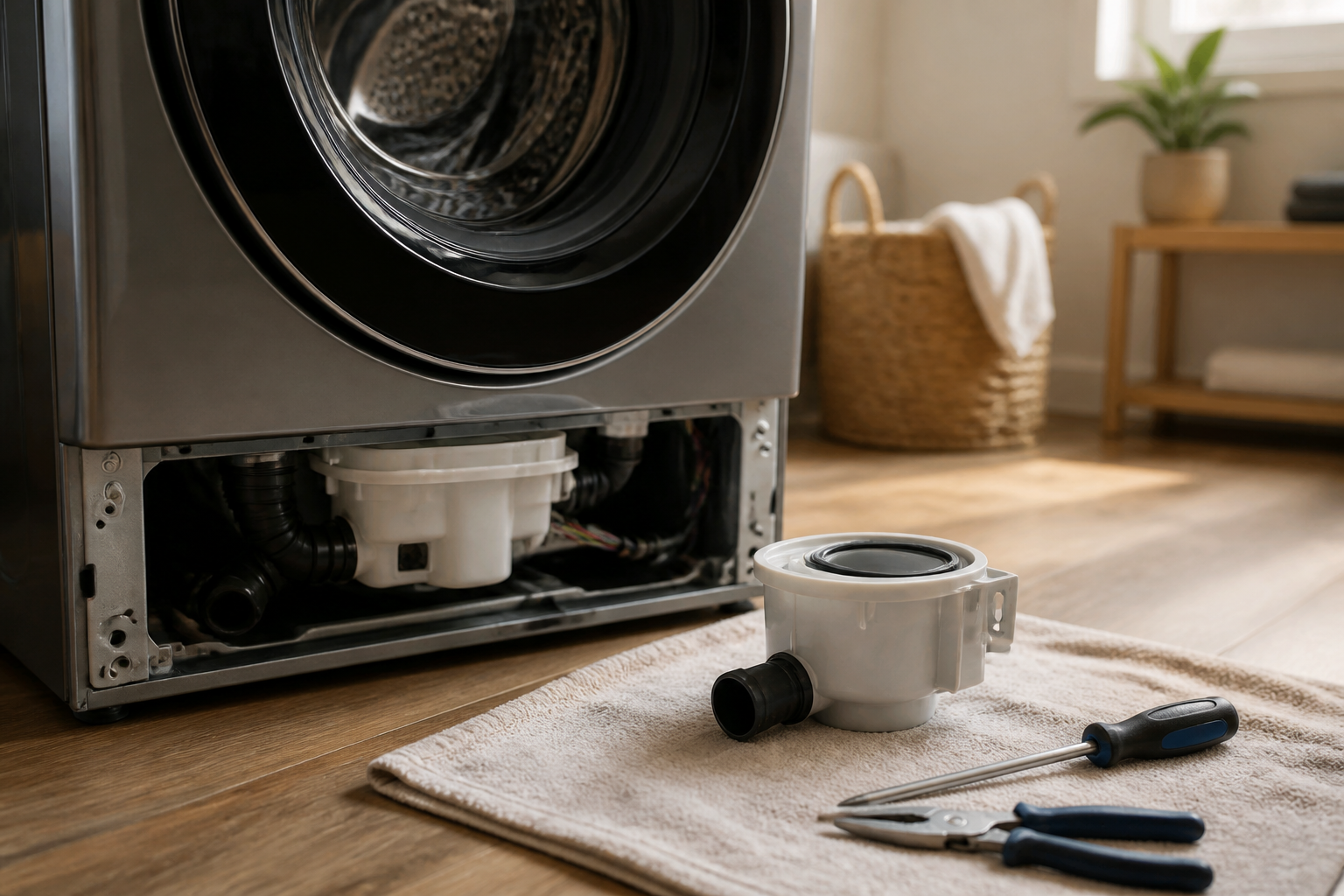
How to Replace and Clean the Drain Catch on the LG WM4500HBA Front-Load Washer
The drain catch—also called the pump filter or coin trap—is one of the most important maintenance components on your LG WM4500HBA front-load washer. Understanding how to properly access, clean, and replace this part will save you hundreds of dollars in repair bills and keep your washer running smoothly for years to come. This comprehensive guide walks you through every step of the process with specific measurements, locations, and troubleshooting tips.
What the Drain Catch Does on the WM4500HBA
The drain catch on your LG WM4500HBA is a cylindrical filter housing located directly in front of the drain pump assembly. Its primary function is to trap foreign objects before they reach the pump impeller—a spinning component that can be damaged by coins, buttons, lint, hair, and other debris. When you wash clothes, small items fall from pockets and seams into the wash basket. The drain catch prevents these objects from causing expensive pump damage or clogs in your home’s plumbing system.
The drain catch assembly consists of a clear or translucent plastic housing with a fine mesh screen and a threaded cap. As water drains from the tub, it passes through this mesh, catching debris while allowing water to flow freely to the pump and out through your home’s drain line. Without regular cleaning, the drain catch becomes clogged with lint, hair, and other material, restricting water flow and causing your WM4500HBA to drain slowly or not at all.
Locating the Access Panel on the WM4500HBA
The drain catch on the LG WM4500HBA is accessed through the bottom-front kick panel—the removable trim piece beneath the door. This location makes sense from a design perspective because it keeps the drain system accessible without requiring you to remove the entire cabinet.
Step-by-step location process:
- Stand in front of your WM4500HBA and look at the area directly below the door opening
- You will see a horizontal plastic panel that sits approximately 4 inches above the floor
- This kick panel is held in place by two to three plastic tabs or clips—one near each bottom corner and occasionally one in the center
- The drain catch housing is positioned behind this panel, typically on the left side of the washer when facing it
- There is usually a small drain hose extending from the pump assembly that exits through the same access area
The kick panel on the WM4500HBA does not require tools to remove in most cases. You simply need to pull firmly upward from the bottom edge to release the plastic tabs holding it in place. Some models may have a small screw at the center bottom—check before pulling.
Manual Water Drainage Before Accessing the Drain Catch
Before you touch the drain catch on your WM4500HBA, you must drain any water remaining in the wash tub and pump assembly. This two-step process uses both a small emergency drain hose and the drain catch housing itself.
Step 1: Using the Emergency Drain Hose
Your LG WM4500HBA includes a small rubber or plastic hose coiled near the drain pump assembly, separate from the main drain system. This emergency drain hose is approximately 12-18 inches long and serves as your first line of defense for removing standing water.
- After removing the kick panel, locate the small hose clipped near the pump assembly—it will be much smaller in diameter than your main drain hose
- Position a shallow pan, bucket, or large towel beneath the opening
- Unclip the hose from its retaining bracket
- Direct the hose end into your pan or bucket and allow water to drain completely—this typically takes 30-60 seconds and yields 1-3 gallons of water
- Once water stops flowing, reclip the hose to its original position or leave it directed into your bucket if water is still dripping
Step 2: Draining Water from the Drain Catch Housing
After using the emergency hose, the drain catch housing itself may still contain water. The drain catch on the WM4500HBA has a small hole or weep opening near its base. Additional water can be released by gently tilting the housing or by opening the cap slightly—but do this only after you’ve used the emergency hose to prevent spillage.
- Have your bucket or towel still positioned below the drain catch
- Locate the threaded cap at the bottom of the translucent housing—this is the visible cylindrical part you’ll actually remove
- Slowly and gently turn the cap counterclockwise one-quarter turn (90 degrees) only—do not remove it completely yet
- Allow any remaining water to drip into your bucket for 10-15 seconds
- Once water stops dripping, you can now proceed to fully remove the cap and access the filter mesh
Removing and Cleaning the Drain Catch Filter on the WM4500HBA
Now that water has been drained, you can safely remove and inspect the drain catch assembly on your WM4500HBA.
Removal Process
- Using your hand (no tools required), grip the threaded cap firmly and rotate it counterclockwise—the threads on the WM4500HBA are standard right-hand threads, so counterclockwise always means “open”
- After approximately 4-5 full rotations, the cap will come free from the housing
- As you remove the cap, be prepared for a small amount of residual water—keep your bucket positioned below
- The cap assembly includes the filter mesh screen itself, which is molded into or attached to the underside of the cap
- Set the cap and mesh aside on a clean surface where you can see what you’re doing
What to Look For Inside the Drain Catch Housing
Now look inside the open housing on your WM4500HBA. You’ll see the inside of the cylindrical chamber where debris collects. Common items you’ll find include:
- Lint and hair—usually forms a wet mat that clings to the interior walls
- Coins—frequently found at the very bottom; the WM4500HBA’s drain catch has caught many people’s loose change
- Buttons and snaps—these fall from garments during the wash cycle
- Small plastic fragments—from broken zippers or detergent pods that didn’t dissolve
- Sand and dirt—especially common if you wash work clothes or outdoor gear
- Pet hair—if you wash pet bedding or clothing with animal hair
- Hard water deposits—mineral buildup that looks like white or tan crusty material
Cleaning the Filter Mesh and Cap
- Remove any large debris by hand from inside the housing—reach in with your fingers and pull out accumulated lint and hair
- Discard this material in a trash can—do not flush it down a sink or toilet
- Take the cap assembly with its attached mesh screen under warm running water
- Use your fingers or a soft brush to gently rub the mesh surface under the running water, working from both sides to dislodge trapped lint
- For stubborn lint or mineral deposits, soak the cap in warm water with a small amount of white vinegar for 15-20 minutes, then scrub again
- Do not use abrasive scrubbers or harsh chemicals that might scratch or damage the plastic mesh
- Rinse the cap thoroughly until water runs clear through the mesh
- While the cap is clean, wipe the inside of the housing with a damp cloth to remove any remaining debris or sludge
- Inspect the interior walls of the housing for cracks or damage (see next section)
Inspecting and Replacing the Drain Catch Housing
While you have the drain catch removed from your WM4500HBA, carefully examine both the cap assembly and the main housing for cracks, splits, or damage that would indicate replacement is needed.
Signs the Housing Needs Replacement
- Visible cracks in the plastic—even small hairline cracks will eventually leak water
- Cloudy or discolored areas—may indicate structural weakness or stress
- Threads that are stripped or damaged—the cap won’t seal tightly, causing leaks
- Mesh screen with holes or tears—defeats the entire purpose of the drain catch
- Persistent leaking from the drain catch area—even after thorough cleaning
- Cracks around the base where the housing connects to the pump—indicates stress failure
If your WM4500HBA’s drain catch housing shows any of these signs, you should order a replacement housing assembly. The part number for the LG WM4500HBA drain catch housing is 5221EA2001T (always verify with your specific model number before ordering). This is the complete housing with integrated mesh and cap.
If only the cap or mesh is damaged but the main housing is intact, you may be able to order just the cap assembly, though most technicians recommend replacing the entire housing as a unit for reliability.
Reinstalling the Drain Catch on the WM4500HBA
Once you’ve cleaned or replaced the drain catch components, reinstallation is straightforward.
- Ensure both the cap assembly and the housing opening are completely dry
- Align the threaded cap with the opening on the drain catch housing
- Begin turning the cap clockwise by hand—you’ll feel it catch the threads immediately
- Continue turning clockwise until the cap is hand-tight—do not overtighten with tools, as this can crack the plastic housing
- The cap should be snug enough that you cannot easily turn it with your fingers, but you should not need to use pliers or wrenches
- Verify the seal is even all the way around the housing—the cap should sit flush against the housing lip
When to Replace the Entire Drain Pump vs. Just Cleaning the Filter
In most cases, cleaning the drain catch on your WM4500HBA solves drainage issues. However, sometimes the problem lies deeper in the pump assembly itself.
When Cleaning the Drain Catch Is Sufficient
- Your WM4500HBA drains slowly or not at all, but the catch is obviously clogged with lint and debris
- You find coins or buttons in the drain catch that may have been blocking flow
- After cleaning, your washer drains normally again
- There are no error codes displayed on the control panel
- You hear normal pump operation sounds after reassembly
When You Need to Replace the Drain Pump
Replace the entire pump assembly on your WM4500HBA if you observe these conditions:
- Grinding or squealing noises coming from the pump area during the drain cycle—indicates bearing or impeller damage
- Visible water leaking from cracks in the pump housing itself (not the catch)
- Error codes displayed—specifically dE, OE, or PE codes indicating drain issues that persist after cleaning the catch
- Water backing up into the tub even after thoroughly cleaning the catch and verifying the drain hose is not clogged
- The drain catch is clean but water won’t drain—suggesting the pump impeller is seized or broken
- Visible debris inside the pump beyond what the drain catch was designed to catch—suggesting the impeller may be damaged
The drain pump assembly for the WM4500HBA includes the catch housing, pump motor, and impeller as a single unit. The part number is typically 4681EA2001T, but always verify compatibility with your specific machine.
Reassembly and Leak Testing
After reinstalling the drain catch on your WM4500HBA, you must test for leaks before running a full wash cycle.
Pre-Test Checks
- Replace the kick panel by aligning it with the bottom of the washer cabinet and pressing upward until the plastic tabs lock into place
- Close and lock the washer door
- Set the cycle to a short drain-only test or the smallest wash cycle available
- Do not use hot water for this test—use cold water only
- Start the cycle and let it fill slightly, then move to the drain phase
Leak Inspection During Test Cycle
- As soon as the drain cycle begins, pause the machine if possible, or open the kick panel discreetly to check for leaks
- Look for water dripping from the drain catch assembly, the threads, or the cap
- Check the area around the pump connection for spray or leaking
- If you see any leaks, immediately stop the cycle and tighten the cap slightly more—but do not over-torque
- If leaking continues after tightening, the housing may be cracked and requires replacement (see previous section)
- If no leaks appear, allow the full drain cycle to complete
- Once the cycle is finished, inspect one more time while the machine is empty but before running a full wash
Full Cycle Test
Run a complete wash cycle on your WM4500HBA with a small load of towels or similar items. This tests the drain catch under full load conditions where maximum water volume flows through the system. After the cycle completes and the machine has drained, check the kick panel area one final time for any signs of leakage.
Maintenance Schedule: How Often to Clean the Drain Catch
The frequency with which you should clean the drain catch on your WM4500HBA depends on your household usage patterns and what you wash.
Recommended Cleaning Frequency
- Heavy usage households (washing daily or near-daily)—clean every 1 month
- Moderate usage households (washing 3-5 times per week)—clean every 1-3 months
- Light usage households (washing 1-2 times per week)—clean every 3-6 months
- If you have pets with shedding fur—increase frequency to monthly regardless of washer usage
- If you wash work clothes, sports gear, or outdoor clothing—clean every 1-2 months
Warning Signs Your WM4500HBA Needs Immediate Drain Catch Cleaning
- Slow draining that wasn’t present before
- Water remaining in the tub after a cycle completes
- Gurgling or drain sounds during operation
- Visible lint or debris floating in the standing water
- A musty or moldy smell coming from the washer
- Error codes related to drainage appearing on the display
The best practice is to inspect the drain catch on your WM4500HBA every month, even if you’re not planning a full cleaning. A quick look can alert you to debris buildup before it becomes a serious problem.
Frequently Asked Questions
What is the exact location of the drain catch on the LG WM4500HBA?
The drain catch is located behind the bottom-front kick panel of the WM4500HBA, accessible without tools. It’s a clear or translucent cylindrical housing with a threaded cap at the bottom, positioned on the left side of the washer when facing it. The housing sits just above the floor level and connects directly to the drain pump assembly.
Do I need any special tools to remove the drain catch from my WM4500HBA?
No special tools are required. The drain catch cap on the WM4500HBA unscrews by hand—you simply grip it firmly and turn counterclockwise. The kick panel is also removed by hand, though some models may have a single center screw you should check for. A bucket or towel for water is essential, but no wrenches, pliers, or screwdrivers are needed.
How much water will drain out when I open the drain catch on my WM4500HBA?
After using the emergency drain hose first (which removes 1-3 gallons), the drain catch itself typically contains less than 1 liter of water. The catch is designed to hold liquid, but most residual water will have drained through the emergency hose. However, always have a bucket ready as water may continue to drip when you open the housing.
Can I clean the drain catch on the WM4500HBA without removing it?
You cannot effectively clean the drain catch without removing the cap assembly. While you could theoretically flush water through it while installed, you would miss the coins, buttons, and other debris trapped inside. The proper procedure requires cap removal, which takes less than five minutes on the WM4500HBA.
Recommended Parts & Tools
LG Washing Machine Drain Catch Tub Assembly
This is the exact replacement drain catch component for the LG WM4500HBA model. Installing a new drain catch assembly ensures proper water drainage and prevents debris from damaging your pump. Check current pricing on Amazon.
Flathead and Phillips Head Screwdriver Set
You’ll need both flathead and Phillips head screwdrivers to remove the access panel and disconnect the drain catch assembly from your washing machine. A quality screwdriver set ensures you won’t strip screws during disassembly. Check current pricing on Amazon.
White Vinegar and Baking Soda Cleaning Solution
Before reinstalling the new drain catch, use vinegar and baking soda to clean the drain pump area and remove any lint or debris buildup that may have accumulated. This preventative cleaning helps extend the life of your new component. Check current pricing on Amazon.
The Drain Catch Assembly That Actually Stops Leaks and Odors on the WM4500HBA
If you’re replacing the drain catch because the old one is cracked, warped, or no longer seals properly, ordering the correct OEM assembly saves you from repeated leaks and the frustration of water pooling under your washer. This is the part that does the actual work—cleaning won’t fix a damaged housing.
What works
- Exact fit for the WM4500HBA—no adapter guessing or forcing clips into place like with generic knockoffs.
- The sealing gasket is thicker and more durable than aftermarket versions, so you won’t see water leaking from the access panel again after three months.
- Comes with the internal mesh screen already installed, so you don’t waste an hour trying to source and fit a compatible filter separately.
What doesn’t
- More expensive than generic drain traps, but the cost difference disappears fast when a cheap one fails and soaks your laundry room floor.
- If your actual problem is a clogged inlet hose or kinked drain line, swapping the catch won’t help—diagnosis matters first.
I’ve seen homeowners order the wrong assembly three times because they thought the leak was just a loose filter—take five minutes to confirm the catch housing is actually cracked or the seal is gone before ordering. Once you’ve verified damage, grab the LG Washing Machine Drain Catch Tub Assembly and your leak problem is solved for real.
This post contains affiliate links. As an Amazon Associate, I earn from qualifying purchases at no extra cost to you.