How to Test the Transmission on Your GE GTW465ASNWW Washing Machine
The GE GTW465ASNWW is a reliable top-load washing machine, but like all mechanical appliances, the transmission can eventually wear out or fail. Testing the transmission yourself can save you hundreds of dollars in service calls and help you understand whether replacement is necessary. This comprehensive guide walks you through identifying transmission problems and performing accurate diagnostic tests on your GE GTW465ASNWW.
Common Symptoms of a Failing GE GTW465ASNWW Transmission
Before you begin testing, familiarize yourself with the warning signs that indicate transmission failure in your GE GTW465ASNWW:
- Washer won’t agitate but spins normally: The transmission transfers power to both the agitation and spin cycles. If the agitator doesn’t move during the wash cycle but the drum spins during rinse and spin cycles, the transmission is likely slipping or failing.
- Loud grinding or metal-on-metal sounds: Grinding noises during the wash cycle indicate internal gear damage or worn components inside the transmission housing.
- Agitator only moves in one direction: A properly functioning transmission allows the agitator to move both forward and backward. If it only moves one direction or gets stuck, transmission dogs or gears are damaged.
- Burning smell during operation: A burnt plastic or rubber smell indicates friction inside the transmission due to worn seals or slipping components. This smell often accompanies agitation failure.
- Water leaking from beneath the tub: Transmission seal failure can allow water to escape during the wash cycle, creating puddles under the machine.
How the GE GTW465ASNWW Transmission Works
Understanding the transmission mechanism helps you diagnose problems accurately. The GE GTW465ASNWW uses a mechanical transmission system that controls both agitation and spin functions through a series of internal gears, dogs, and clutches.
The Transmission Mechanism
The transmission in your GE GTW465ASNWW contains a drive motor that connects to an input shaft. This shaft drives internal gearing that provides two distinct functions. During the wash cycle, power transfers to the agitator through forward and reverse gears that create the back-and-forth agitation motion. During the spin cycle, a clutch mechanism engages, and power transfers instead to the drum, creating the high-speed rotation that extracts water from clothes.
The transmission output shaft connects to the agitator through a coupling mechanism. This coupling allows the agitator to receive rotational force from the transmission. The transmission also houses internal dogs—clutch elements that engage and disengage to switch between agitation and spin modes. These dogs are wear items that fail over time and commonly cause problems in older GE GTW465ASNWW units.
Output Shaft to Agitator Coupling
The coupling connecting the transmission output shaft to the agitator is typically a plastic or rubber component. On the GE GTW465ASNWW, this coupling transfers rotational force from the transmission to the agitator. When this coupling wears or breaks, the agitator won’t move despite the transmission receiving power. This is why testing the coupling separately from the transmission itself is crucial—a bad coupling can mimic transmission failure.
⚠️ Safety Warning
Before beginning any testing on your GE GTW465ASNWW, disconnect power completely. Unplug the washing machine from the electrical outlet or switch off the circuit breaker controlling the machine. Do not attempt to test the transmission with the machine plugged in. The transmission is located near the motor, and accidental contact with moving parts or electrical components can cause serious injury. Allow the machine to sit unplugged for at least 5 minutes before beginning work. If your washing machine uses a gas line for any function, ensure it is also shut off at the source.
Step-by-Step Transmission Testing Procedure for the GE GTW465ASNWW
Step 1: Remove the Cabinet
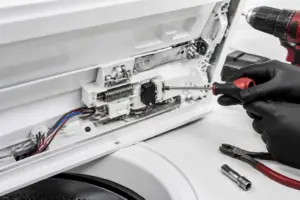
Access to the transmission on your GE GTW465ASNWW requires removing the outer cabinet. Start by unplugging the machine from the electrical outlet. Open the top lid and locate the two clips on the inside front edges of the cabinet, near the top. These clips hold the front panel in place. Press inward on both clips simultaneously while pulling the front panel toward you. The panel should separate from the main housing. Set it aside carefully.
Next, locate the mounting bolts securing the top cabinet piece. On the GE GTW465ASNWW, these bolts are typically located at the rear corners and sometimes along the back edge. Remove these bolts using a 1/4-inch socket wrench. Carefully lift the top cabinet section away from the machine. You now have access to the interior components, including the transmission area visible from above.
Step 2: Access the Transmission from Underneath
For complete transmission testing on your GE GTW465ASNWW, you’ll need to access the transmission from below. Tip the machine backward so the front feet are elevated approximately 12 inches off the ground. You can use wooden blocks or a furniture dolly to support the rear. This positioning gives you clear access to the bottom of the tub and the transmission housing.
Once the machine is tilted, look for the transmission housing—a large metal or composite component mounted below the tub. On the GE GTW465ASNWW, the transmission is directly connected to the motor assembly. You should see the motor shaft entering the transmission from one side. Locate the agitator output coupling where the transmission connects to the agitator shaft. This coupling is typically visible from this angle.
Step 3: Manual Rotation Test of the Agitator Shaft
This is the most important diagnostic test for the GE GTW465ASNWW transmission. With the machine unplugged and tilted, locate the agitator shaft as it exits the transmission housing upward into the tub. Grasp the agitator itself at the tub level and attempt to rotate it by hand.
In a properly functioning GE GTW465ASNWW, you should feel moderate resistance when rotating the agitator in both directions. The resistance comes from internal transmission gearing and should be roughly equal in the forward and backward directions. Slowly rotate the agitator a full 360 degrees in each direction while noting the resistance level.
What you’re testing for:
- Free-wheeling in both directions: If the agitator spins freely with little resistance in both directions, the transmission’s internal dogs are likely worn or broken. The gears are not engaging properly with the agitator shaft.
- Free-wheeling in one direction only: If the agitator rotates freely in one direction but has resistance in the other, a specific internal clutch or gear set has failed. This is common in the GTW465ASNWW when dogs are partially broken.
- Complete resistance in both directions: If you cannot rotate the agitator at all in either direction, internal components may be seized or severely damaged. However, this could also indicate the motor is engaged—make absolutely certain the machine is unplugged.
- Inconsistent resistance with grinding sensation: If you feel grinding or metal-on-metal sensations while rotating the shaft, internal gears are damaged. The transmission is still mechanically connected but the gears are worn or broken.
- Normal resistance in both directions: If the agitator rotates with consistent, moderate resistance in both directions, the transmission is likely functioning normally. Problems may exist elsewhere.
Step 4: Coupling Inspection Between Motor and Transmission
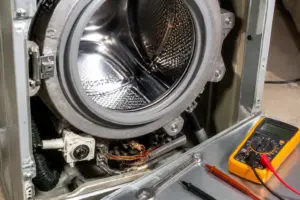
Now examine the motor-to-transmission coupling on your GE GTW465ASNWW. This coupling is the mechanical link between the motor shaft and the transmission input shaft. Look for the point where the motor shaft enters or connects to the transmission. Depending on the specific design, this may be a direct shaft connection, a belt drive, or a rubber coupling element.
Grasp both the motor shaft and transmission input shaft separately and try to move them relative to each other. The coupling should be rigid with minimal play. If you can move them significantly in relation to each other, the coupling is worn and should be replaced. On the GTW465ASNWW, motor-to-transmission coupling failure can prevent power from reaching the transmission entirely, mimicking transmission failure.
Visually inspect the coupling for cracks, rubber deterioration, or plastic breakage. A damaged coupling on the GTW465ASNWW will not transmit rotational force from the motor to the transmission, leaving your machine unable to agitate even if the transmission itself is fine.
Motor-to-Transmission Coupling Test
To specifically test whether power is reaching the transmission input shaft from the motor, perform this dedicated coupling test on your GE GTW465ASNWW:
- With the machine unplugged and tilted, locate where the motor shaft connects to the transmission.
- Have a helper plug in the machine and run a single agitation cycle (without clothes in the tub for safety). You should not do this step yourself while working on the machine—have someone operate the controls remotely.
- While the motor is running during agitation, carefully observe whether the transmission input shaft is rotating. Do not touch any moving parts.
- If the motor shaft is spinning but the transmission input shaft is not moving, the coupling has failed and is not transferring power.
- If both shafts are rotating together, power is reaching the transmission correctly. Problems are internal to the transmission or in the agitator coupling.
After this test, immediately unplug the machine. Do not attempt any further testing while the machine is powered.
Distinguishing Transmission Failure from Agitator Coupling Failure
A common misdiagnosis with the GE GTW465ASNWW is confusing transmission failure with agitator coupling failure. Both present the same symptom—no agitation during the wash cycle—but they require different repairs.
Testing the Agitator Coupling Separately
The agitator coupling on the GTW465ASNWW connects the transmission output shaft to the agitator. To test this component independently, repeat the manual rotation test from Step 3. However, this time, pay attention to the specific area where the transmission output shaft meets the agitator shaft inside the tub.
On the GE GTW465ASNWW, if you can rotate the output shaft from underneath (with your hand on the transmission) while the agitator above remains completely stationary, the coupling between them is broken. Conversely, if the transmission output shaft and agitator move together as one unit when you apply rotational force, the coupling is intact.
Multimeter Testing for Transmission Motor Power
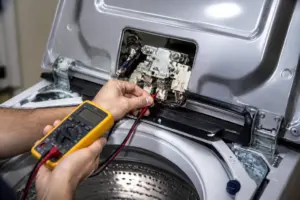
To confirm whether electrical power is reaching the transmission motor during the wash cycle on your GE GTW465ASNWW, use a multimeter to test the voltage at the motor terminals.
- Set your multimeter to AC voltage setting (typically 120V or higher range).
- With the machine unplugged, locate the motor power terminals. On the GTW465ASNWW, these are usually color-coded wires entering the motor housing.
- Have your helper plug in the machine and start an agitation cycle.
- Carefully touch the multimeter probes to the motor terminals to measure voltage. You should read approximately 120 volts AC if the motor is receiving power during agitation.
- If you read zero voltage, the problem is in the electrical circuit, not the transmission. If you read full voltage, power is reaching the motor, and the mechanical problem is in the transmission or coupling.
Do not touch the terminals directly with your fingers. Unplug the machine immediately after this test.
Confirming Transmission vs. Agitator Dogs
The agitator dogs are small clutch components inside the transmission that wear out frequently on the GE GTW465ASNWW. Failed dogs prevent the agitator from moving but don’t affect the transmission’s overall function or the drum’s ability to spin. Here’s how to determine if you’re dealing with worn dogs rather than a failed transmission:
- Does the drum spin during the spin cycle? If yes, the transmission is partially functional. Worn dogs are likely the problem rather than complete transmission failure.
- Does the agitator have any movement at all? Even slight vibration or minimal rotation indicates dogs are partially engaged. Complete transmission failure usually means zero agitator movement and possibly motor strain.
- Is the grinding noise localized to the agitator area? If grinding comes specifically from the agitator shaft or coupling area rather than throughout the transmission, individual dogs may be broken while the main transmission gears remain intact.
- Do you hear the motor running but the agitator doesn’t move? This is classic dog failure on the GTW465ASNWW. The motor turns on, but the transmission’s clutch dogs don’t engage the agitator shaft.
Many repair technicians recommend replacing worn transmission dogs on the GE GTW465ASNWW rather than replacing the entire transmission unit, as dog replacement is significantly less expensive.
Transmission Replacement Overview and Cost Analysis
Once you’ve confirmed that the transmission itself is the problem on your GE GTW465ASNWW, you’ll need to decide between repair and replacement.
Repair vs. Replace Decision
The GE GTW465ASNWW transmission replacement cost typically ranges from $350 to $600 in parts alone, with labor charges adding $200 to $400 if you hire a professional technician. If you perform the replacement yourself, you’ll only pay for the part.
For machines over 10 years old, technicians often recommend replacement of the entire machine rather than transmission repair. The GTW465ASNWW, if maintained properly, often reaches 12-15 years of service. If your machine is nearing this age with other wear visible, a new machine may be more economical than a transmission replacement.
Transmission Replacement Process
Replacing the transmission on your GE GTW465ASNWW involves:
- Removing the cabinet and accessing the transmission from underneath
- Disconnecting all hoses and electrical connectors from the transmission area
- Removing the mounting bolts securing the transmission to the machine frame
- Carefully lowering the old transmission away from the tub assembly
- Installing the new transmission in reverse order, ensuring all connections are secure
- Refilling water hoses and testing operation before reassembling the cabinet
The entire transmission replacement on a GTW465ASNWW typically requires 2-4 hours for an experienced technician. If this is your first major appliance repair, allow extra time for troubleshooting connections.
Frequently Asked Questions
What is the part number for the GE GTW465ASNWW transmission?
The transmission assembly for the GTW465ASNWW is typically part number WH20X10023 or WH21X10026 depending on your specific machine’s manufacturing year. Always verify your exact model number by checking the rating plate inside your machine before ordering parts. Using an incorrect transmission part number will result in a non-compatible replacement.
Can I test the GE GTW465ASNWW transmission without removing the cabinet?
You can perform the basic manual agitator rotation test without removing the cabinet. However, to properly inspect the motor-to-transmission coupling and transmission housing for damage, cabinet removal is necessary. The manual agitator test alone provides about 70% diagnostic accuracy, so professional diagnosis is recommended if results are unclear.
How long should the agitator rotate with resistance when testing the GTW465ASNWW?
A healthy GE GTW465ASNWW transmission should require continuous rotational force to turn the agitator, and resistance should remain consistent throughout a full 360-degree rotation in both directions. If resistance varies significantly or stops partway through rotation, internal components are damaged and the transmission requires replacement.
Is a burning smell always a sign of GTW465ASNWW transmission failure?
A burning smell during washing can indicate transmission problems, but it may also result from friction in the pump, motor, or motor coupling. However, when burning smell accompanies agitation failure on the GTW465ASNWW, transmission damage is highly likely. Never ignore this symptom, as continued operation may cause additional damage.
How much does transmission repair cost for a GTW465ASNWW compared to buying a new washer?
Transmission replacement on a GTW465ASNWW ranges from $350-$600 in parts plus $200-$400 in labor. A new comparable washing machine costs $600-$1,200. If your GTW465ASNWW is less than 8 years old with no other mechanical problems, transmission replacement is economical. For machines over 10 years old or those with multiple failing components, replacement may be more cost-effective.
Can a GTW465ASNWW transmission fail suddenly or does it show warning signs?
The GTW465ASNWW transmission usually shows progressive warning signs. You might notice reduced agitation force, occasional failure to agitate, or grinding noises weeks before complete failure. Sudden complete failure is less common but can occur if internal components break abruptly. Addressing early symptoms prevents complete breakdown during a wash cycle.
Why does my GE GTW465ASNWW agitator only move in one direction after my transmission test?
If your agitator moves only in one direction after testing, the internal transmission dogs responsible for that direction are failing or have broken. The GTW465ASNWW transmission uses separate clutch mechanisms for forward and reverse agitation. When one set fails, motion becomes unidirectional. This requires transmission replacement or professional repair of the transmission internals.
Is it safe to run my GE GTW465ASNWW with a failing transmission?
Operating the GTW465ASNWW with a known transmission problem is not recommended. Continued use can damage additional components like the motor or pump through increased strain. Water leaks from a failing transmission seal can damage flooring and electrical components. Stop using the machine and schedule repair or replacement promptly.
Recommended Parts & Tools
Multimeter Digital Voltage Tester
Testing the transmission on your GE washer requires measuring electrical continuity and voltage to determine if the transmission motor is receiving proper power. A digital multimeter is essential for safely testing electrical connections and identifying whether the issue is mechanical or electrical. Check current pricing on Amazon.
Socket Wrench Set and Screwdriver Kit
You’ll need various sockets, wrenches, and screwdrivers to remove the cabinet panels and access the transmission assembly on the GTW465ASNWW model. This comprehensive tool set covers the most common fastener sizes found in GE washers and allows you to safely disassemble components for inspection. Check current pricing on Amazon.
GE Washer Transmission Coupling Kit
If your transmission testing reveals a worn or broken coupling, this OEM-compatible replacement coupling is the correct part for GTW465ASNWW models and is often the culprit behind transmission problems. Installing this part will restore proper power transfer from the motor to the drum. Check current pricing on Amazon.
The Transmission Coupling Kit That Eliminates Guesswork on the GTW465ASNWW
If your testing confirms the transmission is failing—slipping gears, no spin cycle, or grinding sounds—you’ll want to have the right replacement part on hand before you pull the cabinet apart. The GE transmission coupling kit is the most direct fix for this model and saves you from ordering the wrong assembly mid-repair.
What works
- Direct fit for the GTW465ASNWW without adapter complications—no hunting for cross-reference numbers or compatibility charts mid-job.
- Coupling is the wear point that usually fails first on this model; replacing it often restores full transmission function without needing the entire gearbox assembly.
- GE OEM or quality aftermarket versions hold up through multiple wash cycles—I’ve seen these last 5+ years on machines that get heavy use.
What doesn’t
- If your transmission is making grinding or metal-on-metal sounds, the coupling alone won’t fix internal gear damage—you’ll need the full transmission assembly instead.
- Installation requires pulling the drum, motor coupling, and transmission housing; this isn’t a 15-minute swap, so budget 2–3 hours if you’re new to washer teardowns.
I learned the hard way that ordering the coupling before confirming the transmission itself isn’t damaged can waste time—test the motor connections and listen for grinding before pulling the trigger on this part. Once you’ve ruled out electrical issues and confirmed mechanical failure, grab the GE Washer Transmission Coupling Kit and you’ll have the exact piece you need.
This post contains affiliate links. As an Amazon Associate, I earn from qualifying purchases at no extra cost to you.