How Big a Generator Do I Need? The Complete Technical Sizing Guide
Selecting the right generator size is one of the most critical decisions you’ll make for home backup power. Get it wrong and you’ll either overspend on capacity you’ll never use, or worse — undersize and watch your generator overload, overheat, and shut down during an actual power emergency. This guide walks you through the physics of generator sizing, the wattage requirements of every major appliance, and decision trees that account for the real-world complexity of simultaneous electrical loads.
Why Generator Size Matters — The Cost of Getting It Wrong
Undersizing creates three cascading problems:
First, overloading causes voltage sag. A generator rated for 5,500W running watts becomes unstable when you draw 5,700W. The engine speed drops (generators are constant-speed devices, typically 1,800 or 3,600 RPM), and voltage collapses. At 90% of rated voltage, a 120V circuit drops to 108V. Sensitive electronics like CPAP machines, TV power supplies, and laptop chargers are designed for 100–127V nominal. Below that window, switch-mode power supplies (used in nearly all modern electronics) operate erratically or shut down entirely. Worse — when the load is slightly inductive, the reactive power component can cause voltage swings that damage power supplies permanently.
Second, the generator’s thermal overload circuit trips. Most portable generators have an automatic overload relay that disconnects the load within 10–30 seconds if current exceeds ~110% of rating. This is a safety feature, but it means your refrigerator shuts off every time the compressor cycles during a partial overload condition.
Third, repeated overloading shortens the alternator and engine life dramatically. The alternator windings overheat, the insulation degrades, and bearing wear accelerates. A generator sized for a 3,500W load but run at 5,000W continuously will fail within weeks instead of years.
Oversizing creates different problems:
An oversized diesel generator running at very light loads (below 30% of rated capacity) suffers from “wet stacking” — unburned fuel accumulates in the exhaust system, blocking the muffler, causing black smoke, and degrading engine performance. Gasoline generators are less susceptible to wet stacking but still waste fuel and may run rough at very light loads because the carburetor isn’t optimized for sustained low-power operation. Both oversized gas and diesel units cost more upfront, burn more fuel per kWh delivered, and occupy more space. For standby generators, oversizing can push you into the next electrical service tier (moving from 100-amp to 200-amp service, for example), adding thousands to installation costs.
⚠️ Safety First: Transfer Switches Are Non-Negotiable
Before you even think about generator size, understand the legal and safety framework:
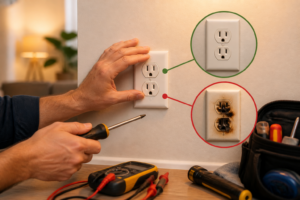
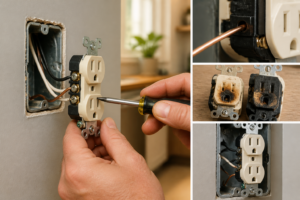
Never connect a portable generator directly to your home’s wiring. This includes “suicide cord” configurations (where you run a heavy-gauge extension cord from the generator into a breaker panel, or plug it directly into a wall outlet after switching off the main breaker). This creates backfeed — the generator energizes utility lines connected to your home, potentially electrocuting utility workers attempting repairs. Backfeed violates National Electrical Code Section 702 (Interconnected Electric Power Production Sources), and most utilities will fine you $5,000–$50,000 if discovered.
Legal ways to connect a portable generator to your home:
- Install a manual transfer switch (typical cost: $500–$1,500 installed) that allows you to switch the main power source between utility and generator, but never both at once. This must be installed by a licensed electrician.
- Install an automatic transfer switch (typical cost: $2,000–$4,000 installed) that detects utility power loss and automatically switches to the generator within 10 seconds. Requires both a transfer switch and a weatherproof inlet box on the exterior of your home.
- Install a generator interlock kit (typical cost: $50–$200 for the kit, plus $300–$800 for professional installation) on your breaker panel. The interlock is a mechanical device that prevents the main utility breaker and the generator breaker from both being ON at the same time. This is legal in most jurisdictions but check your local electrical code.
- Use a sub-panel with a dedicated transfer switch, allowing you to back up only critical circuits (refrigerator, furnace, lights, medical equipment) rather than your entire home. This reduces the generator size needed and is often the most cost-effective option.
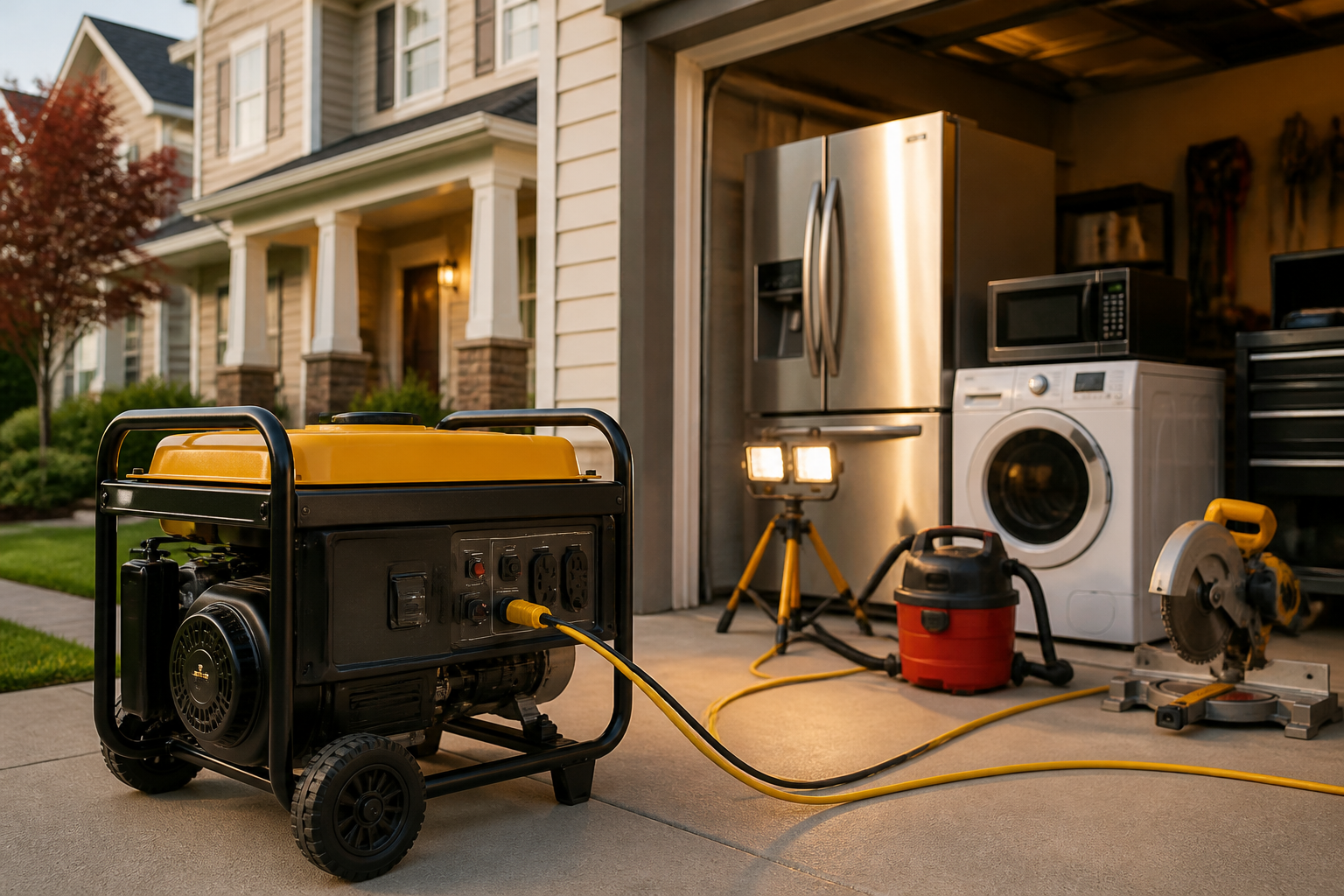
- For portable generators, run extension cords directly from the generator (positioned outside, at least 20 feet from doors and windows) to individual appliances. No electrical modifications needed, but you manually manage what plugs in. This is legal but impractical for whole-home backup.
Why transfer switches matter electrically: When utility power is on, your home’s main breaker feeds from the grid at 120/240V, 60Hz. When you start a generator, it also produces 120/240V, 60Hz — but the phase angle and frequency are slightly different. Switching between them instantly (without a transfer switch) creates a brief moment where both are connected, causing a current surge through the transfer point that can instantly destroy the generator’s alternator windings. The transfer switch ensures a gap of at least 4 breaker pole positions between the two sources, preventing this damage and eliminating backfeed risk.
Running Watts vs. Surge/Starting Watts — The Critical Distinction
Every electrical generator is rated with two different wattage numbers. Understanding the difference between them is the foundation of correct sizing:
Running watts (continuous rating): The amount of power the generator can deliver indefinitely (typically 8+ hours per refueling cycle for portable generators, or continuously for standby units). This is the sustained output that the alternator, voltage regulator, and engine cooling system are designed to handle.
Surge watts (peak rating): The maximum instantaneous power the generator can deliver for a brief period, typically 2–3 seconds. This rating is published because certain loads (motors, compressors, furnace blowers) draw far more power during the startup moment than during normal running. Once the motor is spinning, it draws less power.
The reason for this surge is the physics of motor induction: An induction motor (found in refrigerators, air conditioners, well pumps, washing machines, furnace blowers, etc.) has a rotor that must accelerate from zero RPM to operating speed. During this acceleration phase, the motor draws locked-rotor current — typically 2–3 times the full-load running current. Once the rotor reaches synchronous speed (within a few percent of line frequency × pole count), the current drops to running current and stays there.
Example from a real window air conditioner: A 12,000 BTU window AC unit (commonly specified at 1,200W running) draws approximately 10 amps at 120V during steady-state operation. During the starting transient (the compressor and fan motor accelerating), it draws 30 amps — 3,600W — for about 2 seconds. The generator must supply 3,600W during those 2 seconds or the voltage collapses, the motor can’t overcome the starting torque, and the overload relay trips.
Critical error most homeowners make: They add up only running watts and ignore surge. Example: “I need to run a refrigerator (700W), a window AC (1,200W), and a sump pump (350W) = 2,250W total, so a 3,000W generator will work.” Wrong. If the sump pump compressor and the AC compressor start simultaneously, you need 2,250W running PLUS the highest single starting surge. The AC starts at 3,600W. If both motors start at the same moment: 700W (fridge running) + 1,200W (AC running) + 350W (pump running) = 2,250W baseline, then add the AC starting surge of 3,600W at peak = 5,850W peak demand. A 3,000W generator cannot supply this and will overload.
How surge ratings are specified: Manufacturers measure surge differently. Generac, Honda, and Champion typically publish surge ratings that assume the generator is at no load, then suddenly applies the surge load (so the engine is already at full speed with no voltage drop). Real-world surge is slightly less forgiving because the generator is already supplying baseline loads. To be safe, assume your peak demand = (all simultaneously running appliances in watts) + (the single highest starting surge of any motor). This peak must not exceed the generator’s surge rating.
Resistive vs. inductive loads: Resistive loads (space heaters, incandescent lights, toasters, coffee makers) have no surge — they draw the same current whether starting or running. Inductive loads (motors, compressors, transformers, fluorescent ballasts) have a surge. This is why a 1,500W space heater can run on a small portable generator with no trouble, but a 750W furnace blower (which has a motor) needs a generator with higher surge capacity.
Load Calculation: Step-by-Step
Step 1: Decide What You Actually Need to Power
Many homeowners overestimate their needs. During a multi-day outage, you don’t need everything. Categorize your loads:
Essential (must run): Refrigerator, freezer (food preservation), well pump (water access), sump pump (basement flooding), furnace blower (heating in winter), medical equipment (CPAP, oxygen concentrator, nebulizer), basic lighting, phone charging, communication devices. These keep you safe and preserve critical utilities.
Comfort: Window or central air conditioning, electric water heater (hot showers), microwave (hot meals), washing machine, TV/entertainment. These maintain quality of life during outages lasting 12+ hours.
Luxury: Electric dryer (massive surge — 4,000–5,500W), electric range (even larger, 5,000–12,000W depending on number of burners), garage door opener, pool pump, yard equipment. During an emergency, these can wait.
A practical approach: Size for essential + comfort, then note which luxury loads you can’t run simultaneously with comfort loads.
Step 2: Create Your Load Table
Make a spreadsheet with three columns: appliance name, running watts, starting surge watts. Go through your home systematically.
For appliances you already own: Check the nameplate. Most appliances have a sticker on the back or inside the door listing “Input Power” or “Rated Power.” This is usually running watts. Example: a refrigerator’s nameplate might say “350W” — that’s the running draw. The starting surge is not listed on the nameplate; you’ll use the reference table below.
For appliances you don’t yet own: Use the reference table provided below, then cross-check against the specific model. A high-end refrigerator with an ice maker and water dispenser draws more than a basic model. A high-efficiency HVAC blower draws less than an older unit of the same HP rating.
For major appliances you’re unsure about: Check the circuit breaker in your panel. A 20-amp breaker typically protects 2,400W (20A × 120V), suggesting the appliance draws close to that at full load. A 40-amp breaker (240V) protects about 9,600W. The breaker size is the designer’s estimate of maximum safe draw.
Measuring actual power draw: Use a Kill-A-Watt meter (about $25). Plug the appliance in and run it under typical use conditions. The meter shows running watts in real-time. This is far more accurate than manufacturer specs, which are often conservative.
Step 3: Determine the “Critical Coincidence” Load
In practice, not everything runs simultaneously. But you must account for the worst-case scenario — when multiple motors might start at nearly the same time.
Scenario 1 (winter): Furnace blower (heating), refrigerator, sump pump, lights, TV. On a cold morning when the furnace cycles and the sump pump drains a recent heavy rain, these might all be running. If the furnace starts (1,800W surge) while the compressor in the fridge runs (400W), and the sump pump is in midcycle (350W), your instantaneous demand is 1,800W + 400W + 350W = 2,550W at peak.
Scenario 2 (summer): Central AC, refrigerator, well pump (if you have one), furnace blower (for AC circulation), washing machine, microwave. The AC is the dominant load. A 2-ton central AC starting (7,500W surge) while the refrigerator runs (400W) and furnace blower runs (600W) creates a peak of 7,500W + 400W + 600W = 8,500W. Smaller generators cannot handle this.
How to estimate critical coincidence: Look at your home’s 200-amp main breaker. That’s an upper limit — your utility panels are sized so that simultaneous operation of all major circuits doesn’t exceed about 150–160 amps at 240V (36,000–38,400W). But you don’t have a 200-amp generator at home. You’ll have a 4,000–8,000W unit. So identify the single highest-load scenario: “What combination of appliances would draw the most power?” Usually it’s the air conditioner plus a few baseload appliances.
Appliance Wattage Reference Table — Complete
| Appliance | Running Watts | Starting/Surge Watts | Notes |
|---|---|---|---|
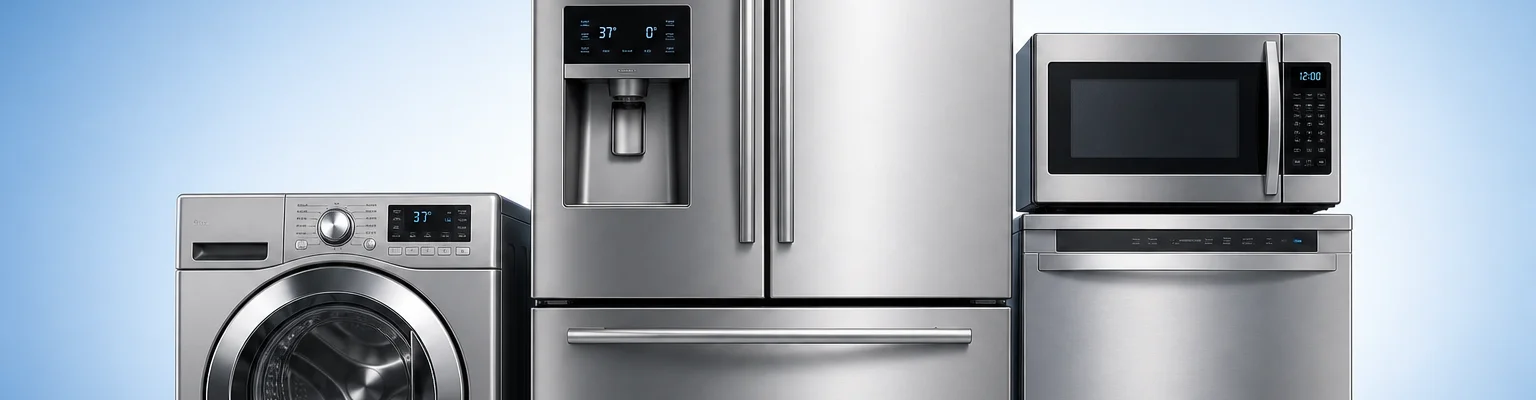
| Refrigerator (standard) | 100–800 | 1,200–2,400 | Wide range depends on age, efficiency rating, size. Older units higher. French door with ice maker at top range. |
| Chest Freezer | 100–500 | 800–1,500 | Smaller surge than fridge; simpler compressor design. |
| Window AC (5,000 BTU) | 500–700 | 1,500–2,100 | Single-phase 120V units, common for bedroom backup cooling. |
| Window AC (12,000 BTU) | 1,000–1,400 | 3,000–4,200 | 240V units more common at this size; check voltage rating on nameplate. |
| Central AC (1.5 ton, 18,000 BTU) | 1,500–2,000 | 3,600–5,400 | Compressor + condenser fan; always 240V three-phase (utility), single-phase portable generators struggle to start three-phase compressors. |
| Central AC (2 ton, 24,000 BTU) | 2,000–2,800 | 5,000–8,000 | Most common residential size. Highest surge at startup when both compressor and condenser fan start together. |
| Central AC (3 ton, 36,000 BTU) | 3,000–4,000 | 7,500–12,000 | Large homes or multi-zone; usually requires a whole-home standby generator to run reliably. |
| Well Pump (1/2 HP) | 750 | 1,500–2,200 | Most common residential well pump; requires robust generator due to high surge. |
| Well Pump (1 HP) | 1,000 | 2,000–3,300 | Larger wells or deeper draws; high surge makes sizing critical. |
| Sump Pump (1/3 HP) | 350–500 | 700–1,500 | Often cycles automatically in basements with seepage; lower surge than well pump. |
| Furnace Blower (1/2 HP, ECM motor) | 300–500 | 600–1,000 | Modern electronically commutated motors (ECM) draw less than older PSC motors; check your furnace nameplate. |
| Furnace Blower (1/2 HP, standard PSC) | 600–800 | 1,200–2,400 | Older furnaces; higher surge due to less efficient motor design. |
| Space Heater (electric, 1,500W) | 1,500 | 0 (resistive load) | Pure resistive; no surge. Often comes in 750W and 1,500W models. |
| Electric Water Heater (full element) | 3,500–5,500 | 0 (resistive) | Large load; usually 240V. Most generators cannot run this simultaneously with other loads. |
| Gas Water Heater (electric ignition) | 20–150 | 0–200 |