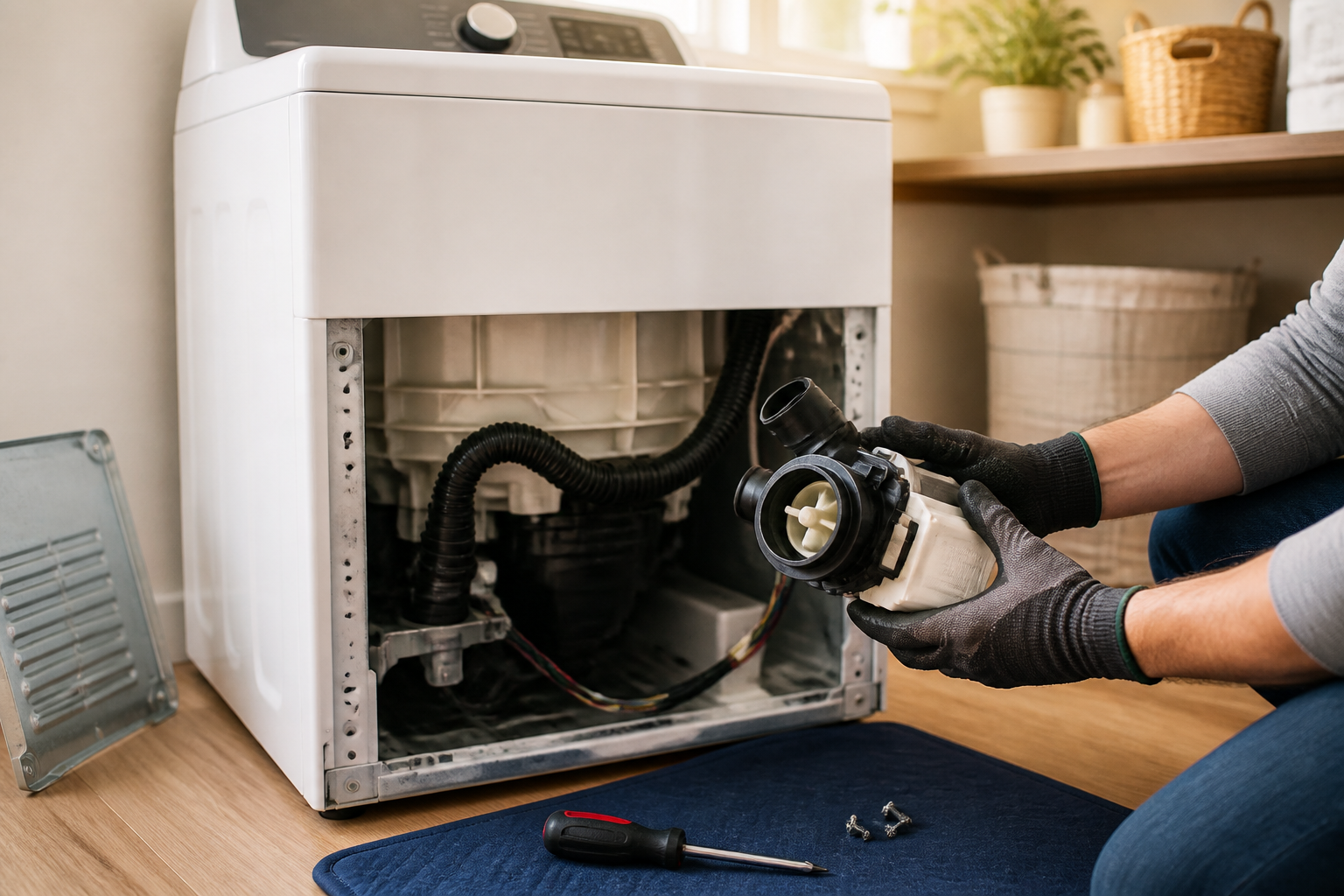
Drain Pump Replacement for GE GTW720BSNWS Top-Load Washer
When your GE GTW720BSNWS top-load washer won’t drain, the drain pump is often the culprit. This pump is responsible for forcing water out of the tub and into your home’s drain system. Over time, the pump can fail due to motor burnout, mechanical wear, or debris blockage that damages the impeller. This repair involves removing the pump assembly from the bottom of the washer cabinet and installing a replacement unit (WH23X10030 or equivalent). Difficulty Level: MODERATE. The job requires basic mechanical skills, careful attention to water connections, and about 45-60 minutes of work time.
Symptoms
- Water remains standing in the tub after the wash cycle completes
- Washer makes grinding or squealing noises during the drain cycle
- Error code displays on the control panel (often “OE” or “DE” codes indicating drain errors)
- Water drains very slowly or intermittently during the spin cycle
- Visible water leaking from beneath the GE GTW720BSNWS cabinet during operation
- Pump runs but no water exits the drain outlet hose
⚠️ Safety Warning
- Unplug the washer before beginning any work. Do not rely on the power switch alone—disconnect the unit completely from the electrical outlet to prevent shock hazard.
- Turn off the water supply valves at both hot and cold water connections behind the GE GTW720BSNWS. This prevents accidental flooding if hoses are disturbed.
- The washer lid is heavy. Use proper lifting technique or have a helper support it while you work. Propping the lid open with a safe object prevents it from dropping unexpectedly.
- Drain all water from the tub before beginning. Use a manual siphon, wet/dry vacuum, or towels to remove standing water. Wear gloves—washer water may contain detergent residue or bacteria.
- The pump housing may be hot if the washer was recently running. Allow 30 minutes for the appliance to cool before touching internal components.
Parts Needed
- Drain Pump Assembly: WH23X10030 (OEM GE part, genuine replacement for GE GTW720BSNWS and similar models)
- Alternative Part Number: WH23X10009 (compatible substitute pump assembly if WH23X10030 is unavailable)
- Inlet Hose or Water Seal Kit (if original appears cracked or damaged): Consider ordering a replacement hose clamp kit (typically includes 2-3 stainless steel hose clamps, size #40 or #50) as a precaution
- Gasket or seal material (optional): Some technicians apply a thin bead of food-grade silicone around the pump outlet connection for added watertight security
Tools Required
- Phillips head screwdriver (for cabinet screws and pump mounting bolts)
- Flathead screwdriver (for prying and hose clamp adjustment)
- Adjustable wrench or socket set (7/16″ and 1/2″ sockets recommended) for hose clamp nuts
- Needle-nose pliers (for removing hose clamps and connector clips)
- Bucket or drain pan (to catch residual water from disconnecting hoses and pump inlet)
- Wet/dry vacuum or towels (to remove standing water from the tub)
- Flashlight or headlamp (the drain pump is located at the base of the cabinet, where lighting is dim)
Step-by-Step Instructions
Step 1: Prepare the Washer and Workspace
Unplug the GE GTW720BSNWS from the electrical outlet. Locate the water supply shutoff valves behind the washer (typically two knobs or lever handles on the wall at the connection point). Turn both the hot and cold water supply valves clockwise until they stop. Do not apply excessive force—hand-tight is sufficient. Place a bucket or drain pan beneath the washer to catch water that will drip when you disconnect hoses. Position a flashlight or headlamp so you can see the underside of the washer cabinet where the pump is located.
Step 2: Remove Standing Water from the Tub
Open the lid of the GE GTW720BSNWS. Using a wet/dry vacuum, siphon, or clean towels, remove all standing water from inside the tub. Empty the pump’s internal water reservoir by tilting the unit slightly or using a vacuum hose to extract water around the pump inlet area. This step prevents spillage and makes handling the pump safer. Wring out towels into a bucket as needed.
Step 3: Access the Drain Pump Housing
The pump on the GE GTW720BSNWS is located at the bottom-front-left of the cabinet (when facing the machine). You may need to tilt the entire washer backward slightly or place it on its back on a sturdy work surface (with help from another person) to access the pump. Alternatively, remove the front lower access panel by unbolting 2-3 Phillips head screws located along the bottom edge of the cabinet. If your model has a removable base panel, disconnect the power cord clip that may be fastened to it. Note the positions of any electrical connectors for reassembly.
Step 4: Disconnect the Pump Inlet Hose
Locate the inlet hose connected to the pump—this is the hose running from the pump upward into the washer tub area. Using a flathead screwdriver or hose clamp pliers, loosen the hose clamp on the pump side (turn the screw on the clamp counterclockwise 3-4 full turns until the clamp band is loose enough to slide off). Slide the hose clamp off toward the pump outlet to free the hose. Gently pull the inlet hose away from the pump connection. Be prepared for a small amount of water to spill—position your bucket underneath. Cap or plug the hose opening with a cloth to prevent contamination.
Step 5: Disconnect the Pump Outlet Hose
The outlet hose is the larger diameter hose exiting the pump toward the rear or side of the washer cabinet and leading to the drain standpipe or home drain line. Using your wrench or adjustable pliers, locate the hose clamp securing this connection. Turn the clamp screw counterclockwise 4-5 full turns until the band is loose. Slide the clamp off and away from the pump outlet. Disconnect the outlet hose carefully—a significant amount of trapped water may remain inside. Allow it to drain into your bucket. Set the outlet hose aside.
Step 6: Disconnect the Pump Motor Connector
The drain pump motor is powered by a small electrical connector (typically a 2-pin or 3-pin plastic push-fit connector with a colored clip, often blue or black). Locate this connector on the pump body or nearby on the wiring harness. Gently squeeze or press the clip on the connector and pull straight away from the pump. Do not yank the wires—the connector should separate cleanly. If there is a secondary ground wire or clip, note its location and method of attachment (screw terminal or push-clip) for reassembly.
Step 7: Remove the Old Pump Assembly
The pump housing is held to the washer cabinet or pump mounting bracket by 2-3 Phillips head screws. These are typically located around the perimeter of the pump body. Using your Phillips screwdriver, remove all mounting bolts by turning counterclockwise. Keep these screws in a safe location—they will be reused. Carefully slide the old pump assembly away from its mounting location and lift it out of the cabinet, angling it as necessary to clear any nearby components. If the pump is stuck, do not force it; gently rock it side to side while pulling.
Step 8: Inspect the Pump Mounting Area and Connections
Before installing the new pump, examine the mounting bracket on the GE GTW720BSNWS and the connection points on the hoses. Look for cracks, corrosion, or debris inside the hose connections. If the inlet or outlet hoses appear cracked, kinked, or discolored (white mineral buildup or black mold), this is an ideal time to replace them as well. Wipe the mounting area clean with a damp cloth and dry thoroughly. Check that all hose clamps are in good condition; replace any that are bent or rusted.
Step 9: Position and Install the Replacement Pump (WH23X10030)
Unpack the new drain pump (WH23X10030 or equivalent) and compare it visually with the old pump to confirm compatibility. The inlet and outlet ports should be in the same relative positions. Carefully position the new pump into the mounting location on the GE GTW720BSNWS, aligning the screw holes with the mounting bracket. Insert the 2-3 Phillips head mounting screws through the pump housing and into the bracket, turning clockwise by hand first to ensure you are not cross-threading. Once hand-tight, use your screwdriver to tighten each screw fully (snug but not over-tightened—approximately 6-8 foot-pounds of torque if you have a torque screwdriver).
Step 10: Reconnect the Pump Inlet Hose
Position the inlet hose over the pump’s inlet port. Slide a hose clamp onto the hose from the pump side. Push the hose fully onto the inlet port until it seats completely. Slide the hose clamp so that it is centered over the connection joint and tighten by turning the clamp screw clockwise 3-4 full turns until the clamp is snug. Do not over-tighten—the goal is a watertight seal without crushing the hose.
Step 11: Reconnect the Pump Outlet Hose
Push the outlet hose firmly onto the pump’s outlet port until it seats completely and you feel resistance. Slide a hose clamp onto the outlet hose and position it over the connection joint. Tighten the clamp screw counterclockwise 4-5 full turns until the connection is snug and water-tight. Ensure the outlet hose path is clear and not kinked, allowing it to route properly to the drain standpipe or household drain line.
Step 12: Reconnect the Pump Motor and Test
Align the pump motor electrical connector with its mate on the wiring harness and press firmly until you hear or feel a click. The connector should be fully seated. If there is a secondary ground wire, reconnect it to the designated terminal (typically a screw on the pump housing or bracket). Reinstall any access panels or base cover, securing them with the original Phillips head screws. Turn the water supply valves back on by rotating the shutoff knobs counterclockwise until they stop. Plug the GE GTW720BSNWS back into the electrical outlet. Run a short drain cycle (press the Drain & Spin button or run a cycle to completion) and observe for leaks around the pump connections. The tub should drain within 2-3 minutes. If water drains properly and no leaks are visible, the repair is complete.
Troubleshooting
- Water still doesn’t drain after pump replacement: Check the outlet hose for kinks, clogs, or improper connection to the home drain system. Verify that the hose clamps are tight and the outlet hose is not kinked where it exits the cabinet. A clogged drain line beyond the washer may require professional plumbing service.
- Leaking from the inlet or outlet connection: Disconnect the hose, inspect the port for cracks or debris, and verify that the hose is pushed fully onto the port. Retighten the hose clamp an additional 1-2 turns. If leaking persists, the pump port may be damaged and the unit may need replacement.
- Pump motor does not run during drain cycle: Confirm that the electrical connector is fully seated and the clip is locked. Check for tripped circuit breakers on your home’s electrical panel. If the connector appears corroded, gently clean the pins with a dry cloth and reseat. If the motor still does not run, the replacement pump may be defective (contact the manufacturer).
- Grinding or squealing noises from the new pump: Stop the washer immediately. Turn off water and power. This may indicate debris inside the pump (sand, lint, or coins). Open the pump inlet and flush it with clean water, or contact GE customer service for a warranty replacement.
- Washer displays drain error code after replacement: The pressure switch or drain sensor may need time to reset. Unplug the washer for 5 minutes, then plug it back in and run a test cycle. If the error persists, the pressure switch or wiring harness may need inspection by a technician.
- Small amount of water pooling at the base of the GE GTW720BSNWS: This is normal during the first drain cycle as residual water in the pump housing is expelled. Run a second empty cycle to clear any remaining water. If pooling continues, recheck hose clamp tightness and inlet/outlet seals.
When to Call a Professional
- If the drain pump replacement does not resolve the no-drain issue after verification that hoses are properly connected and the home drain line is clear. This may indicate a faulty pressure switch, clogged drain line deeper in the plumbing system, or control board malfunction that requires professional diagnosis.
- If you discover cracks in the pump housing, cracked hoses, or damage to the mounting bracket during disassembly. These components may require replacement beyond the scope of a simple pump swap, and improper repair could lead to water damage.
- If the washer cabinet needs to be tilted or disassembled in ways not described here (such as complete cabinet separation). This requires specialized tools and knowledge of the GE GTW720BSNWS internal structure and may void your warranty if performed incorrectly.
- If you are uncomfortable working with electrical connectors, hoses, or water connections, or if this is your first major appliance repair. A professional technician can complete the GE GTW720BSNWS drain pump replacement safely and efficiently, often with a warranty on both parts and labor.
Recommended Parts & Tools
Drain Pump WH23X10030 for GE Washer
This OEM-equivalent drain pump is a direct replacement for the GE GTW720BSNWS and resolves drainage issues caused by pump failure or blockage. The WH23X10030 is engineered to match the original specifications and restore proper water evacuation in your top-load washer. Check current pricing on Amazon.
Pump and Drain Cleaning Tool Kit for Washing Machines
Before replacing the drain pump on your GE GTW720BSNWS, use this multi-piece cleaning kit to clear lint, debris, and blockages that may be preventing proper drainage. The kit includes a flexible auger and cleaning brushes designed specifically for washer drain lines and pump chambers. Check current pricing on Amazon.
The Drain Pump That Actually Solves the GTW720BSNWS No-Drain Problem
When water sits in the tub after the cycle ends, nine times out of ten it’s this pump that’s failed. Ordering the correct OEM part the first time saves you from the frustration of installing a knockoff that either doesn’t fit tight or burns out again in six months.
What works
- Drop-in replacement—mounting bracket and electrical connector align perfectly without modification or adapter hunting.
- Motor torque is strong enough to push water even when the drain line has minor buildup, so you’re not fighting weak flow halfway through.
- Impeller design matches OEM specs, so it handles the lint and soap residue that actually comes through a top-loader without jamming.
What doesn’t
- If your drain hose is kinked or your home’s drain line is actually blocked, this pump won’t force water through—you’ll solve the symptom but not the root cause.
- Shipping time matters if you have standing water in the tub; this isn’t an overnight fix, so plan ahead.
I’ve seen homeowners order generic pumps online and end up with a unit that fits loosely or has a weaker motor, forcing a second teardown after two weeks of use. Getting the WH23X10030 part number right from the start means you’re installing the same unit GE engineers designed for this specific model. Drain Pump WH23X10030 for GE Washer
This post contains affiliate links. As an Amazon Associate, I earn from qualifying purchases at no extra cost to you.