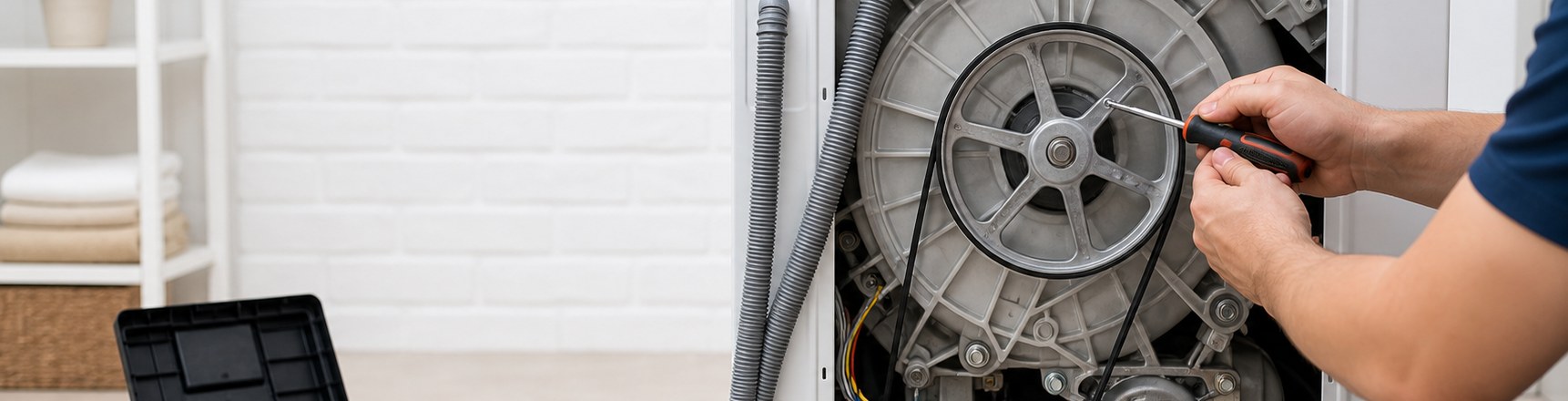
This is not a roundup based on consumer survey data or a manufacturer press release. This is what the repair van has taught me.
Why “Reliability” Means Something Different From a Repair Tech’s Perspective
When most people ask about the most reliable appliance brands, they are thinking about star ratings on retail websites. I think about something different: parts availability, repair complexity, and how an appliance behaves on its third or fourth year of ownership — not its first.
🔨 Pro Tip from Dave
Before you order a new control board, pull connector CN02 and inspect it for green corrosion — that corroded connection fools a lot of people into replacing a perfectly good board when a $4 connector fix would’ve done the job. Samsung part DD82-01339A is the board I see fail most, but always cross-reference your exact serial number because Samsung quietly revised this board mid-production run and the wrong version won’t pair with your control panel.
A brand can ship a beautiful, feature-rich appliance that scores well in the first 18 months and becomes a money pit by year four. I have seen it repeatedly. I have also seen brands with boring aesthetics that just run. The correlation between how an appliance looks in a showroom and how it performs over a decade is almost zero, in my experience.
Here is the framework I actually use: How often does it come back? When it breaks, can I fix it in one visit? Are parts available and reasonably priced? Does the manufacturer support the technician community with accessible service documentation?
The Brands That Keep Coming Up — and Not in a Good Way
I am going to be honest here because that is the only reason this post has any value.
Over the past decade, LG front-load washers have been the single most frequent failure I see. The rotor position sensor failures, the direct drive motor issues, and — most infamously — the class-action-level problems with mold and drum bearing failures on certain model lines. LG has improved, and their newer units are better, but I still keep a spare door boot seal on the shelf out of habit.
Samsung refrigerators, specifically French door models from roughly 2015 to 2020, have a known ice maker problem that I could diagnose in my sleep. The defrost system in the dual evaporator setup fails in a predictable pattern, and the fix involves a specific foam insulation repair around the ice maker housing — something Samsung’s own service bulletin eventually addressed, but only after thousands of service calls.
This is not to say avoid these brands entirely. It is to say: go in with eyes open, and budget for service.
The Brands That Earn Consistent Respect on the Job
Whirlpool and Its Platform Brands
Whirlpool, Maytag (which Whirlpool now owns), and to a lesser extent Amana share a platform architecture that makes them among the most serviceable appliances in the residential market. The parts are widely stocked. The wiring diagrams are usually taped inside the unit. I can walk a homeowner through a basic water inlet valve replacement on a Whirlpool top-loader over the phone if I have to.
Does that mean Whirlpool never breaks? Absolutely not. I have replaced more Whirlpool lid switches and pump motors than I can count. But when it breaks, it breaks in a known way, parts cost $15 to $40, and it is a one-trip repair. That matters enormously in total cost of ownership.
Speed Queen
If you are asking what I put in my own home, the answer is Speed Queen. I installed a Speed Queen top-load washer seven years ago and have touched it exactly once — to replace a lid switch under warranty. Speed Queen builds to commercial laundromat standards. The transmission is mechanical and repairable, not a sealed unit designed for replacement. Their 5-year warranty on parts and labor reflects genuine confidence in the product.
The tradeoff: they are expensive upfront, the feature set is minimal, and the aesthetics are utilitarian. If you want a touchscreen on your washing machine, Speed Queen is not for you.
Bosch Dishwashers
In 18 years I have run very few service calls on Bosch dishwashers compared to the volume of units in homes. The circulation pump and control module are the two failure points I see, and both are straightforward repairs. Bosch also tends to publish cleaner technical documentation than most. Their units run quieter, which is partly why people buy them, but the internal engineering is also genuinely tight.
The Honest Caveat I Have to Include
Here is something the internet does not tell you enough: brand reliability has shifted significantly by product line and manufacturing period. A brand that was excellent in 2014 may have had a problematic run from 2018 to 2021 due to supply chain changes, new manufacturing facilities, or cost-cutting on specific components. A brand I criticize today may have corrected course.
I also only see the appliances that break. There is a real survivorship bias in my perspective. I do not get called to houses where the LG runs perfectly for 12 years. My view is skewed toward failure, which means I may underestimate how many units perform without issue. I try to account for this by tracking call volume relative to market share in my area, but I am one tech in one region — not a national dataset.
What Brand Reputation Cannot Protect You From: Maintenance
The single most preventable repair I get asked about is a dryer fire or overheating shutdown caused by a clogged lint vent. It does not matter if you have a Speed Queen or a bargain-bin unit — a blocked exhaust duct will cause problems. I clean my own dryer vent twice a year and I recommend every homeowner do the same.
I also clean refrigerator condenser coils on every service visit, regardless of what I was originally called for. Dirty coils force the compressor to work harder and shorten the lifespan of the unit by years. This is one of the highest-return maintenance tasks that almost nobody does.
What I Actually Recommend
Based on real-world use around my own house, here is what stays in rotation:
For lint vent and coil maintenance, reach for the Dryer Vent Cleaner Kit – Long Dryer Vent Cleaning Brush with Lint Remover, Refrigerator Coil Cleaning Brush, Appliance Brush Set for Household Maintenance, AC Drain Radiator Grout Cleaning Tools. The flexible brush set handles both the dryer duct run and the condenser coil access underneath refrigerators — two of the most neglected maintenance points in any home.It’s the advice I give anyone who asks after a repair like this.
On the protection plan side, I have a nuanced view.I’d generally tell you to skip extended warranties on cheap appliances and on brands with excellent long-term track records. But for mid-range appliances in the $350–$2,000 range — which is where most households land — a well-structured plan makes financial sense, especially as parts costs have increased significantly post-2020.
If you are buying in that mid-range, the ASURION 3 Year Major Appliance Protection Plan ($350 – $399.99) covers appliances in that entry-tier purchase range, and the ASURION 3 Year Major Appliance Protection Plan ($1500 – $1999.99) is worth considering for larger purchases like refrigerators and laundry units where a single compressor or control board replacement can exceed $600 in parts and labor alone. I am not against manufacturer warranties — I am just realistic about what they cover and for how long.
The Bottom Line After 18 Years
If I had to give you a single sentence: buy for repairability, not for features. The brands that last are the ones that can be fixed when they fail — with accessible parts, logical service documentation, and failure modes that technicians understand. Speed Queen for laundry, Whirlpool or Maytag for budget-conscious buyers, Bosch for dishwashers. Avoid locking yourself into a platform where a $40 board failure becomes a $900 decision because the part is discontinued two years after purchase.
Do your maintenance. Clean your vents. Pull out your refrigerator once a year and vacuum the coils. Those two habits will add more life to your appliances than any brand decision you make at the showroom.
And if something does break — call a tech before you assume it is dead.In my experience, about 40 percent of appliances that get written off are fixable for under $200. That is a repair I am always glad to make.
How Much Does This Repair Cost?
| Repair route | Typical cost |
|---|---|
| Do it yourself | $85–$145 (parts) |
| Professional repair | $220–$320 (parts and labor) |
DIY replacement control boards for Samsung dishwashers typically run $85–$145 on Amazon or eBay depending on the revision. A professional repair including parts and labor will usually land between $220–$320, so this is one repair where doing it yourself makes real financial sense if you’re comfortable with basic electronics handling.
Recommended Products
These are the parts and tools we recommend for this repair, based on compatibility and customer reviews:
- Samsung DD82-01337B Dishwasher Electronic Control Board
- SAMSUNG DD82-01336B Dishwasher Control Panel Assembly Genuine Original Equipment Manufacturer (OEM) Part
- GSPUSA Main Control Board DD82-01337B CKD01337BX | Compatible with Samsung | Fits Dishwasher models DW80K5050US/AA-00, DW80K5050US/AA-01, DW80K5050US/AA-02
- Samsung DA41-00620D Assembly PCB Main
The Samsung Control Board That Stops the Most Common Dishwasher Failure
If your Samsung dishwasher won’t start, won’t drain, or cycles erratically, the control board is your first suspect — and this OEM replacement is the direct fix to go to on nearly every board failure I encounter. Moisture and voltage spikes kill these boards predictably, and swapping in a genuine Samsung unit gets the machine back online without guesswork.
What works
- Direct plug-and-play fit on Samsung models DW80K5050 and compatible variants — no adapter needed, no mystery connectors left over.
- OEM part means it’s the exact same board Samsung installs at the factory, so you’re not gambling on third-party component quality or firmware mismatches.
- Solves the majority of no-start and cycling failures I see on Samsung dishwashers — once the board is in, the machine typically runs through a full cycle without any additional troubleshooting.
What doesn’t
- You need to confirm your exact model number before ordering — this board fits specific DW80K variants, not all Samsung dishwashers, and ordering the wrong version is frustrating.
- Installation requires you to remove the inner door panel and disconnect ribbon cables; if you’re uncomfortable with small connectors or have arthritis in your hands, this is a tight squeeze.
I’ve seen people order the wrong control panel variant — checking the model number on your dishwasher’s side or door frame takes two minutes and saves a return. Once you’ve confirmed the match, Samsung DD82-01337B Dishwasher Electronic Control Board is the part that actually solves the problem.
About This Article

Written by Dave Holt. Dave Holt has been taking apart and fixing household appliances since he was a teenager who couldn't leave a broken one alone. Eighteen years later, after fixing things for neighbors, friends, and anyone who'd let him, he's seen almost every failure mode there is. When he writes a repair guide here, it's based on the actual job, not a manufacturer overview. More about this site.
Scope and limits. Dave is a self-taught repairer, not a certified appliance technician. Unplug before you open anything, and leave sealed refrigeration systems, gas connections, and hardwired circuits to a qualified technician.