Water fill slow
Let’s dive into this step-by-step guide to tackle the slow water fill issue on your Amana NTW4516FW (Top Load). With the right tools and parts, most homeowners can wrap up this repair in just 1–2 hours, saving some cash and avoiding a service call.
🔨 Pro Tip from Dave
On the NTW4516FW, the water inlet valve (part number WPW10144820) comes with dual solenoids, and I often see folks replacing just one side. Trust me, it’s better to swap out the whole valve assembly while you’re in there. Don’t forget to check the inlet screen filters as well; sediment buildup is often misdiagnosed as a faulty valve, so be sure to clean those first.
Part of our Top 20 Washing machine Models & Common Repair Issues Guide. Browse all washing machine repair guides for related models and issues.
Common Symptoms & Causes
Here are some symptoms that indicate your Amana NTW4516FW is facing a slow water fill issue:
- The washer takes longer than 5–7 minutes to fill before the cycle begins
- The tub fills with only a thin trickle of water during the wash or rinse cycle
- Clothes come out insufficiently wet or detergent residue remains after washing
- The washer pauses mid-cycle as it struggles to reach the correct water level
Typically, these issues stem from a clogged or faulty water inlet valve, kinked supply hoses, or mineral buildup that restricts water flow into the washer.
Safety First
- Unplug the washing machine from the power outlet before starting any repair — never work on a live appliance.
- Shut off the water supply valve before disconnecting any water lines or hoses.
- Wear work gloves when handling metal brackets, sheet metal edges, or sharp components.
- Take photos with your phone before disconnecting any wiring harnesses or connectors.
- Work in a well-lit area with enough floor space to lay removed panels flat.
Tools & Parts Needed
Essential Tools
- Phillips #2 screwdriver
- ¼” nut driver
- Torx T20 screwdriver
- Multimeter
- Bucket and towels
Replacement Parts
- Water inlet valve
- inlet screen filters
- inline water pressure gauge
Step-by-Step Repair Instructions
Step 1
First, ensure both hot and cold supply valves behind the washer are fully open. A partially closed valve is the most common reason for a slow fill, so check those. Inspect the hoses for kinks or any signs of wear that might restrict water flow. If your hoses are over 5 years old, consider replacing them with braided stainless steel lines while you have access.
Step 2
Next, shut off both supply valves and disconnect the hoses to access the inlet port screens. These fine mesh filters catch sediment before it enters the valve. Use needle-nose pliers to pull them out and clean them under running water, using an old toothbrush if necessary. Clogged screens are a major culprit when it comes to slow fills, especially if you have older iron pipes or well water. Make sure to reinstall the screens securely before reconnecting the hoses.
Step 3
Now, let’s check the household water pressure at the washer connection with an inline gauge. Your Amana NTW4516FW needs between 20 and 120 PSI for proper operation. If you’re on well water and the pressure is low, you might need to service the pressure tank or pump, or add a booster pump if that’s the issue. Remember to relieve line pressure by shutting off the valve and opening a nearby faucet before you disconnect anything.
Step 4
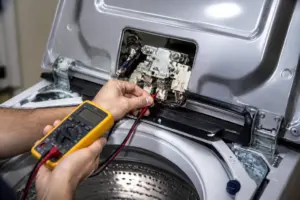
Remove the rear access panel by unscrewing the four quarter-inch hex screws. Once inside, test each solenoid coil of the water inlet valve with a multimeter set to Rx1 resistance mode. A healthy solenoid should read between 200 and 500 ohms. If it reads infinity (OL), the coil is open and the valve assembly needs replacing. Make sure to unplug the washer before probing any electrical components to avoid shock.
Step 5
Locate the pressure switch, which is typically mounted near the top of the cabinet and connected to the tub by a small rubber hose. Test it by gently blowing into the hose after disconnecting it from the tub fitting. A functioning switch will make a clicking sound, indicating it’s sensing pressure. If there’s no click, the switch has failed and should be replaced.
Step 6
Reconnect all hoses, making sure they’re finger-tight plus a quarter turn with pliers. Restore power and run a normal cycle while watching the fill phase. The tub should reach the correct water level within 3 to 4 minutes. If you notice hesitation or an unusually low water level, revisit the previous steps to identify any unresolved components. After the first full cycle, check under the machine for any drips to ensure all connections are leak-free.
Where to Buy Replacement Parts
- Amana NTW4516FW water inlet valve WPW10247306 replacement
- Amana top load washer inlet screen filter cleaning
- water pressure gauge washing machine supply line test
When to Call a Professional
If you’ve gone through all these steps and the issue persists, the problem could lie with a failed main control board, a worn drive motor, or wiring that requires specialized diagnostic equipment. In that case, it’s best to contact a licensed appliance technician, but remember to shut off both the hot and cold supply valves before any work that opens the fill circuit.
How Much Does This Repair Cost?
| Repair route | Typical cost |
|---|---|
| Do it yourself | $15–$75 (parts) |
| Professional repair | $150–$300 (parts and labor) |
For DIY parts to fix a slow water fill on the Amana NTW4516FW, expect costs between $15 and $75, depending on whether you need a new inlet valve, hose, or filter screen. A professional service call typically runs between $150 and $300 once you factor in labor and parts. Tackling this repair yourself can save you a substantial amount.
Frequently Asked Questions
Why is my Amana NTW4516FW filling with water so slowly?
The most common cause is a clogged inlet screen on the water inlet valve, which restricts water flow over time. Cleaning or replacing the inlet valve usually resolves the issue quickly.
Can low household water pressure cause slow fill on this model?
Absolutely. The Amana NTW4516FW needs at least 20 PSI to fill properly, so check your home’s water pressure before replacing any parts.
Do I need a technician to replace the water inlet valve?
Most homeowners can replace the inlet valve themselves with basic tools and the correct replacement part for the NTW4516FW. Just remember to unplug the washer before starting any repair.
Recommended Products
These are the parts and tools I recommend for this repair, based on compatibility and customer reviews:
- Upgraded W10144820 Washer Water Inlet Valve Compatible with whirlpool amana kenmore Washers,Replace AP6015761, W10140914, WPW10144820,W10311458,W1AP6015761,PS11749042 Washing Machine Replacement Parts
- W10144820 Washer Water Inlet Valve Washing Machine Replacement Part Replace WPW10144820, WPW10144820VP, W10311458, AP4371093, AP6015761, EAP11749042, PS11749042, W10140914, etc
- FOMIUZY Washer Machine Water Inlet Valve Cold & Hot Part Fit Amana Inglis Roper NTW4516FW3 NTW4516FW2 RTW4516FW2 NTW4516FW4 NTW4655EW1 WTW4816FW3 NTW4665GW0 Replaces W11210463 W11101906 W10869803
- 4-Pack AGM73269501 Washing Machine Water Filter Screen, Fit for LG, Kenmore & Whirlpool Washer Machines, Washer Water Inlet Valve Filter Screen, Replace 1810261, AP5202486, PS3618281, EAP3618281
The Water Inlet Valve That Fixes Slow Fill on the NTW4516FW
If you’ve cleaned the inlet screens and confirmed water pressure is adequate, the inlet valve assembly itself is likely your culprit. This is the part to go to when slow fill persists after basic troubleshooting—it’s a direct replacement for the Amana NTW4516FW and handles both hot and cold water lines.
What works
- Exact fit for the NTW4516FW series—no adapter guessing or forcing connectors that almost fit.
- Both hot and cold water solenoids are included in one assembly, so you’re not swapping parts twice if you got the diagnosis slightly wrong.
- Installs in under 15 minutes once you unscrew the fill hose connections—no special tools needed beyond a flathead screwdriver and an adjustable wrench.
What doesn’t
- Not compatible with Whirlpool or Kenmore direct-fit unless you verify your exact model number first—cross-brand parts look similar but mounting tabs can differ.
- You’ll need to drain the hoses and have a bucket ready before you start—water will still be in the lines and it’ll spill.
I’ve seen people order a generic water inlet valve first, only to find it was a dual-solenoid model designed for a different fill pattern. It bolts right in, but the fill never normalizes because the valve timing is wrong for this washer. Get the model-specific water inlet valve to avoid that mistake.
About This Article

Written by Dave Holt. Dave Holt has been taking apart and fixing household appliances since he was a teenager who couldn't leave a broken one alone. Eighteen years later, after fixing things for neighbors, friends, and anyone who'd let him, he's seen almost every failure mode there is. When he writes a repair guide here, it's based on the actual job, not a manufacturer overview. More about this site.
Scope and limits. Dave is a self-taught repairer, not a certified appliance technician. Unplug before you open anything, and leave sealed refrigeration systems, gas connections, and hardwired circuits to a qualified technician.