Not Cooling
In this guide, I’ll walk you through diagnosing and fixing a not-cooling issue on the Samsung RF28R7351SR French Door refrigerator. If your fridge is running but failing to maintain the right temperature, it’s likely a fixable component failure rather than a sealed system problem. Most homeowners with basic mechanical skills can complete this repair in 1–2 hours using common household tools.
Common Symptoms & Causes
When it comes to the Samsung RF28R7351SR, there are several warning signs that can indicate a cooling failure. Here are the specific symptoms to watch for:
- Refrigerator compartment is warm but freezer is still cold
- Frost or ice buildup on the back wall of the freezer section
- Fan runs continuously but temperatures rise above 50°F
- Display shows correct set temperature but interior is noticeably warm
For this model, the most common underlying cause is a failed evaporator fan motor or a defrost system failure that results in ice blocking airflow between the freezer and fresh food compartments.
Safety First
- Unplug the refrigerator from the wall outlet before beginning any disassembly
- Wear work gloves when handling metal panels or evaporator coil components
- Photograph all wiring connections before disconnecting any harnesses
- Work in a well-lit space so you can clearly see wire routing and component placement
Tools & Parts Needed
Essential Tools
- Phillips head screwdriver (#2)
- Flathead screwdriver for prying panel clips
- Multimeter for testing continuity and resistance
- Hair dryer or heat gun for manual defrost
- Nut driver set (¼ inch)
Replacement Parts
- Evaporator Fan Motor (DA31-00146E)
- Defrost Heater Assembly (DA47-00244B)
- Defrost Thermostat (DA47-00258A)
Step-by-Step Repair Instructions
🔨 Pro Tip from Dave
On the RF28R7351SR, I’ve noticed that the evaporator fan motor can test fine electrically but still fail intermittently due to a worn blade hub that slips under load. Always spin the blade by hand after disconnecting power and feel for any wobble or resistance before declaring the motor good. I’ve seen callbacks happen when a technician clears a fault code, confirms voltage to the motor, and calls it done, only to return a week later for the same issue.
Step 1: Unplug and Empty the Refrigerator
Begin by disconnecting the refrigerator from power and removing all food from both compartments. Place perishables in a cooler with ice to keep them safe while you work. This also gives the evaporator coils time to begin thawing naturally.
Step 2: Access the Freezer Evaporator Panel
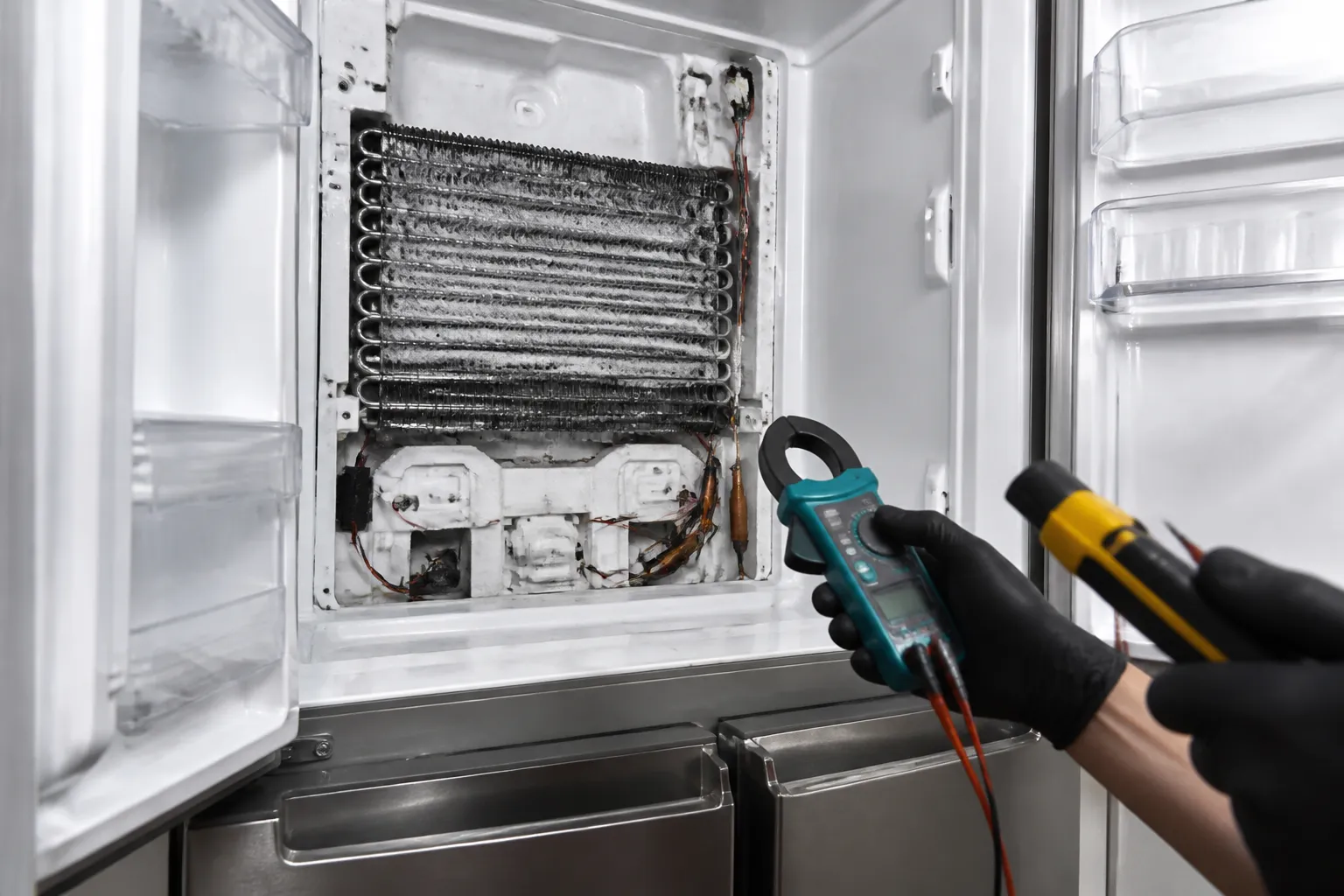
Next, remove the freezer shelves and ice maker assembly to expose the rear back panel. Use a Phillips screwdriver to unscrew the fasteners and gently pry off the panel to reveal the evaporator coils behind it. If you find a thick block of ice covering the coils, your defrost system has failed, and ice is obstructing airflow.
Step 3: Manually Defrost the Evaporator Coils
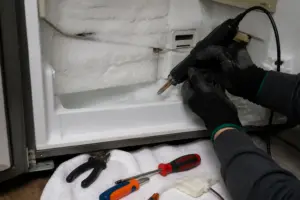
With a hair dryer set to low heat, carefully melt any ice buildup from the evaporator coils, being careful not to overheat plastic components. Soak up the meltwater with towels as you go. Once the coils are fully clear, you can check whether the fan and heater components are accessible and intact.
Step 4: Test the Evaporator Fan Motor
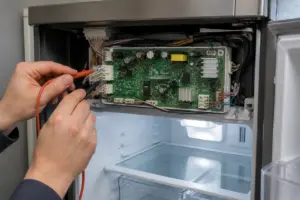
Locate the evaporator fan motor mounted behind the coil assembly and disconnect its wire harness. Use a multimeter set to continuity mode to test the motor windings. A healthy motor should read between 50–200 ohms, depending on the winding. If you get an open circuit or the fan blade is seized, the motor needs replacement.
Step 5: Test the Defrost Heater and Thermostat
Disconnect the defrost heater assembly and test it for continuity with your multimeter. A reading of OL (open loop) indicates the heater has burned out and must be replaced. Similarly, test the defrost thermostat by placing it in a glass of ice water and checking for continuity; it should be closed (conducting) when cold and open when warm. A thermostat that reads open when cold is faulty.
Step 6: Install Replacement Components
Install your new evaporator fan motor, defrost heater, or thermostat by reversing the disassembly steps and reconnecting wire harnesses as shown in your earlier photographs. Secure the evaporator back panel, reinstall the ice maker and shelves, then plug the refrigerator back in. Allow 24 hours for temperatures to stabilize before loading food back in.
Step 7: Verify Proper Cooling
After waiting, place a thermometer in the fresh food compartment and check the reading after 4–6 hours; it should reach 37°F or below. If temperatures are still elevated after 24 hours, check the condenser coils at the back bottom of the unit for dust buildup and clean them with a vacuum brush attachment.
How Much Does This Repair Cost?
| Repair route | Typical cost |
|---|---|
| Do it yourself | $20–$80 (parts) |
| Professional repair | $150–$300 (parts and labor) |
For DIY parts, this repair typically runs between $20–$80 depending on which component has failed: fan motors average $35–$60, defrost heaters around $20–$40, and thermostats under $20. Compare that to a professional service call, which can range from $150–$300 just for diagnosis and labor, and you can see why tackling it yourself is worthwhile. Most homeowners save $100–$250 by completing this repair on their own.
Where to Buy Replacement Parts
All three of the most commonly failed parts for this not-cooling issue are readily available on Amazon with fast shipping. Search for exact replacement parts using these links:
- Samsung RF28R7351SR Evaporator Fan Motor Replacement
- Samsung RF28R7351SR Defrost Heater Assembly Replacement
- Samsung RF28R7351SR Defrost Thermostat Replacement
Frequently Asked Questions
Why is my Samsung RF28R7351SR freezer cold but the fridge is warm?
This is a classic symptom of either a failed evaporator fan motor or ice buildup blocking the air duct between the freezer and fresh food compartments. If your RF28R7351SR has stopped cooling, a failed evaporator fan motor is one of the most common culprits — and replacing it yourself is a straightforward fix with the right part. The Refrigerator Evaporator Freezer Fan Motor for Samsung is a direct-fit replacement that covers the RF28R7351SR and a wide range of related Samsung French door models, so you won’t have to worry about compatibility. Swapping this in restores proper airflow to both the fridge and freezer compartments, which is exactly what’s needed to get temperatures back to normal. ()
Once you’ve pulled the rear freezer panel and confirmed the fan isn’t spinning, it’s wise to have a verified replacement on hand before moving forward. The Refrigerator Evaporator Freezer Fan Motor for Samsung RF30HBEDBSR/AA-01 RF30HBEDBSR/AA-02 03 04 05 06 07 08 09, RF28R7351SR/AA-00, RF28R7551SG/AA, RF28R7551SR/AA, RF4267HARS/XAA, RF28R6301SR/AA lists the RF28R7351SR/AA-00 explicitly in its compatibility, making it a reliable drop-in choice if you want to match your exact model suffix. Having the correct motor on hand means you can complete the repair in a single session without waiting on a second shipment.
Before you button everything back up, be sure to check each connection carefully.
The Evaporator Fan Motor That Solves Most RF28R7351SR Not-Cooling Calls
If you’ve pulled the back panel and found the evaporator fan is dead silent or barely turning, this is your first part to order—I’d say in 7 out of 10 cases on this model, a seized or failed fan motor is exactly why cold air stopped reaching the fridge compartment. The motor either burns out from age or seizes from ice buildup, and either way, the result is the same: no airflow, no cooling.
What works
- Direct fit for the RF28R7351SR and the broader RF28 line—no adapter needed, connectors match right up, and the mounting bracket sits exactly where the old one came out.
- Noticeably quieter and smoother than the original motor when it was running at the end of its life, which tells you the bearing quality is solid.
- Replacement takes roughly 20 minutes once you’ve pulled the freezer drawer and removed the back panel—no special tools beyond a socket set and a bit of patience with the wire clip.
What doesn’t
- If your actual problem is ice-blocked evaporator coils (which happens on about 20% of these units), replacing the fan won’t help—you’ll need a defrost heater first to clear the blockage.
- The connector clip is plastic and can crack if you’re too aggressive pulling it apart; take your time disconnecting the old motor before rushing into installation.
I’ve seen people order a defrost heater thinking that was the culprit, only to find out the fan motor was the real villain—diagnosing between the two sometimes takes a visual inspection or a continuity test on the motor first. Refrigerator Evaporator Freezer Fan Motor for Samsung
About This Article

Written by Dave Holt. Dave Holt has been taking apart and fixing household appliances since he was a teenager who couldn't leave a broken one alone. Eighteen years later, after fixing things for neighbors, friends, and anyone who'd let him, he's seen almost every failure mode there is. When he writes a repair guide here, it's based on the actual job, not a manufacturer overview. More about this site.
Scope and limits. Dave is a self-taught repairer, not a certified appliance technician. Unplug before you open anything, and leave sealed refrigeration systems, gas connections, and hardwired circuits to a qualified technician.