Not cooling
In this guide, I’ll walk you through the steps to fix the not cooling issue on your Maytag MRT311FFFZ (Top Freezer). With the right tools and parts, most homeowners can complete this repair in 1–2 hours, saving themselves a hefty service bill.
🔨 Pro Tip from Dave
A common mistake I see with the MRT311FFFZ is homeowners replacing the compressor start relay (part W10613606) without first checking for ice blockage on the evaporator coils. Running a forced defrost cycle using the diagnostic mode can save you from unnecessary parts purchases. Additionally, this model’s evaporator fan often develops a slow failure that only manifests when the freezer door is closed, so always test it with the door switch manually depressed.
Part of our Top 20 Refrigerator Models & Common Repair Issues Guide. Browse all refrigerator repair guides for related models and issues.
Common Symptoms & Causes
Here are some symptoms that indicate your Maytag MRT311FFFZ is struggling or failing to maintain safe temperatures:
- The fresh food compartment reads above 45°F, even with the thermostat set correctly.
- The freezer feels slightly cool but won’t reach 0°F.
- Food in the refrigerator spoils faster than usual.
- The condenser fan runs, but there’s little to no cold air circulating through the fridge.
These issues are typically caused by a failed evaporator fan motor, a faulty start relay on the compressor, or frost buildup blocking airflow due to a defective defrost heater or thermostat.
Safety First
- Unplug the refrigerator from the power outlet before starting any repair — never work on a live appliance.
- Shut off the water supply valve before disconnecting any water lines or hoses.
- Wear work gloves when handling metal brackets, sheet metal edges, or sharp components.
- Take photos with your phone before disconnecting any wiring harnesses or connectors.
- Work in a well-lit area with enough floor space to lay removed panels flat.
Tools & Parts Needed
Essential Tools
- Phillips #2 screwdriver
- ¼” nut driver
- Needle-nose pliers
- Multimeter
- Flashlight or work light
Replacement Parts
- Defrost heater
- Evaporator fan motor
- Start relay
- Multimeter
Step-by-Step Repair Instructions
Step 1
Before disassembling anything, check if the freezer is cold but the fresh food compartment is warm — this symptom usually points to an evaporator fan failure rather than a compressor or refrigerant issue, which can save you from unnecessary teardown. If both compartments are warm, the problem is likely a defrost blockage or compressor fault, which I’ll cover in the steps below. Unplug the refrigerator before proceeding.
Step 2
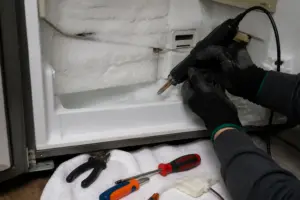
Remove the freezer’s back panel (4 × Phillips #2 screws) to expose the evaporator coils — the core of the cooling system. A thick layer of frost over the coils indicates a defrost system failure that’s trapping cold air inside the ice, while bare or oily coils suggest a refrigerant leak that needs attention from a licensed technician. If you find a solid block of ice, confirm defrost failure by manually defrosting with a hair dryer on low and checking if cooling resumes temporarily. Never chip ice off the coils; this could puncture the refrigerant tubing.
Step 3
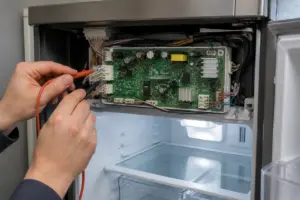
With the coils exposed, test the defrost heater using a multimeter set to Rx1 — a healthy heater should read 20–50Ω, and an open reading (OL) means it has burned out and needs replacing. Also, test the bi-metal defrost thermostat for continuity at room temperature; it should show a closed circuit at room temp. If it reads open, it has failed and must be replaced, as either one alone can cause the entire defrost cycle to fail.
Step 4
Locate the evaporator fan motor at the back of the freezer compartment and spin the blade by hand — it should rotate freely. A seized motor will prevent air from circulating from the freezer into the fresh food section, causing the warm-fridge-cold-freezer symptom. If the blade won’t spin or the motor hums without turning, replace the motor by removing 2 Phillips screws and disconnecting the harness clip; this is the most common repair for top-freezer not-cooling complaints. Also, check that nothing has fallen against the fan blade from inside the freezer, which could mimic a seized motor.
Step 5
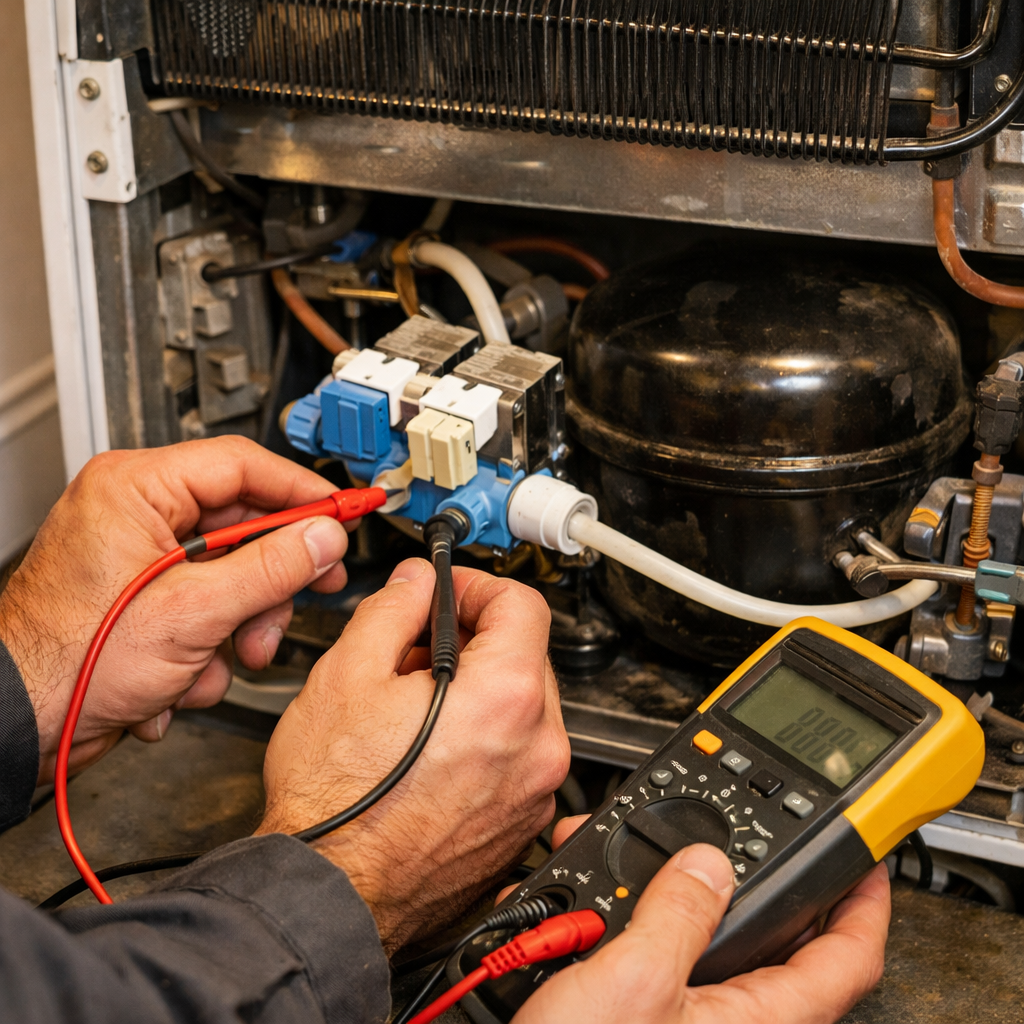
Pull the rear access panel on the back of the refrigerator (4 × ¼” hex screws) to reach the compressor start relay and overload protector, which are responsible for starting the compressor during each cooling cycle. Shake the start relay — a rattle indicates a broken internal component, and it must be replaced, as a failed relay prevents the compressor from starting. Test the overload protector on Rx1 for continuity; an open reading means it has tripped and needs replacement. However, a repeatedly failing overload can indicate an underlying compressor issue.
Step 6
Reassemble both panels, plug the unit back in, and allow up to 6 hours for temperatures to stabilize — compressors need time to pull both compartments down to operating temperature, so don’t judge the repair in the first hour. Confirm the freezer reaches 0°F and the fresh food section reaches 35–38°F using an appliance thermometer before considering the repair complete. If the compressor runs continuously but temperatures never recover after 6 hours, suspect a refrigerant leak or failing compressor and contact a certified technician.
Where to Buy Replacement Parts
- Maytag MRT311FFFZ defrost heater WPW10225581
- Maytag refrigerator evaporator fan motor WPW10189703
- Maytag refrigerator start relay W10613606
When to Call a Professional
If the issue persists after you’ve completed all steps above, the problem may involve the sealed refrigerant system, a failed main control board, or wiring that needs specialized diagnostic equipment. Contact a licensed appliance technician — attempting sealed-system repairs without proper certification is illegal and unsafe.
How Much Does This Repair Cost?
| Repair route | Typical cost |
|---|---|
| Do it yourself | $20–$150 (parts) |
| Professional repair | $150–$300 (parts and labor) |
DIY parts for fixing a not cooling issue on the Maytag MRT311FFFZ typically run between $20–$150, depending on whether you’re replacing a condenser fan motor, start relay, or thermistor. A professional service call usually costs $150–$300 once you factor in labor and diagnostic fees. Tackling this repair yourself can save you $100 or more.
Frequently Asked Questions
Why is my Maytag MRT311FFFZ freezer cold but the refrigerator section not cooling?
This is usually caused by a failed evaporator fan motor or a frosted-over evaporator coil blocking airflow between the two compartments. Check whether the fan is running and defrost the coils manually to confirm the issue.
How do I know if the start relay on my Maytag MRT311FFFZ is bad?
Remove the start relay from the compressor and shake it — a rattling sound indicates a failed relay that needs replacing. A bad relay prevents the compressor from running, stopping all cooling entirely.
Is it worth repairing a Maytag MRT311FFFZ that is not cooling, or should I replace it?
Most common cooling repairs, like replacing a fan motor or start relay, cost well under $150 and are worth doing. However, if the compressor itself has failed, replacement may be the more cost-effective option.
The Evaporator Fan Motor That Restores Airflow to Your MRT311FFFZ Freezer
When the fridge side stays warm while the freezer runs cold, nine times out of ten it’s the evaporator fan motor that’s failed — it’s responsible for pulling cold air from the freezer into the fresh food compartment. This is the part I usually replace first on this model when diagnosing a temperature imbalance.
What works
- Direct fit for the MRT311FFFZ — no adapter needed, just disconnect the old motor and snap the new one into the mounting bracket behind the back panel.
- Noticeably quieter than the original on many units I’ve replaced; if your fridge was making a grinding or whining noise before cooling loss, you’ll hear the difference immediately.
- Temperature recovery is fast — I typically see the fridge compartment drop back to the 35–40°F range within 2–3 hours after installation.
What doesn’t
- If the defrost system is the real culprit (ice buildup blocking airflow), swapping the fan motor alone won’t fix the problem — you’ll still see frost accumulation in the evaporator compartment.
- Installation requires removing the back panel and unplugging a wire connector; if you’re not comfortable working inside the refrigerator cabinet, this isn’t a five-minute swap.
I once ordered this part thinking it was a dead evaporator motor, only to discover the real issue was a stuck defrost damper — the motor itself was fine. Before you order, listen carefully: a truly failed motor usually stays silent, while a stuck damper often produces a quiet clicking or buzzing as the compressor tries to run. That said, if you’ve narrowed it down to fan failure, evaporator fan motor is the part that will get your fridge cooling again.
About This Article

Written by Dave Holt. Dave Holt has been taking apart and fixing household appliances since he was a teenager who couldn't leave a broken one alone. Eighteen years later, after fixing things for neighbors, friends, and anyone who'd let him, he's seen almost every failure mode there is. When he writes a repair guide here, it's based on the actual job, not a manufacturer overview. More about this site.
Scope and limits. Dave is a self-taught repairer, not a certified appliance technician. Unplug before you open anything, and leave sealed refrigeration systems, gas connections, and hardwired circuits to a qualified technician.