Ice maker stopped
In this step-by-step repair guide, I’ll walk you through fixing your ice maker stopped issue on the GE GTS22KSNRSS (Top Freezer). With the right tools and parts, most homeowners can complete this repair in 1–2 hours and avoid a costly service call.
🔨 Pro Tip from Dave
Before replacing parts on the GE GTS22KSNRSS, it’s crucial to check the freezer temperature. This unit needs to hold at or below 10°F for the ice maker to cycle properly. Also, the water inlet valve solenoid (part WR57X10051) is a frequent silent failure; it can test fine visually but still be too weak to open fully, so always check water flow pressure at the valve before condemning the ice maker assembly itself.
Part of our Top 20 Refrigerator Models & Common Repair Issues Guide. Browse all refrigerator repair guides for related models and issues.
Common Symptoms & Causes
If your GE GTS22KSNRSS ice maker has stopped working, you may notice one or more of the following telltale signs before the unit fails completely.
- The ice maker produces no ice cubes despite the freezer maintaining proper temperature
- The ice maker arm is in the down position but the unit remains completely silent
- You hear the water inlet valve click but no water fills the ice mold
- Existing ice in the bin melts and is never replaced with a fresh batch
These issues are most commonly caused by a failed ice maker assembly, a faulty water inlet valve, a defective ice maker module, or a worn door switch that interrupts power to the unit.
Safety First
- Unplug the refrigerator from the power outlet before starting any repair — never work on a live appliance.
- Shut off the water supply valve before disconnecting any water lines or hoses.
- Wear work gloves when handling metal brackets, sheet metal edges, or sharp components.
- Take photos with your phone before disconnecting any wiring harnesses or connectors.
- Work in a well-lit area with enough floor space to lay removed panels flat.
Tools & Parts Needed
Essential Tools
- Phillips #2 screwdriver
- ¼” nut driver
- Needle-nose pliers
- Multimeter
- Flashlight or work light
Replacement Parts
- GE ice maker module
- water inlet valve
- wire bail arm (shut-off)
- multimeter
Step-by-Step Repair Instructions
Step 1
Locate the wire bail arm on the right side of the ice maker — it acts as a simple on/off switch, and if it has been accidentally nudged upward (by overfilled ice or a shifted bin), the ice maker shuts off completely. Lower the bail arm to the horizontal position to resume production. This is the most common cause of a ‘stopped’ ice maker and costs nothing to fix.
Step 2
Check that your freezer is holding 0°F using a standalone thermometer, because the ice maker’s harvest thermostat will not initiate a cycle if the compartment is above 10°F. A warm freezer points to a separate sealed-system or evaporator fan issue that must be resolved before the ice maker will work. Pro tip: give the freezer 24 hours after any recent door-open events or restocking before condemning the ice maker itself.
Step 3
Remove the ice storage bin and reseat it firmly, making sure it slides fully into its guides. A misaligned or overfull bin physically lifts the bail arm into the OFF position, mimicking a failed ice maker when the unit is actually fine. While the bin is out, clear any clumped or bridged ice that could be blocking the ejector arm.
Step 4
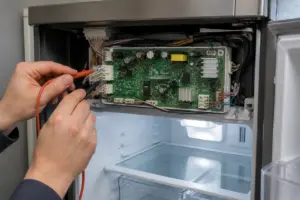
Disconnect power before proceeding, then remove the two Phillips screws securing the ice maker module and unplug the wire harness. Set your multimeter to Rx1 and probe the module’s winding terminals — a reading near zero or an open (OL) reading indicates a failed winding and the module must be replaced. A healthy winding shows low but measurable resistance; consult the GE tech sheet for the exact spec if available.
Step 5
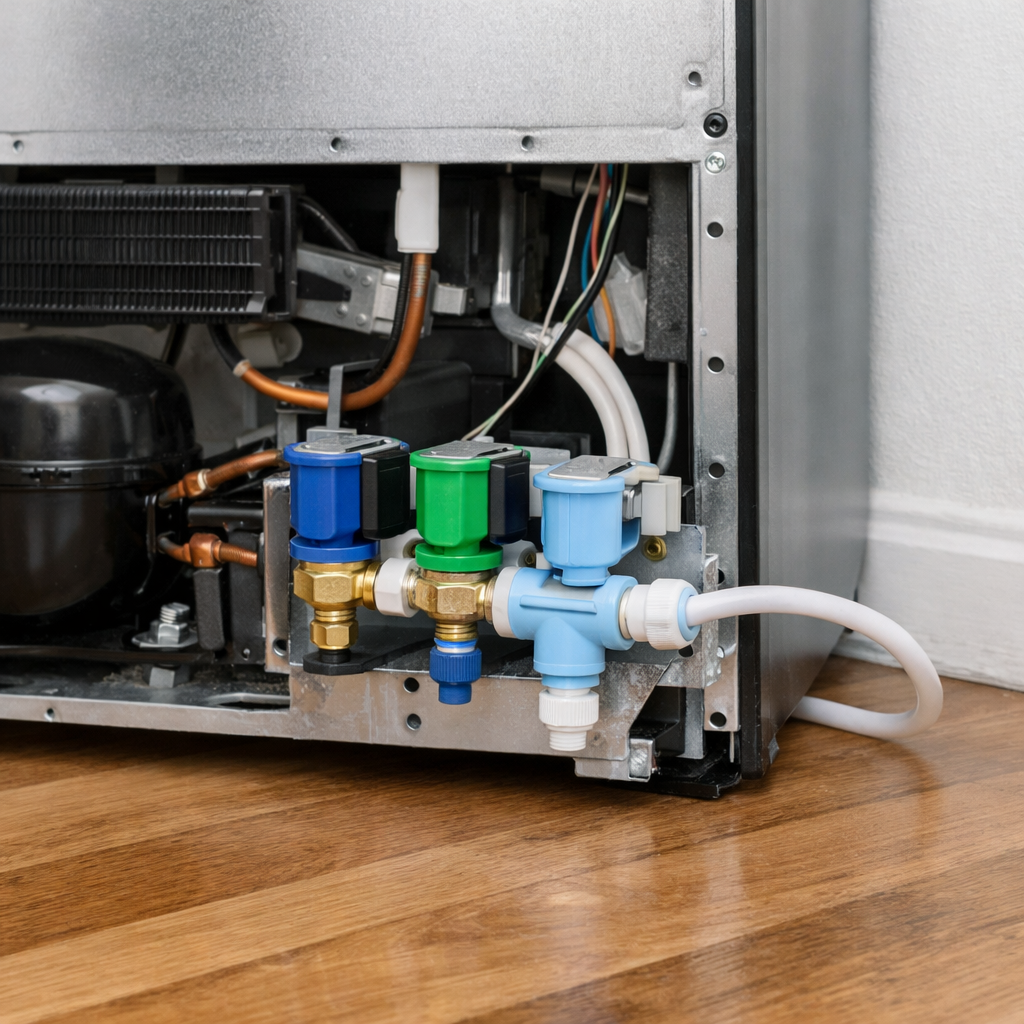
Pull the lower rear access panel (four 1/4-inch hex screws) to reach the water inlet valve, then disconnect power and the water supply before testing. Set your multimeter to resistance mode and probe the ice maker solenoid terminals on the valve — a reading outside the 200–500Ω target, or an open circuit, means the solenoid has failed and the valve assembly should be replaced. Safety note: always shut off the saddle valve or household water supply before disconnecting any water line to avoid flooding.
Step 6
Reassemble all components, restore water supply, and plug the refrigerator back in, then allow up to three hours for the freezer to restabilize and the ice maker to complete its first harvest cycle. If no ice is produced, trigger the built-in test cycle using the procedure on the GE service sheet, which is typically clipped inside the freezer wall panel behind the ice maker. A successful test cycle that produces ice confirms the unit is working; no movement during the test cycle points to a wiring or control board fault requiring further diagnosis.
Where to Buy Replacement Parts
- GE GTS22KSNRSS ice maker module WR30X10093
- GE refrigerator water inlet valve WR57X10032
- GE refrigerator ice maker wire bail arm replacement
When to Call a Professional
If the issue persists after completing all steps above, the problem may involve the sealed refrigerant system, a failed main control board, or wiring that requires specialized diagnostic equipment. Contact a licensed appliance technician — attempting sealed-system repairs without EPA 608 certification is illegal and unsafe.
How Much Does This Repair Cost?
| Repair route | Typical cost |
|---|---|
| Do it yourself | $20–$100 (parts) |
| Professional repair | $150–$300 (parts and labor) |
DIY replacement parts for a GE GTS22KSNRSS ice maker — such as a new ice maker assembly or water inlet valve — typically cost between $20 and $100. A professional repair service call usually runs $150 to $300 once labor is included. Tackling this repair yourself can save you $100 or more.
Frequently Asked Questions
Why did the ice maker on my GE GTS22KSNRSS suddenly stop making ice?
The most common causes are a tripped ice maker shutoff arm, a clogged water filter, or a frozen water supply line. Check these simple issues before assuming a major component has failed.
How do I know if the water inlet valve needs replacing?
If the freezer temperature is correct but no water enters the ice maker, the inlet valve is likely faulty. You can test it for continuity using a multimeter to confirm before purchasing a replacement.
Is this repair safe to do myself on the GE GTS22KSNRSS?
Most ice maker repairs on this model are DIY-friendly and require only basic tools. Always unplug the refrigerator and shut off the water supply before starting any repair work.
Recommended Products
These are the parts and tools I recommend for this repair, based on compatibility and customer reviews:
- GE Refrigerator Ice Maker Assembly
- Upgrade Ice Maker Dispenser Auger for GE Refrigerator Replacement Parts WR17X11705 WR17X11939 PS1018130 AP3849786 AP3672963 PS964350 Ice Bucket Auger
- BlueStars Upgraded WR57X10051 Refrigerator Dual Inlet Water Valve – Compatible with G.E, Hotpoint & Kenmore Refrigerators – Replaces WR57X10040 AP3672839 PS901314 IMV513 WR2X10105
- Upgraded WR57X10051 WR57X10032 Refrigerator Water Inlet Valve Compatible with GE Hotpoint Kenmore,Replacement For IMV513 AP3672839 PS901314 WR57X10064 WR57X10032 WR57X10040 4960236 AP6995571 WR57X0099
The Water Inlet Valve That Fixes Most Stopped Ice Makers on This Model
If your GTS22KSNRSS ice maker has power but isn’t filling with water, the water inlet valve is almost always the culprit—it either fails to open or gets stuck partially closed. This is the first part I replace on this model before touching the ice maker assembly itself.
What works
- Direct fit for the GTS22KSNRSS water line—no adapter hunting or cutting tubing to fit odd dimensions.
- Solenoid coil is identical to the OEM part, so if you hear a click when the ice maker cycles but still no water, this swap usually solves it immediately.
- Access is straightforward from the back of the fridge—you don’t need to pull the interior ice bucket or disassemble the door, which saves time and frustration.
What doesn’t
- Won’t fix a stopped ice maker if the problem is actually a frozen water line or clogged filter—check those first by running water through the dispenser.
- If your ice maker is cracked or the auger is seized, replacing the valve alone won’t restart production; you’ll need the full ice maker assembly too.
I’ve seen people order the ice maker assembly first thinking it was the obvious fix, only to find out the valve was the real problem—and then they still had to buy this part anyway. Turn off water at the source, drain the line, and grab the water inlet valve before you go deeper into the repair.
About This Article

Written by Dave Holt. Dave Holt has been taking apart and fixing household appliances since he was a teenager who couldn't leave a broken one alone. Eighteen years later, after fixing things for neighbors, friends, and anyone who'd let him, he's seen almost every failure mode there is. When he writes a repair guide here, it's based on the actual job, not a manufacturer overview. More about this site.
Scope and limits. Dave is a self-taught repairer, not a certified appliance technician. Unplug before you open anything, and leave sealed refrigeration systems, gas connections, and hardwired circuits to a qualified technician.