Frigidaire FFHT1821TS Drainage Problems: Complete Troubleshooting and Repair Guide
The Frigidaire FFHT1821TS is a reliable top-mount refrigerator, but like all refrigerators with automatic defrost systems, it relies on a drainage system to remove water created during the defrost cycle. When this drainage system fails, you’ll notice water pooling inside the fridge, ice buildup in the freezer, or puddles forming on your kitchen floor. This comprehensive guide walks you through diagnosing and fixing drainage problems on your FFHT1821TS.
Understanding Drainage Problems on the FFHT1821TS
Common Signs of Drainage Issues
Drainage problems on the Frigidaire FFHT1821TS manifest in several distinct ways that alert you to a system malfunction:
- Water pooling at the bottom of the fresh food section: You’ll notice standing water on the floor of the refrigerator, typically accumulating in the lowest areas or corners. This water has a stale smell and can cause food spoilage.
- Water leaking onto your kitchen floor: A puddle forms under the refrigerator, usually near the front or back legs. This indicates the defrost water is not being properly routed to the evaporation pan or drain system.
- Excessive frost and ice buildup in the freezer: The freezer section develops thick ice buildup on walls, shelves, and food items. This is a secondary symptom indicating that defrost water isn’t draining properly, causing humidity to refreeze.
- Water dripping from freezer compartment into fresh food section: You may see active dripping or wet areas on the bottom shelf of the refrigerator directly below the freezer section.
- Frost on the back wall of the fresh food section: Frost or ice formation on the interior back panel, particularly in the lower section, signals defrost system failure.
How the Defrost Drain System Works on the FFHT1821TS
Understanding your Frigidaire FFHT1821TS drainage system is essential for effective troubleshooting. The system works through a series of interconnected components:
The defrost cycle: Multiple times per day, the FFHT1821TS automatically enters a defrost cycle where the evaporator coil (located on the back wall of the freezer section) is warmed slightly. This melts frost that has accumulated on the coil.
Water collection and drainage: The melted water drips downward into a small drain hole, typically located on the freezer floor near the back wall. On the FFHT1821TS, this drain hole is usually positioned at coordinates approximately 4-6 inches from the rear panel and centered left-to-right.
Drain tube pathway: From the freezer drain hole, water enters a vinyl drain tube that runs down the back exterior of the refrigerator. This tube connects to a second drain tube that terminates in the evaporation pan (also called the drain pan) located beneath the refrigerator, typically under the compressor compartment.
Evaporation pan function: The evaporation pan collects defrost water. Heat from the compressor naturally warms this pan, causing the water to evaporate rather than accumulating. On a properly functioning FFHT1821TS, the pan remains mostly dry or contains only a small amount of residual water.
Diagnosing the Specific Problem
Clogged Defrost Drain Hole: The Most Common Issue
The defrost drain hole on your Frigidaire FFHT1821TS is the most common failure point. This hole, which measures approximately 3/8 inch in diameter, becomes blocked by ice, food particles, or mineral deposits. When clogged, water cannot drain from the freezer floor, causing it to back up into the fresh food section.
How to identify a clogged drain hole: Look at the freezer floor of your FFHT1821TS. You should see a small drain opening—this is where water exits the freezer during the defrost cycle. Place your hand near this hole and feel for air movement when the compressor is running. You can also attempt to locate the drain visually by looking for a small circular opening, often positioned near the rear wall.
What causes clogging: Ice naturally forms around the drain hole opening, occasionally blocking it completely. Food particles, frost crystals, and mineral deposits from water also accumulate in the drain passage.
Step-by-Step: Clearing a Clogged Defrost Drain Hole
- Unplug the FFHT1821TS from the electrical outlet. Wait 5 minutes to allow any residual charge to dissipate.
- Remove all food items from the freezer section to access the freezer floor. Place perishable items in a cooler with ice.
- Remove the freezer shelves and baskets by gently lifting and sliding them out. Note their positions for reinstallation.
- Prepare a hot water and baking soda solution: Mix 2 tablespoons of baking soda with 2 cups of hot (not boiling) water in a container. The baking soda acts as a gentle abrasive and deodorizer.
- Locate the drain hole on the freezer floor. On the FFHT1821TS, this opening is typically positioned 4-6 inches from the rear panel. Look for a small round hole, often with frost around it.
- Use a turkey baster to flush the drain: Fill the turkey baster with the hot baking soda solution. Insert the baster tip directly into the drain hole and squeeze firmly. Repeat 5-6 times, allowing liquid to flow into the drain between applications. You may hear gurgling sounds, which indicates water is flowing through the drain tube.
- Follow with hot water rinse: Using the same turkey baster, flush the drain hole 3-4 times with plain hot water to clear any remaining baking soda residue.
- Clear the exterior drain tube: On some FFHT1821TS models, you can access the drain tube from beneath the refrigerator. See the section below on “Clearing the Exterior Drain Tube” for detailed instructions.
- Reinstall all components: Replace the freezer baskets and shelves in their original positions. Plug the FFHT1821TS back in and allow it to run for 2 hours before reloading with food.
- Monitor the freezer floor for the next 24 hours. The floor should remain dry or contain only trace moisture.
What if the drain remains clogged? If hot water and baking soda don’t clear the blockage, the ice plug may be too solid. Try this advanced technique: With the FFHT1821TS unplugged and empty, pour a small container of warm (80-90°F) water into the drain hole and wait 15 minutes. This allows ice to soften slightly. Then repeat the turkey baster flushing method.
Clearing the Exterior Drain Tube on the FFHT1821TS
The vinyl drain tube that connects the interior freezer drain to the exterior evaporation pan can also become clogged. This tube runs down the back of the refrigerator.
- Unplug the FFHT1821TS and ensure it has been unpowered for at least 5 minutes.
- Pull the refrigerator away from the wall carefully, using furniture sliders to avoid floor damage. Leave enough space to access the back panel—typically 12-18 inches.
- Locate the drain tube: Looking at the back of the FFHT1821TS, identify the vinyl drain tube. It’s typically white or clear and runs from the top rear area (where it connects to the interior freezer drain) downward to the evaporation pan area. The tube diameter is usually 3/8 inch.
- Trace the tube to where it enters the evaporation pan: Follow the tube downward until it connects to the drain pan assembly beneath the refrigerator.
- Disconnect the drain tube: Gently pull the tube away from its connection points. On the FFHT1821TS, the tube typically inserts into a rubber grommet fitting. Hand-pull with a gentle twisting motion—do not use pliers, which can crack the tube.
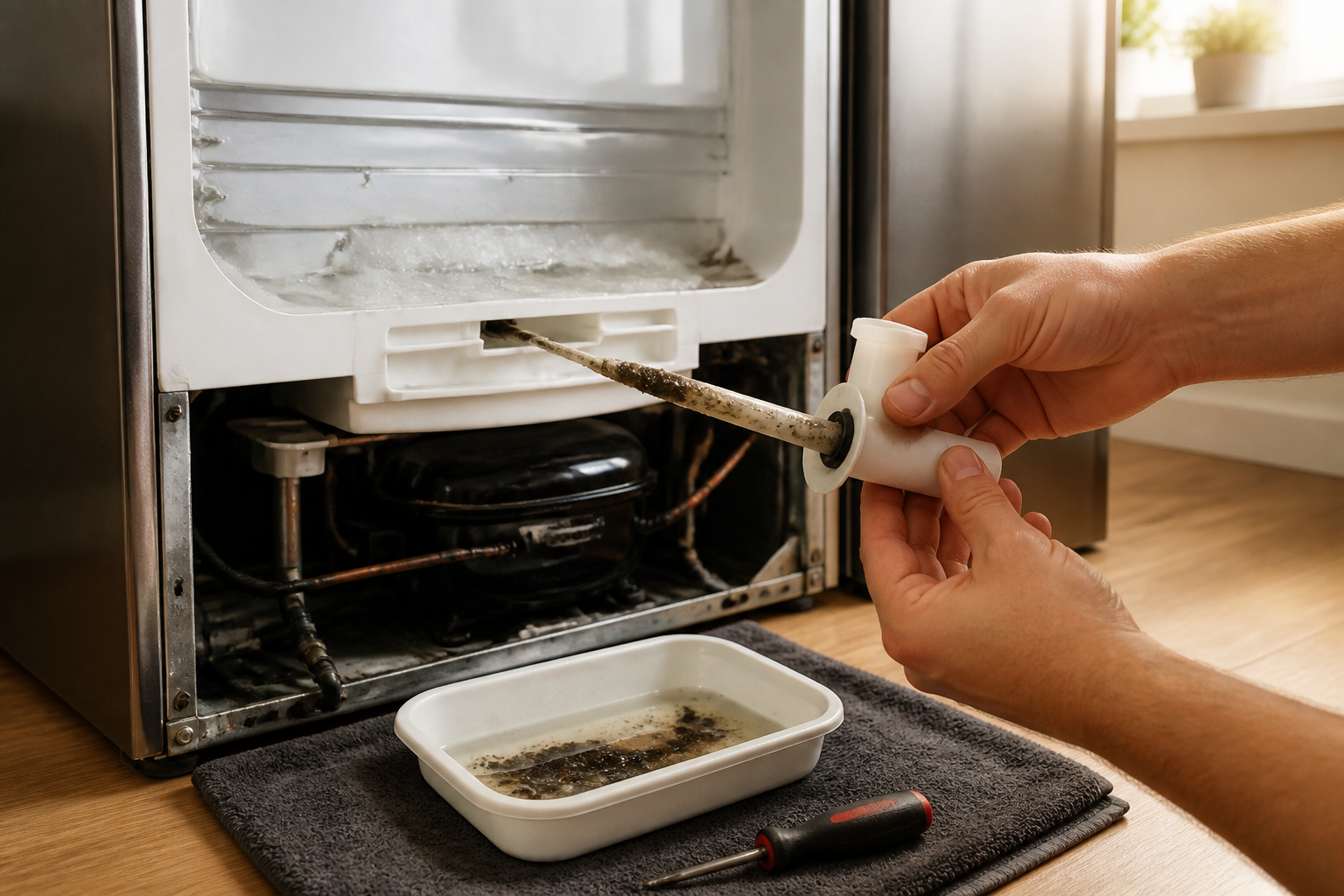
- Flush the drain tube: Using a turkey baster filled with hot water, flush the tube from the upper end, allowing water to flow out the bottom end into a bucket. Repeat 8-10 times. You may see sediment, mineral deposits, or ice fragments expelled.
- Use a plumbing snake if necessary: If water doesn’t flow freely, the blockage is solid. A 1/4-inch plumbing snake (available at hardware stores) can be carefully fed through the tube to break up ice plugs or mineral buildup. Feed the snake slowly and don’t force it.
- Reconnect the drain tube: Once cleared, reinsert the tube into its rubber grommet connection, ensuring it sits firmly and won’t slip out during operation.
- Inspect the connection for leaks: With the refrigerator still unplugged, manually pour a small amount of water into the interior freezer drain hole. Observe whether water flows through the tube into the pan without leaking from connection points. If leaking occurs at the connection, the rubber grommet may need replacement.
- Push the refrigerator back into place and plug in the FFHT1821TS.
Checking the Drain Heater on Your FFHT1821TS
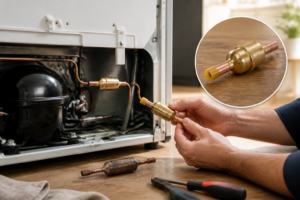
Some Frigidaire FFHT1821TS models include a small heating element in the drain tube designed to prevent ice from forming in the drain. If your model has this feature, the heater can fail, causing water to freeze in the drain tube during cold periods.
Identifying if your FFHT1821TS has a drain heater: Look at the drain tube where it exits the refrigerator cabinet on the back. If you see a small cylindrical component (approximately 2 inches long and 1/2 inch in diameter) with electrical wire connections, your model has a drain heater. Consult your FFHT1821TS manual or contact Frigidaire customer service to confirm.
Testing the drain heater: This requires a multimeter set to the ohms (resistance) setting. Unplug the FFHT1821TS, then carefully disconnect the electrical connectors on the heater element. Touch the multimeter probes to the heater terminals. A working heater shows a resistance reading between 20-100 ohms. A reading of infinity (or no continuity) indicates the heater is burned out and requires replacement.
If the heater is faulty: The heater element is a replaceable part. The part number for most FFHT1821TS models is available through Frigidaire parts suppliers. Replacement involves disconnecting electrical connectors and unbolting the heater from the drain tube assembly. Installation is the reverse process—connect electrical terminals securely and ensure the heater element is positioned directly on the drain tube to provide even heat.
Inspecting and Cleaning the Evaporation Pan
The evaporation pan (drain pan) located beneath your Frigidaire FFHT1821TS can develop its own problems that prevent proper drainage.
Accessing the Evaporation Pan
- Unplug the FFHT1821TS from the electrical outlet.
- Pull the refrigerator away from the wall using furniture sliders, creating 18-24 inches of clearance.
- Remove the access panel: The front bottom of the FFHT1821TS typically has a removable kick plate or access panel. This may be held by clips or a few screws. Carefully remove it to expose the compressor compartment and evaporation pan area.
- Locate the drain pan: The evaporation pan is usually a rectangular plastic container positioned beneath the compressor. It’s typically white or beige and measures approximately 18 inches long and 10 inches wide, with a depth of 3-4 inches.
- Visually inspect the pan for the following conditions.
What to Look For in the Evaporation Pan
- Cracks or breaks in the plastic: Even small cracks allow water to escape instead of evaporating, causing floor leaks beneath the FFHT1821TS.
- Separation of pan seams: The pan may have been dislodged or the seal compromised, allowing water to seep from connection points.
- Excessive water accumulation: A healthy evaporation pan should contain little to no water. If water pools more than 1/2 inch deep, the pan isn’t draining properly or the drain tube inlet is clogged.
- Algae or mold growth: Black or green slime on the interior surfaces indicates biological growth from stagnant water, suggesting poor evaporation and possible drain obstruction.
- Sediment or mineral buildup: White or tan crusty deposits indicate hard water mineral accumulation in the pan.
Cleaning the Evaporation Pan on Your FFHT1821TS
- With the FFHT1821TS unplugged, carefully slide the evaporation pan out from beneath the refrigerator. It should pull straight out from the side or front, depending on your model’s configuration.
- Empty any standing water into a sink or bucket.
- Prepare a cleaning solution: Mix 1 part white vinegar with 3 parts water in a bucket. Vinegar dissolves mineral deposits and kills mold and algae.
- Soak the pan: Place the evaporation pan in a bathtub or large sink filled with the vinegar solution for 30 minutes. This softens mineral and biological buildup.
- Scrub thoroughly: Using a soft brush or non-abrasive scrub pad, scrub the interior surfaces of the pan, paying special attention to corners and the drain inlet opening. Remove all visible deposits and slime.
- Rinse completely: Rinse the pan multiple times under hot running water until all vinegar odor is gone and water runs clear.
- Dry the pan: Allow the pan to air dry completely before reinstalling, or dry with a clean cloth.
- Inspect the drain inlet: While the pan is removed, look for the drain tube connection point on the underside. Ensure the tube inlet is clear and unobstructed. If necessary, flush this inlet with hot water using a turkey baster.
- Reinstall the pan: Slide the clean evaporation pan back under the FFHT1821TS until it seats fully. Ensure it’s level—a tilted pan won’t drain effectively.
Cracked Evaporation Pan: Replacement Instructions
If your inspection reveals cracks in the evaporation pan of your FFHT1821TS, the pan must be replaced. A leaking pan cannot be effectively repaired.
- Order a replacement evaporation pan from a Frigidaire parts supplier using your FFHT1821TS model number. The part number is typically available in your refrigerator’s manual.
- With the FFHT1821TS unplugged, remove the old pan by sliding it out from beneath the refrigerator.
- Disconnect the drain tube from the pan’s inlet by gently pulling or unscrewing the connection, depending on your model’s design.
- Position the new pan in the same location beneath the refrigerator, ensuring it sits level.
- Reconnect the drain tube to the inlet on the new pan, pushing firmly until the connection is secure.
- Verify proper positioning: The pan should be fully seated and level. Ensure no water can escape from the sides or back.
- Plug in the FFHT1821TS and monitor the pan for 24 hours of operation to confirm proper drainage.
Testing After Repair: 24-Hour Monitoring Protocol
After performing any drainage repair on your Frigidaire FFHT1821TS, proper testing is essential to confirm the fix is successful and prevent future water damage.
Immediate Post-Repair Inspection
- Plug in the FFHT1821TS and allow the compressor to run for 10 minutes to initiate a defrost cycle.
- Check the freezer floor for any water accumulation. A small amount of moisture is normal, but standing water indicates the problem persists.
- Look underneath the refrigerator for any leaking water on the kitchen floor.
- Listen for unusual sounds such as water splashing or gurgling, which might indicate the drain tube is directing water to an unintended location.
24-Hour Extended Monitoring
- Allow the FFHT1821TS to operate normally for a full 24 hours with the door opening and closing naturally during this period.
- Check the freezer floor every 6 hours for water accumulation. Use a cloth to wipe the floor and assess moisture levels.
- Inspect beneath the refrigerator twice during this period (at 12 hours and 24 hours) for floor leaks.
- Visually inspect the evaporation pan, if accessible, to confirm water is collecting properly. The pan may contain water, but it should be minimal—typically less than 1/4 inch in depth.
- Check food items in the freezer for any frost or ice buildup. Properly functioning FFHT1821TS models maintain minimal frost on food.
- If conditions are normal after 24 hours, the repair is successful. Reload the
Recommended Parts & Tools
Refrigerator Defrost Drain Line Cleaning Kit
This specialized cleaning kit includes flexible tubing and brush attachments designed to clear ice and debris from the defrost drain line on your Frigidaire refrigerator. A clogged drain is the primary cause of drainage problems, and this tool makes it easy to dislodge blockages without damaging the line. Check current pricing on Amazon.
Plastic Drain Pan Replacement for Frigidaire Refrigerators
The drain pan under your refrigerator collects condensation from the defrost cycle, and cracks or deterioration can cause water leaks and pooling. This OEM-compatible replacement pan ensures proper water collection and drainage into your home’s plumbing system. Check current pricing on Amazon.
HVAC Flush and Cleaning Liquid for Refrigerant Lines
This safe, non-corrosive flushing solution helps clear mineral deposits and sediment buildup from defrost drain lines that regular water cannot remove. Using this product as part of your maintenance routine can prevent future clogs and drainage issues. Check current pricing on Amazon.
The Drain Line Cleaning Kit That Actually Clears Frozen FFHT1821TS Blockages
If you’ve confirmed water isn’t draining from the defrost system, a clogged drain line is almost always the culprit—and trying to flush it with hot water alone rarely works when ice or mineral buildup is involved. This kit gives you the right tools to push through blockages without damaging the plastic tubing that Frigidaire uses on this model.
What works
- The flexible tubing and brush attachments fit the tight, angled drain passages in the FFHT1821TS without forcing or kinking the line—I’ve snapped drain tubing before by using rigid tools.
- Includes a hand pump that provides steady, controlled pressure; you can actually feel when the blockage breaks free instead of blasting through with compressed air and accidentally cracking the drain pan.
- The mild flushing solution removes mineral deposits and ice that simple hot water leaves behind, so the drain stays clear longer after the initial fix.
What doesn’t
- If your drain line is completely separated from the drain pan fitting, this kit won’t reattach it—you’ll need to locate and reseat the tubing first, which sometimes requires removing the kick plate and lower back panel.
- The solution bottles are small; if you have multiple clogs or a heavily fouled system, one kit might not be enough for a thorough flush on the first pass.
I’ve made the mistake of diagnosing a water pooling issue as a failed drain pan when the real problem was just a blockage three inches into the line—I replaced the pan unnecessarily before cleaning the line on a second look. Save yourself that step and grab the Refrigerator Defrost Drain Line Cleaning Kit first if water is backing up inside the fridge.
This post contains affiliate links. As an Amazon Associate, I earn from qualifying purchases at no extra cost to you.