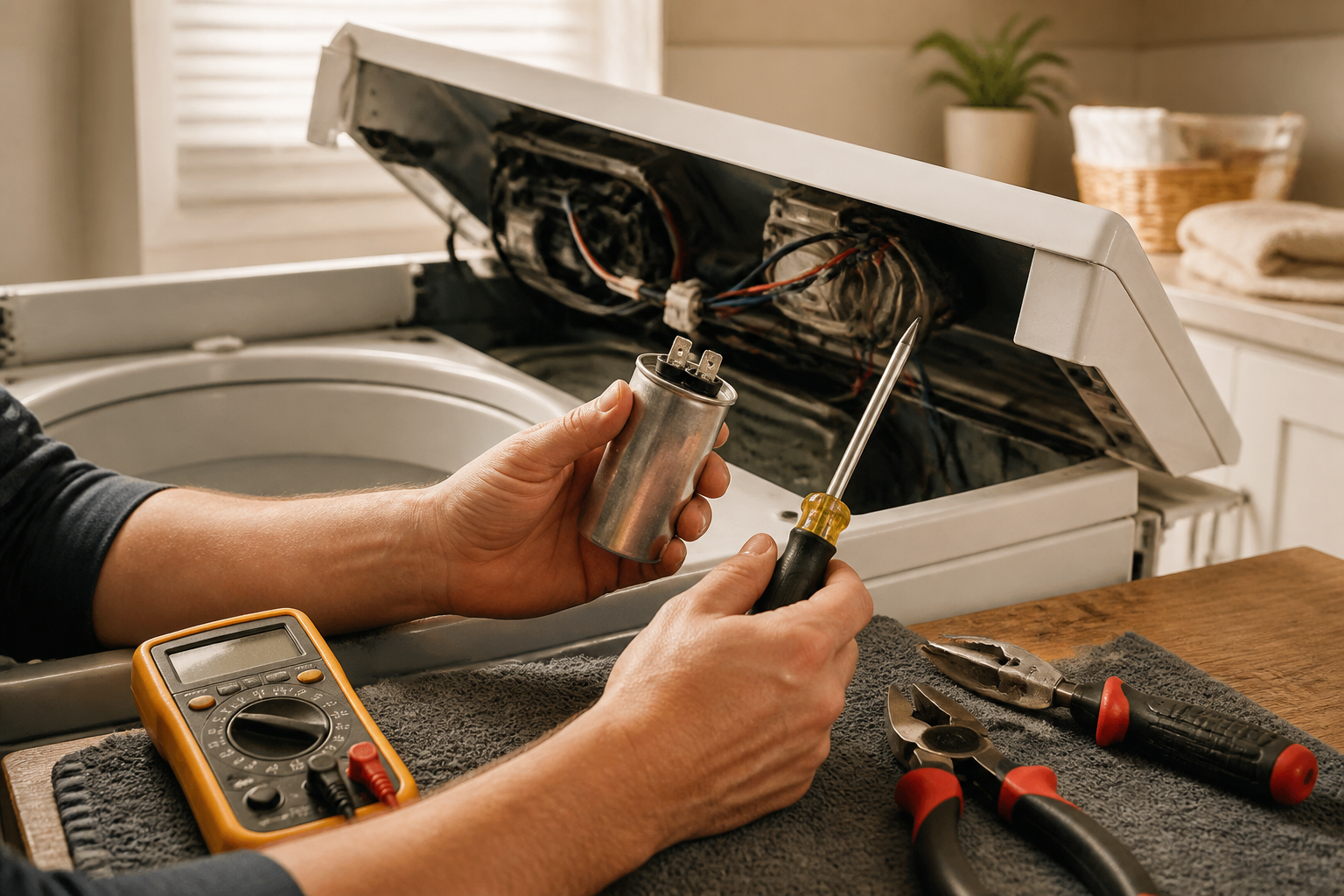
⚠️ Critical Safety Warning: Speed Queen Capacitors Hold Dangerous Electrical Charge
YES – Speed Queen capacitors can hold a potentially lethal electrical charge even when the appliance is unplugged. This stored electrical energy can deliver a dangerous shock that can cause serious injury or death. Never touch capacitor terminals without first safely discharging the component. Even after being disconnected from power for several minutes, capacitors in Speed Queen washers and dryers can retain enough charge to cause harm.
- Always disconnect power at the circuit breaker, not just the wall outlet
- Wait at least 5 minutes after disconnecting power before beginning work
- Use insulated tools rated for electrical work
- Wear rubber-soled shoes and avoid working in damp conditions
- Never touch both capacitor terminals simultaneously
- Always discharge capacitors before handling or testing
Understanding Capacitor Charge Retention in Speed Queen Appliances
Capacitors are electrical components that store energy in an electric field between two conductive plates. In Speed Queen washers and dryers, capacitors serve critical functions in motor operation, but this energy storage capability means they can retain dangerous voltage levels long after the appliance is unplugged.
How Long Do Speed Queen Capacitors Hold a Charge?
The duration a capacitor holds its charge depends on several factors:
- Start Capacitors (15-30 μF): Can hold charge for 1-5 minutes in optimal conditions
- Run Capacitors (5-15 μF): May retain charge for 5-15 minutes or longer
- Dual Run Capacitors (combination units): Can hold charge for 10-30 minutes
- Environmental factors: Humidity, temperature, and capacitor age affect discharge time
Important: Even a “quick” 1-2 minute retention period can deliver enough energy to cause serious injury. Never assume a capacitor is safe to handle based on time alone.
Types of Capacitors in Speed Queen Appliances
Speed Queen uses different capacitor types depending on the model and motor configuration:
Start Capacitors: Provide extra torque during motor startup, typically 15-30 μF at 330V. Found in older Speed Queen top-load washers and some dryer models. These disconnect after the motor reaches operating speed via a centrifugal switch.
Run Capacitors: Remain in the circuit during operation to maintain proper motor phase relationships. Common values are 5-15 μF at 370V or 440V. Used in permanent split capacitor (PSC) motors found in newer Speed Queen front-load washers and most dryer models.
Dual Run Capacitors: Combine start and run functions in a single unit with multiple terminals. Often labeled with two capacitance values like “40/5 μF” for fan and compressor circuits in some commercial-grade Speed Queen units.
Safe Capacitor Discharge Procedures
Before touching any capacitor in your Speed Queen appliance, you must safely discharge stored energy. There are two accepted methods:
Method 1: Insulated Screwdriver Discharge
- Ensure power is disconnected at the circuit breaker
- Use a screwdriver with fully insulated handle rated for electrical work
- Hold the insulated portion only – never touch the metal shaft
- Carefully touch the screwdriver blade across both capacitor terminals simultaneously
- You may see a small spark – this is normal and indicates discharge
- Repeat 2-3 times to ensure complete discharge
Method 2: Resistor Discharge (Recommended)
- Use a 20,000-ohm, 2-watt resistor with insulated test leads
- Connect resistor leads across capacitor terminals
- Hold for 5-10 seconds to allow gradual discharge
- This method is safer as it prevents sparking and component damage
Warning: Never use metal objects like pliers or uninsulated tools for discharge. Never short terminals with wire or other conductors, as this can damage the capacitor or create dangerous arcing.
Capacitor Locations in Speed Queen Models
Speed Queen Top-Load Washers
In models AWN432, AWN542, TC5000WN, and similar top-load units:
- Remove the rear panel or top cabinet (depending on model year)
- Capacitor is typically mounted on the motor housing or nearby bracket
- Look for a cylindrical or oval component with wire terminals
- Common location: Lower right side of the motor assembly
- May be enclosed in a metal housing labeled “CAPACITOR”
Speed Queen Front-Load Washers
In models AFN50, FF7005SN, AFNE9000VW, and similar front-load units:
- Access typically requires removing the top panel and rear service panel
- Capacitor location: Mounted on or near the motor at the bottom rear of the unit
- May be integrated into the motor’s electrical box
- Some models have the capacitor in a separate housing connected via wire harness
Speed Queen Electric Dryers
In models ADG3, ADE3, DR5000WE, and similar electric dryer models:
- Remove the lint filter and top panel
- Capacitor typically mounted on the motor housing or blower assembly
- Common location: Center-rear of the unit, accessible from the top
- May be a dual-run capacitor serving both drum motor and blower fan
Speed Queen Gas Dryers
In models ADG3LRG, SDGX071, and similar gas units:
- Capacitor usually serves the blower motor only
- Location: Mounted on blower housing, typically top-center of unit
- Access via top panel removal after disconnecting gas supply
Identifying Bad Capacitor Symptoms
Capacitor failure in Speed Queen appliances presents specific symptoms that help diagnose the problem:
Motor-Related Symptoms
- Humming without starting: Motor energizes but doesn’t turn, often indicates start capacitor failure
- Slow or weak starting: Motor struggles to reach normal speed, suggesting capacitor degradation
- Intermittent operation: Motor starts sometimes but not others, common with failing run capacitors
- Overheating: Motor runs hot due to improper phase relationships from bad run capacitor
- Reduced performance: Weak spin cycles or poor agitation in washers, poor airflow in dryers
Visual Inspection Signs
- Bulging or swollen case: Indicates internal pressure from failed dielectric
- Leaking oil or fluid: Brown or clear fluid around capacitor base
- Burned or blackened terminals: Evidence of overheating or arcing
- Cracked housing: Physical damage that compromises internal components
- Corrosion on terminals: Green or white buildup affecting electrical connections
Testing Speed Queen Capacitors with a Multimeter
Proper capacitor testing requires a digital multimeter with capacitance measurement capability. Here’s the complete testing procedure:
Required Equipment
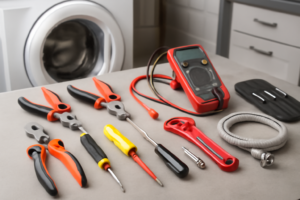
- Digital multimeter with capacitance function (μF measurement)
- Insulated test leads
- Safety equipment (rubber gloves, safety glasses)
- Discharge resistor or insulated screwdriver
Testing Procedure
- Safety first: Disconnect power and safely discharge the capacitor
- Disconnect wiring: Remove wire terminals from capacitor (photograph connections first)
- Set multimeter: Select capacitance mode (μF or microfarad)
- Test start capacitor: Place meter leads on capacitor terminals
- Read measurement: Should be within 10% of rated value printed on capacitor label
- Test run capacitor: Same procedure, checking against labeled specifications
- Check for shorts: Switch meter to resistance mode – should show infinite resistance initially, then gradually decrease as internal components charge meter’s test voltage
Interpreting Test Results
Good Capacitor:
- Capacitance within 10% of rated value
- No physical damage or leakage
- Resistance test shows initial high resistance that gradually decreases
Bad Capacitor:
- Capacitance more than 20% above or below rated value
- Zero capacitance reading (open circuit)
- Resistance test shows immediate low resistance (short circuit)
- Physical damage, swelling, or leakage
Step-by-Step Capacitor Replacement
Tools and Materials Needed
- Replacement capacitor (exact microfarad and voltage ratings)
- Screwdriver set (Phillips and flathead)
- Wire nuts or crimp connectors
- Digital camera or smartphone for reference photos
- Electrical tape
- Multimeter for verification
Replacement Procedure
- Power disconnect: Turn off circuit breaker and unplug appliance
- Access capacitor: Remove necessary panels following model-specific procedures
- Document connections: Photograph wire connections before disconnecting
- Discharge safely: Use proper discharge method described earlier
- Remove old capacitor: Disconnect wires and remove mounting bracket
- Install new capacitor: Mount replacement in same position and orientation
- Connect wiring: Attach wires to proper terminals using reference photos
- Secure connections: Ensure all connections are tight and properly insulated
- Test installation: Verify proper motor operation before reassembling panels
- Final verification: Run complete wash or dry cycle to confirm repair
Critical Installation Notes
Voltage Rating: Always match or exceed the original voltage rating. Using 440V capacitor to replace 370V is acceptable, but never use lower voltage.
Capacitance Value: Must match exactly. A 15 μF capacitor cannot be replaced with 20 μF without potential motor damage.
Terminal Configuration: Some capacitors have specific terminal arrangements. Ensure proper wire placement to maintain motor rotation direction.
Speed Queen Model-Specific Considerations
Commercial vs. Residential Models
Speed Queen’s commercial laundry equipment often uses higher-rated capacitors than residential models:
- Commercial washers: May use 440V capacitors vs. 370V in residential units
- Stack units: Often have separate capacitors for washer and dryer components
- Coin-operated models: May include additional capacitors for control circuits
Newer Electronic Control Models
Speed Queen models with electronic controls (manufactured after 2018) may have:
- Motor control modules that include capacitor functions
- Different access procedures due to integrated components
- Diagnostic modes accessible through control panels
- Warranty considerations for DIY repairs
Frequently Asked Questions
How long should I wait after unplugging my Speed Queen washer before working on the capacitor?
Wait a minimum of 5 minutes after disconnecting power, but always safely discharge the capacitor before handling regardless of time elapsed. Capacitors can hold charge for much longer than 5 minutes, especially in dry conditions. The only safe approach is to properly discharge the component using an insulated screwdriver or discharge resistor.
Can I replace a Speed Queen capacitor with a higher microfarad rating?
No, never replace a capacitor with a different microfarad rating. Using a higher capacitance value can cause the motor to draw excessive current, overheat, and suffer permanent damage. Always match the exact microfarad rating printed on the original capacitor. Voltage rating can be higher (370V replaced with 440V) but capacitance must be exact.
What voltage should I expect when testing a charged Speed Queen capacitor?
A fully charged capacitor in a Speed Queen appliance can retain 200-400 volts depending on the model and capacitor type. This voltage is dangerous and potentially lethal. Never test voltage on a potentially charged capacitor – always discharge it safely first, then perform capacitance and resistance testing with the capacitor removed from the circuit.
Why does my Speed Queen dryer capacitor keep failing?
Repeated capacitor failure usually indicates an underlying problem: motor bearings creating excessive load, voltage fluctuations in home electrical supply, overheating due to blocked venting, or incorrect capacitor replacement. Check motor operation, verify proper voltage supply (240V for dryers), ensure adequate ventilation, and confirm replacement capacitors match original specifications exactly.
Can I bypass the capacitor temporarily to test my Speed Queen motor?
Never bypass or eliminate the capacitor in a Speed Queen appliance. The capacitor is essential for proper motor operation and phase relationships. Running a motor without its required capacitor will cause overheating, poor performance, and potential motor damage. If testing motor function, use a known-good replacement capacitor rather than bypassing the component entirely.
How do I know if my Speed Queen has a start capacitor, run capacitor, or both?
Check the motor nameplate and wiring diagram, usually located on the motor housing or inside the electrical panel. Start capacitors are typically larger (15-30 μF) and may have three terminals if connected through a relay. Run capacitors are usually smaller (5-15 μF) and permanently connected. Some Speed Queen models use dual-run capacitors with multiple capacitance values labeled on a single unit.
What should I do if I accidentally touch a charged Speed Queen capacitor terminal?
If you receive an electrical shock from a capacitor, immediately disconnect from the source and assess your condition. Capacitor shocks can cause muscle contractions, burns, or heart rhythm disruptions. Seek immediate medical attention if you experience chest pain, irregular heartbeat, difficulty breathing, or burns. Even if you feel fine, consider consulting a healthcare provider, especially if you have any pre-existing heart conditions.
Are Speed Queen capacitor part numbers interchangeable between washer and dryer models?
Speed Queen capacitors are not universally interchangeable between different appliance types. Washers and dryers have different motor requirements and load characteristics. Always verify the exact part number, capacitance value, voltage rating, and terminal configuration before substituting. Using an incorrect capacitor can damage the motor or create safety hazards, even if the physical size appears similar.
When to Call a Professional
Most of the repairs in this guide are within reach for a careful DIYer with basic tools. In my experience, if you’ve discharged the capacitor and the motor still won’t start, hums loudly, or trips the breaker immediately, that’s the point where the diagnosis has moved beyond the capacitor itself and into motor winding or control board territory — and that’s when you want a certified tech with a multimeter and motor load tester on site rather than guessing your way through an expensive component swap. When in doubt, a diagnostic service call typically costs $80–$120 and can save you from a misdiagnosis that costs more in parts.
Recommended Parts & Tools
Speed Queen Washer Start Capacitor 35MFD 370V
This genuine Speed Queen replacement capacitor is the exact part you’ll need if testing reveals your original capacitor has failed. The 35MFD 370V rating is the most common specification for Speed Queen washers and ensures proper motor starting performance. Check current pricing on Amazon.
Fluke 117 Electrician’s True RMS Multimeter
A quality multimeter is essential for safely testing capacitor voltage and verifying it has fully discharged before handling. This Fluke model provides accurate readings and has the safety features needed for appliance electrical work. Check current pricing on Amazon.
Klein Tools 1000V Insulated Screwdriver Set
These insulated screwdrivers are crucial for safely working around electrical components like capacitors that may hold a charge. The 1000V rating provides protection while the comfortable grip ensures precise control when connecting capacitor terminals. Check current pricing on Amazon.