
Ice Maker Not Making Ice – Samsung RF27T5201SR French Door Refrigerator Repair
The ice maker in the Samsung RF27T5201SR French Door Refrigerator often faces failure, predominantly stemming from issues with water supply, electrical components, or mechanical blockages. Typical culprits include a faulty water inlet valve, a defective ice maker assembly, frozen water lines, or issues with the control board connections. Depending on which component needs attention, the repair can range from MODERATE to ADVANCED difficulty. This ice maker system is located in the upper left section of the fresh food compartment, comprising various interconnected components working together to produce ice cubes. With basic electrical knowledge and tools, many homeowners can successfully diagnose and repair common ice maker issues, though some repairs may require professional refrigerant handling.
Symptoms
- No ice cubes are produced despite the ice maker being turned on and adequate water pressure being available.
- Sounds of the ice maker cycling occur, but no ice drops into the collection bin.
- Water fills the ice maker mold, but the freezing process never completes or the ice doesn’t eject.
- Ice maker produces hollow, malformed, or cloudy ice cubes consistently.
- Error codes are displayed on the ice maker control panel, or the ice maker LED indicator remains off.
- Water leaks from the ice maker assembly onto the refrigerator floor or shelves below.
⚠️ Safety Warning
Before starting any repair work on your Samsung RF27T5201SR, ensure to disconnect the refrigerator from electrical power by unplugging it or switching off the dedicated circuit breaker. Never attempt electrical repairs while the unit is energized, as this refrigerator operates on 115V AC current, posing serious injury or death risks. The ice maker system has both electrical components and pressurized water lines, creating electrical shock hazards if water contacts live wires. When removing panels or components, keep in mind that the Samsung RF27T5201SR weighs around 350 pounds, and improper weight distribution could cause it to tip. Always enlist a second person when moving or tilting the refrigerator. Use safety glasses when working around small components, and insulated tools when testing electrical connections with a multimeter.
Parts Needed
- Samsung Ice Maker Assembly – Part Number DA97-15217A (complete ice maker unit for RF27T5201SR)
- Water Inlet Valve – Part Number DA62-03819A (dual solenoid valve, 120V AC)
- Ice Maker Wire Harness – Part Number DA39-00006V (8-pin connector harness)
- Water Filter Head Assembly – Part Number DA97-17376B (if water flow issues are detected)
- Ice Maker Fill Cup – Part Number DA63-06741A (plastic water directing cup)
- Temperature Sensor – Part Number DA32-00006W (thermistor for ice maker temperature monitoring)
Tools Required
- Phillips head screwdriver (magnetic tip recommended for small screws)
- Flathead screwdriver (1/4 inch width for prying connectors)
- Digital multimeter capable of measuring AC/DC voltage and resistance
- Needle-nose pliers for manipulating wire connections in tight spaces
- Flashlight or headlamp for illuminating interior compartments
- Hair dryer or heat gun for thawing frozen water lines
- Towels and a shallow pan for collecting water during disassembly
Step-by-Step Instructions
Step 1: Access the Ice Maker Assembly
🔨 Pro Tip from Dave
On the RF27T5201SR, Samsung’s ice maker has a built-in test cycle — press and hold the Test button on the ice maker module for about 3 seconds until you hear a chime. Watch the full cycle play out; the exact point where it stalls or fails will indicate which component is at fault before you’ve even touched a single part. Many technicians skip this critical step and end up replacing parts unnecessarily.
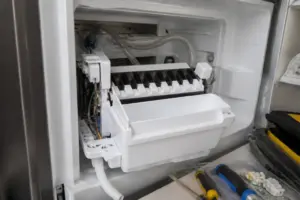
Clear out all items from the upper left section of the Samsung RF27T5201SR fresh food compartment where the ice maker is mounted. Ensure the ice maker power switch located on the left wall of the refrigerator compartment is in the ON position. Lift the ice bin straight up and out of the compartment. You’ll then see the white plastic ice maker assembly attached to the left wall, secured by four visible Phillips head screws. The wire harness connector will be at the bottom rear of the ice maker unit, featuring an 8-pin white plastic connector.
Step 2: Test Power Supply to Ice Maker
With the refrigerator still plugged in and running, carefully access the wire harness connector at the bottom of the ice maker assembly. Using your multimeter set to AC voltage, test between pins 1 and 2 of the connector (the leftmost pins when viewing from the front). You should see approximately 120V AC when the ice maker is in a fill cycle. If you measure no voltage, the issue may be with the main control board or wiring harness. Check continuity through the wire harness by disconnecting it and measuring resistance between corresponding pins at both ends.
Step 3: Remove Ice Maker Assembly
Ensure to disconnect power to the Samsung RF27T5201SR completely before proceeding. Disconnect the 8-pin wire harness by gently pulling the white plastic connector straight out from the ice maker assembly. Remove the four Phillips head screws securing the ice maker to the left wall. These screws are typically 1/4 inch long and may be coated with thread-locking compound. Carefully slide the ice maker assembly forward and out of the mounting bracket, being cautious of the water fill tube connection at the top rear of the unit.
Step 4: Inspect Water Fill System
Examine the clear plastic water fill tube connecting to the top of the ice maker assembly. This tube should be free of ice blockages and properly seated in the fill cup assembly. Lift the fill cup straight up from the ice maker; it should come out easily without tools. Look for cracks in the fill cup or mineral deposits that could obstruct water flow. The fill cup should direct water into the center four cavities of the ice maker mold first, then overflow into the remaining outer cavities.
Step 5: Test Ice Maker Motor and Harvest Mechanism
With the ice maker assembly removed, find the small test button on the front right side (usually orange or red). Press and hold this test button for 5-10 seconds to initiate a manual harvest cycle. The ice maker should complete a full rotation within 3-4 minutes, with the rake mechanism rotating counterclockwise to sweep ice from the mold. If the motor fails to operate or makes grinding noises, the internal gear assembly has failed, necessitating the replacement of the entire ice maker assembly.
Step 6: Check Water Inlet Valve Operation
The water inlet valve for the Samsung RF27T5201SR is located behind the refrigerator at the bottom rear panel. Remove the lower rear access panel by unscrewing six Phillips head screws around the perimeter. The dual solenoid water valve is mounted to the left side of the compressor compartment with two water lines connected (one to the ice maker, one to the water dispenser). Test the valve while the refrigerator is unplugged: detach the two-wire connector from each solenoid and measure across its coil terminals with your multimeter set to ohms. Each coil should read within the specified range on the Samsung service sheet—typically a few hundred ohms—while an OL reading indicates the coil is open, and a near-zero reading signals it is shorted. Once both coils confirm good readings, restore power, refit the panel, and run a normal water dispense, allowing the ice maker to fill; the control board should energize each coil in turn, delivering around 8 ounces per minute.
Step 7: Test Temperature Sensor and Thermostat
Locate the small temperature sensor (thermistor) attached to the bottom of the ice maker mold using thermal paste or a metal clip. This sensor should measure approximately 16,000 ohms resistance at 0°F and 5,000 ohms at 32°F when tested with your multimeter. If resistance readings deviate more than 10% from these parameters, replace the temperature sensor. This sensor prevents the ice maker from attempting to harvest ice before it’s fully frozen, protecting the rake mechanism from damage.
Step 8: Check Water Filter and Pressure
A clogged water filter can restrict flow to the ice maker in the Samsung RF27T5201SR. To inspect, remove the water filter located in the upper right corner of the fresh food compartment by turning it counterclockwise 1/4 turn. Install a bypass cap (provided with the refrigerator) and check ice maker operation for 24 hours. If ice production improves, it’s time to replace the water filter. Water pressure to the refrigerator should be between 35-120 PSI—pressure below 35 PSI will obstruct proper ice maker filling.
Step 9: Reassemble and Test System
Reinstall the ice maker assembly by reversing the removal steps, ensuring the water fill tube is properly seated and the wire harness connector clicks securely into place. Replace all four mounting screws and tighten them firmly, but avoid overtightening, as this can crack the plastic mounting tabs. Restore power to the Samsung RF27T5201SR and let the ice maker go through two complete cycles before expecting ice production. The first cycle fills with water, while the second should produce the initial batch of ice cubes.
Step 10: Verify Proper Operation
Keep an eye on the ice maker for 48 hours to ensure it operates consistently. Under normal conditions, the Samsung RF27T5201SR ice maker should produce about 8 pounds of ice per 24-hour period. Confirm that ice cubes are well-formed, clear in appearance, and drop cleanly into the ice bin without sticking to the rake mechanism. Additionally, verify that the ice maker stops producing ice when the bin is full and resumes when ice is removed.
Troubleshooting
- If the ice maker remains non-functional after replacing components, check the main control board connections and consider board replacement, as the control board may not be sending proper signals to the ice maker components.
- Hollow or malformed ice cubes typically indicate insufficient water fill time—adjust fill time by replacing the control module or checking for partial water line blockages.
- If the ice maker operates but the ice tastes off or appears cloudy, replace the water filter and flush the water system by dispensing 3 gallons through the water dispenser.
- If there’s continuous water leaking from the ice maker, it usually indicates a cracked water fill cup or damaged ice maker mold, requiring a complete assembly replacement.
- The ice maker may cycle but never drop ice, indicating a faulty harvest thermistor or a mechanical jam in the rake assembly that requires motor replacement.
- If ice production is slower than normal but the ice maker functions, ensure the ambient temperature around the refrigerator stays below 80°F and that the refrigerator isn’t overloaded, affecting airflow.
When to Call a Professional
- If you suspect refrigerant leaks or if the refrigerator isn’t maintaining proper temperatures along with ice maker problems, as refrigerant handling requires EPA certification.
- When main control board replacement is necessary, as this requires programming and calibration specific to the Samsung RF27T5201SR model.
- If water inlet valve replacement necessitates moving the refrigerator and you’re unable to safely maneuver the 350-pound unit.
- When multiple systems are failing simultaneously, indicating potential electrical problems that require comprehensive diagnosis and repair.
When to Call a Professional
Most repairs in this guide are achievable for a careful DIYer with basic tools. From my experience, if you’ve already replaced the water inlet valve and ice maker assembly and the unit isn’t producing ice, that’s the time to call a tech. You’re likely dealing with a control board communication fault or a wiring harness issue that requires live-voltage diagnostic testing and manufacturer wiring diagrams for safe tracing. When in doubt, a diagnostic service call typically costs $80–$120 and can save you from a misdiagnosis that leads to higher parts costs.
Recommended Parts & Tools
Samsung DA97-15217D Refrigerator Ice Maker Assembly
This genuine Samsung ice maker assembly is tailored specifically for French door refrigerators, including the RF27T5201SR model. If your ice maker has completely stopped working or is producing malformed ice cubes, replacing the entire assembly often resolves the issue. This OEM part guarantees perfect compatibility with your Samsung refrigerator’s ice-making system.
Samsung DA62-01477A Water Filter HAF-CIN/EXP
A clogged or expired water filter is one of the most common causes of ice maker problems in Samsung refrigerators. This genuine Samsung water filter is compatible with the RF27T5201SR and should be replaced every six months to maintain proper water flow to the ice maker. Installing a fresh filter can often restore ice production when the ice maker stops working due to water flow restrictions.
The Ice Maker Assembly That Actually Solves the Samsung RF27T5201SR No-Ice Problem
If you’ve ruled out the water inlet valve and confirmed that water is reaching the ice maker housing, the assembly itself has likely failed internally—it could be a cracked fill tube, a dead motor for the ejector arm, or a thermostat that has gone bad. This might seem like a last resort, but it’s the right move when diagnostics indicate that the issue lies with the ice maker module rather than upstream water supply problems.
What works
- A genuine Samsung part ensures that the fill tube diameter and freeze cycle timing match the fridge’s control board expectations—preventing ice from backing up or the trays from being underfilled.
- Comes with the ejector arm and motor already installed, so you won’t have to troubleshoot mechanical binding or motor polarity issues during assembly.
- Direct bolt replacement with three fasteners and two water connections—no rewiring or bracket modifications are necessary for this model.
What doesn’t
- You’ll need to drain the fridge or have towels ready, as the water line disconnects directly from the assembly—water will drip from the old unit during removal.
- This won’t fix problems upstream like a clogged water filter or a failed inlet valve solenoid, so confirm those components are functioning before ordering this assembly.
I’ve had owners order this part after I diagnosed it over the phone, only to call back frustrated because the real issue was a $20 water filter that hadn’t been changed in four years—mineral deposits were restricting fill. Don’t be that call. If water is flowing to the ice maker and the assembly motor sounds dead or the tray won’t cycle, this is your part. Samsung DA97-15217D Refrigerator Ice Maker Assembly
About This Article

Written by Dave Holt. Dave Holt has been taking apart and fixing household appliances since he was a teenager who couldn't leave a broken one alone. Eighteen years later, after fixing things for neighbors, friends, and anyone who'd let him, he's seen almost every failure mode there is. When he writes a repair guide here, it's based on the actual job, not a manufacturer overview. More about this site.
Scope and limits. Dave is a self-taught repairer, not a certified appliance technician. Unplug before you open anything, and leave sealed refrigeration systems, gas connections, and hardwired circuits to a qualified technician.