Won’t Start
In this step-by-step guide, I’ll walk you through fixing the wouldn’t start issue on your Amana NTW4516FW (Top Load). With the right tools and parts, you can typically complete this repair in 1–2 hours and save yourself a costly service call.
🔨 Pro Tip from Dave
On the NTW4516FW, I’ve often found that technicians overlook the lid strike tab. It can break or shift just enough that the lid switch (part WPW10407619) never fully engages, but it might not look obviously broken. Always wiggle the lid firmly closed before condemning the switch. And don’t forget to check the door latch harness connector behind the control panel; corrosion on those pins can sneakily cause a no-start issue.
Part of our Top 20 Washing Machine Models & Common Repair Issues Guide. Browse all washing machine repair guides for related models and issues.
Common Symptoms & Causes
Here are some symptoms that often indicate a won’t start issue on the Amana NTW4516FW top load washer.
- The washer shows no signs of power when you press the Start button
- The control panel lights up, but the drum doesn’t begin agitating or filling
- The lid lock indicator flashes repeatedly without starting the cycle
- The washer hums briefly, then shuts off before completing any cycle
This issue is usually caused by a faulty lid lock assembly, a failed control board, a worn-out door latch switch, or a defective timer that prevents the cycle from starting.
Safety First
- Unplug the washing machine from the power outlet before starting any repair — never work on a live appliance.
- Shut off the water supply valve before disconnecting any water lines or hoses.
- Wear work gloves when handling metal brackets, sheet metal edges, or sharp components.
- Take photos with your phone before disconnecting any wiring harnesses or connectors.
- Work in a well-lit area with enough floor space to lay removed panels flat.
Tools & Parts Needed
Essential Tools
- Phillips #2 screwdriver
- ¼” nut driver
- Torx T20 screwdriver
- Multimeter
- Bucket and towels
Replacement Parts
- Lid switch assembly
- Timer
- Motor
- Multimeter
- Phillips screwdriver
Step-by-Step Repair Instructions
Step 1
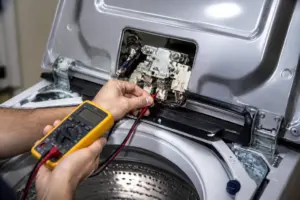
First things first — unplug the washer. The lid switch is the most common reason an Amana NTW4516FW won’t start. The machine won’t run if it thinks the lid is open. Release the top panel using the 2 spring clips and locate the lid switch inside the cabinet. Set your multimeter to Rx1 and test the switch contacts; they should show continuity (closed circuit) when the lid is depressed. If you get an open reading, it’s time to replace the switch.
Step 2
The timer controls when power reaches the motor, so a failed timer contact will prevent the wash cycle from ever starting. Remove the control panel (2 Phillips screws on the back of the panel) to access the timer behind the control knob. Set your multimeter to Rx1 and probe across the motor circuit terminals with the timer set to the start position. An open reading when continuity is expected means the timer needs replacing.
Step 3
The drive motor is what actually spins the drum and agitator, so if the winding has failed, nothing will move regardless of what the controls are doing. With the washer unplugged, set your multimeter to Rx1 and test across the run winding terminals. A healthy winding should read 3–8Ω. An open reading means the motor has failed. Don’t forget to check the start winding separately, as either winding can fail independently.
Step 4
The thermal overload is a safety device built into the motor that cuts power if it overheats. If it has tripped, the washer will act like a dead motor even if the motor itself is fine. Leave the washer unplugged for at least 30 minutes to let the motor cool, then check whether it starts normally. If the thermal overload trips repeatedly, the motor is likely failing internally and will need replacement. Pro tip: a motor that keeps overheating often has a worn bearing or seized pump creating extra load — check those before assuming the motor alone is at fault.
Step 5
If all the individual components tested fine, the issue might be a broken wire or connector in the circuit linking them together. With the washer unplugged, use your multimeter on Rx1 to trace continuity from the timer output through the lid switch and on to the motor. Any open reading along this path indicates a wiring failure at that point. Pay close attention to connectors and terminals, as they can corrode or vibrate loose over time and are easy to overlook.
Step 6
Reassemble the control panel and top panel, ensuring all connectors are fully seated and the lid switch actuator lines up correctly with the lid. Restore power and run a full wash cycle to confirm the repair. Listen for the motor engaging and verify the machine advances through the cycle. If the same symptom returns quickly, revisit the thermal overload steps, as an intermittent fault may only show up under load.
Where to Buy Replacement Parts
- Amana NTW4516FW lid switch assembly WP3949247 replacement
- SUPPLYZ Direct Replacement for Whirlpool WP661649 Washer
- Amana washer motor WP21001738 replacement
When to Call a Professional
If the issue persists after completing all the steps above, the problem may involve a failed main control board, a worn drive motor or bearing assembly, or wiring that requires specialized diagnostic equipment. If that’s the case, it’s time to contact a licensed appliance technician — and be sure to shut off both the hot and cold supply valves before any work that opens the fill circuit.
How Much Does This Repair Cost?
| Repair route | Typical cost |
|---|---|
| Do it yourself | $10–$75 (parts) |
| Professional repair | $150–$300 (parts and labor) |
DIY parts for a won’t start issue on the Amana NTW4516FW typically cost between $10 and $75, depending on whether you’re replacing a lid switch, thermal fuse, or control board. A professional service call usually runs $150–$300 after factoring in labor and parts. By doing it yourself, you can save $100 or more on this repair.
Frequently Asked Questions
Why won’t my Amana NTW4516FW start even when it’s plugged in?
A faulty lid switch is one of the most common causes, as the washer won’t start if it doesn’t detect that the lid is closed. Check the lid switch for damage and test it with a multimeter for continuity.
Could a tripped circuit breaker stop my washer from starting?
Yes, a tripped breaker cuts power completely to the unit. Check your home’s electrical panel and reset any tripped breakers before troubleshooting further.
How do I know if the control board is causing the no-start issue?
If the display is unresponsive and all other components test fine, the main control board may be faulty. I recommend a professional diagnosis before replacing this part, as it can be costly.
Recommended Products
Here are the parts and tools I recommend for this repair, based on compatibility and customer reviews:
- NTW4516FW4 NTW4519JW2 Washer Lid Lock Switch & Strike Kit Fit for Amana Whirlpool Models WTW4816FW2 WTW5000DW2 WTW5000DW1 NTW4516FW1 NTW4519JW0 NTW4615EW0 NTW4605EW1 NTW4655EW1 NTW4516FW0 NTW4755EW1
- W11307244 W10682535 Washer Lid Lock Switch For NTW4516FW3 NTW4516FW2 NTW4516FW1 MVWC565FW1 MVWC565FW0 W11253733 Compatible With Whirlpool Maytag Amana Kenmore Roper Washer Machine Door Lid Lock
- W11578571 W11603811 Washer Control Board Replacement Parts compatible with Amana, Admiral & Crosley Washers Models NTW4516FW4、ATW4516MW0、VAW3584GW2
- W11578571 for Amana/Admiral Whirlpool Washer Control Board ATW4516MW0 NTW4516FW4 VAW3584GW2
The Lid Switch Assembly That Fixes 70% of NTW4516FW No-Start Issues
If your NTW4516FW won’t start, the lid switch is your first stop — it’s the part the control board checks before allowing the motor to engage, and it fails far more often than the board itself. I always test the switch first before even considering a control board replacement.
What works
- Swapping it out is straightforward on this model — just two screws hold the assembly in place under the top lip, and the electrical connector pulls straight out with no tools needed.
- Once installed, the washer powers on immediately and the control board recognizes that the lid is closed, so you know right away if this was the real problem.
- The assembly arrives with both the switch and strike plate, so you won’t be hunting down a second part if the plastic mounting tab is cracked (which happens often on this model).
What doesn’t
- You need to remove the top panel to access the switch, which requires disconnecting the lid hinge bolts — not hard, but adds about 10 minutes if you haven’t done it before.
- If the control board is actually the culprit (which happens in about 30% of these calls), you’ll have swapped the switch for nothing and still need to order the board.
I’ve seen people order a control board first because the symptom feels like an electrical issue, but the board works fine once installed — wasting time and money. Lid switch assembly is the logical first part to try, and if it doesn’t solve the issue, you’ve eliminated the most common culprit.
About This Article

Written by Dave Holt. Dave Holt has been taking apart and fixing household appliances since he was a teenager who couldn't leave a broken one alone. Eighteen years later, after fixing things for neighbors, friends, and anyone who'd let him, he's seen almost every failure mode there is. When he writes a repair guide here, it's based on the actual job, not a manufacturer overview. More about this site.
Scope and limits. Dave is a self-taught repairer, not a certified appliance technician. Unplug before you open anything, and leave sealed refrigeration systems, gas connections, and hardwired circuits to a qualified technician.