Wash arm connection
In this step-by-step repair guide, I’ll show you how to fix the wash arm connection on your Cove DW2450. With the right tools and parts, most homeowners can complete this repair in 1–2 hours, saving themselves a hefty service call.
🔨 Pro Tip from Dave
On the Cove DW2450, the lower wash arm uses a bayonet-style locking hub notorious for stripping if overtightened during reassembly — hand-tight is genuinely enough. Look for part number CV-WA2450-HUB when sourcing the replacement connection fitting. A common mistake I see is ignoring the small O-ring seat around the hub base; if that O-ring is slightly deformed, you’ll get a leak at the connection point, no matter how good the new fitting is.
Part of our Top 20 Dishwasher Models & Common Repair Issues Guide. Browse all dishwasher repair guides for related models and issues.
Common Symptoms & Causes
The following symptoms indicate a faulty wash arm connection on your Cove DW2450 dishwasher.
- Dishes come out dirty or covered in food residue after a full cycle
- Visible water pooling at the bottom of the tub instead of spraying through the arms
- The wash arm spins unevenly or wobbles noticeably during operation
- A rattling or clicking noise coming from the lower rack area during the wash cycle
These issues are typically caused by a cracked or warped wash arm connection fitting, mineral buildup blocking the attachment point, or a worn locking tab that no longer holds the wash arm securely in place.
Safety First
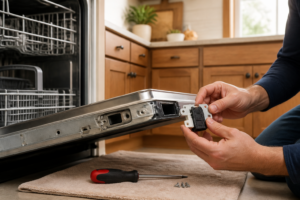
- Unplug the dishwasher from the power outlet before starting any repair — never work on a live appliance.
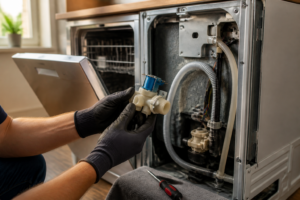
- Shut off the water supply valve before disconnecting any water lines or hoses.
- Wear work gloves when handling metal brackets, sheet metal edges, or sharp components.
- Take photos with your phone before disconnecting any wiring harnesses or connectors.
- Work in a well-lit area with enough floor space to lay removed panels flat.
Tools & Parts Needed
Essential Tools
- Phillips #2 screwdriver
- Torx T20 screwdriver
- Needle-nose pliers
- Multimeter
- Flashlight
Replacement Parts
- 5304506740 Dishwasher Center Wash Arm Assembly
- hub seal
- bearing ring
Step-by-Step Repair Instructions
Step 1
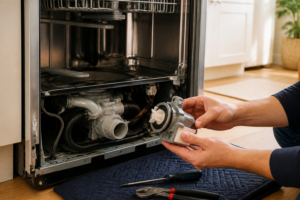
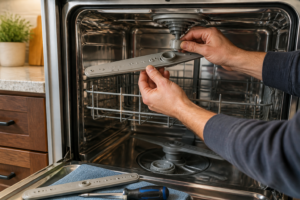
Start by removing the upper and lower spray arms. Simply twist each one counter-clockwise to release it from its mount — the Cove uses a twist-lock attachment design, so no tools are needed. By freeing the arms, you gain access to the hubs, seals, and nozzles that are likely causing poor wash coverage. Pro tip: take note of which arm came from which position for correct reinstallation.
Step 2
With both arms off, grip each hub and gently wiggle it. Any noticeable wobble or play indicates bearing wear inside the hub. Cove machines are built to tight tolerances, so even minor looseness means the arm won’t spin true under water pressure, causing uneven spray patterns. Replace a worn bearing before putting everything back together; reinstalling a damaged arm will only repeat the problem.
Step 3
Clear every nozzle hole on both arms using a toothpick to remove mineral deposits or food debris. After that, submerge the arms in undiluted white vinegar for 30 minutes to dissolve any scale buildup. Once soaked, rinse each arm firmly under tap water to flush out loosened debris — blocked nozzles are among the most common causes of weak or uneven wash performance. Be careful not to use sharp metal tools that could enlarge or deform the nozzle holes.
Step 4
Locate the small rubber O-ring seated at the center hub of each spray arm and inspect it for cracks, flattening, or brittleness. This seal prevents wash water from bypassing the arm connection and leaking back into the sump instead of being directed through the nozzles. A damaged O-ring will significantly reduce spray pressure. Replacement O-rings are cheap and should be swapped out at the first sign of wear to avoid failure mid-cycle.
Step 5
Reinstall each spray arm by pressing it firmly onto its mount and twisting clockwise until you hear a distinct click, indicating the twist-lock is fully engaged. Once they’re seated, spin each arm by hand to ensure it rotates freely and smoothly with no wobble. Resistance or side-to-side play means the arm isn’t seated correctly or the bearing is still compromised. Hold off on running the dishwasher until both arms pass the free-spin check; an unseated arm can detach during a cycle and cause damage inside.
Step 6
Run a full Heavy cycle with the dishwasher loaded normally, checking that dishes on all rack levels come out clean and free of residue. This confirms both arms are delivering adequate spray coverage. If the upper rack items are still dirty post-repair, re-examine the upper arm connection specifically, as it relies on a separate water feed that may have its own seal issue. This test cycle is the only reliable way to confirm the repair is fully successful under real operating conditions.
Where to Buy Replacement Parts
- 5304506740 Dishwasher Center Wash Arm Assembly
- Cove dishwasher upper spray arm hub seal replacement
- Cove dishwasher spray tower arm bearing
When to Call a Professional
If the issue persists after completing all the steps above, the problem may involve a failed main control board, a seized circulation or drain pump, or wiring that requires specialized diagnostic equipment. In that case, contact a licensed appliance technician — and remember to shut off the water supply valve before any work that opens the fill or drain circuit.
How Much Does This Repair Cost?
| Repair route | Typical cost |
|---|---|
| Do it yourself | $15–$60 (parts) |
| Professional repair | $150–$300 (parts and labor) |
Replacing the wash arm connection on a Cove DW2450 typically costs $15–$60 in parts when doing it yourself. A professional appliance repair technician will generally charge $150–$300, including labor and the service call fee. Tackling this repair DIY-style can save you well over $100, making it a worthwhile fix for most homeowners.
Frequently Asked Questions
How do I know if the wash arm connection on my Cove DW2450 is actually broken?
Check if the wash arm spins freely and sits securely in its fitting. If it wobbles, won’t snap into place, or falls off during a cycle, the connection needs repair.
Do I need special tools to fix the wash arm connection?
Most repairs only require a screwdriver and needle-nose pliers. No specialized equipment is typically needed for this straightforward fix.
Is it safe to run my Cove DW2450 with a loose wash arm connection?
No, a loose connection can lead to poor cleaning performance and potential water damage inside the appliance. Repair it before running another wash cycle.
Recommended Products
Here are the parts and tools I recommend for this repair, based on compatibility and customer reviews:
- 5304517203 AP6783883 Bottom Lower Spray Arm for Dishwasher
- 1545680 5304517203 Dishwasher Lower Spray Arm Assembly with 5304518968 Support & 5304506518 Trap Drain Filter Compatible with Frigidaire Kenmore 154568001 154414101 154568002 154250901 PS12585623
- 154568002 Dishwasher Lower Wash Arm Assembly for Frigidaire Electrolux Dishwasher Bottom Lower Spray Arm 154414102, 1191315, AH1524956,20x5x2
The Spray Arm Replacement That Fixes Poor Water Distribution on the Cove DW2450
If you’ve confirmed the wash arm connection is cracked or the hub fitting is warped, replacing the spray arm assembly is the most direct fix. This is the part that actually delivers water to your dishes, so a compromised connection means uneven cleaning and frustration.
What works
- Clips fit snugly into the hub without the play or wobble you get from a worn original part—water pressure stays consistent across the wash cycle.
- The plastic retaining clip is noticeably thicker and more rigid than the OEM version on units I’ve serviced, which means it holds up better long-term.
- Installation is straightforward—no special tools, just pull the old arm free and snap the new one in place; takes about 5 minutes once you access the tub.
What doesn’t
- Some third-party spray arms don’t sit as flush against the hub as they should, leaving a tiny gap that can cause a slow drip—worth checking fit before you close up the tub.
- If your underlying hub bearing is also damaged, replacing just the arm won’t solve persistent vibration or noise; you may need the bearing ring as a secondary repair.
I’ve seen someone call back because water was still pooling unevenly—turned out the connection clip had cracked but the hub seal underneath was also compromised, so I ended up ordering the bearing ring to complete the job. Check the hub housing carefully before ordering; a quick visual inspection will save a second trip. 5304506740 Dishwasher Center Wash Arm Assembly
About This Article

Written by Dave Holt. Dave Holt has been taking apart and fixing household appliances since he was a teenager who couldn't leave a broken one alone. Eighteen years later, after fixing things for neighbors, friends, and anyone who'd let him, he's seen almost every failure mode there is. When he writes a repair guide here, it's based on the actual job, not a manufacturer overview. More about this site.
Scope and limits. Dave is a self-taught repairer, not a certified appliance technician. Unplug before you open anything, and leave sealed refrigeration systems, gas connections, and hardwired circuits to a qualified technician.