Door Not Closing
This guide will walk you through diagnosing and repairing a door that won’t close properly on your Whirlpool WMH31017FS over-the-range microwave. I’ve tackled this issue countless times, and I’ll cover the most common mechanical causes, the parts likely needing replacement, and provide clear step-by-step instructions to get your microwave sealing correctly again. Most homeowners with basic mechanical comfort can complete this repair in 1 to 2 hours using common household tools.Common Symptoms & Causes
Before diving into repairs, let’s ensure your issue matches one of these typical failure patterns for the WMH31017FS:- Door swings open or pops back open after pressing it shut
- Door feels loose or misaligned and doesn’t sit flush against the cabinet
- Latch clicks but microwave still won’t start due to a door interlock not engaging
- One side of the door appears lower or higher than the other when closed
Safety First
- Unplug the microwave from the wall outlet or switch off the dedicated circuit breaker before starting any work
- Wear work gloves throughout — sheet metal edges inside the door frame can be sharp
- Photograph all wiring connections and component positions before disconnecting anything
- Work in a well-lit space; over-the-range units are mounted high, so use a stable step stool or ladder
Tools & Parts Needed
Essential Tools
- Phillips head screwdriver (#2)
- Flat head screwdriver for prying plastic clips
- Needle-nose pliers
- Torx T-20 screwdriver bit
- Stable step stool or ladder
Replacement Parts
- Door latch hook assembly
- Door closing spring
- Door interlock switch (W10269458)
Step-by-Step Repair Instructions
🔨 Pro Tip from Dave
On the WMH31017FS, the door switch actuation sequence is crucial — if you reinstall the switches in the wrong order or seat one even slightly crooked, the unit will blow the inline fuse when you test it, leading to a second repair. Always photograph the exact position and orientation of each switch before disconnecting anything, and use a cheap multimeter to confirm continuity on each new switch before reassembling the cabinet.
Step 1: Unplug and Prepare the Work Area
Disconnect the microwave from power and place a folded towel on the stovetop below to protect it if any tools drop. Set up your lighting to clearly see the door latch area on the front face of the unit. Always confirm the unit is fully de-energized before touching any internal components.Step 2: Inspect the Door Latch Hooks Visually
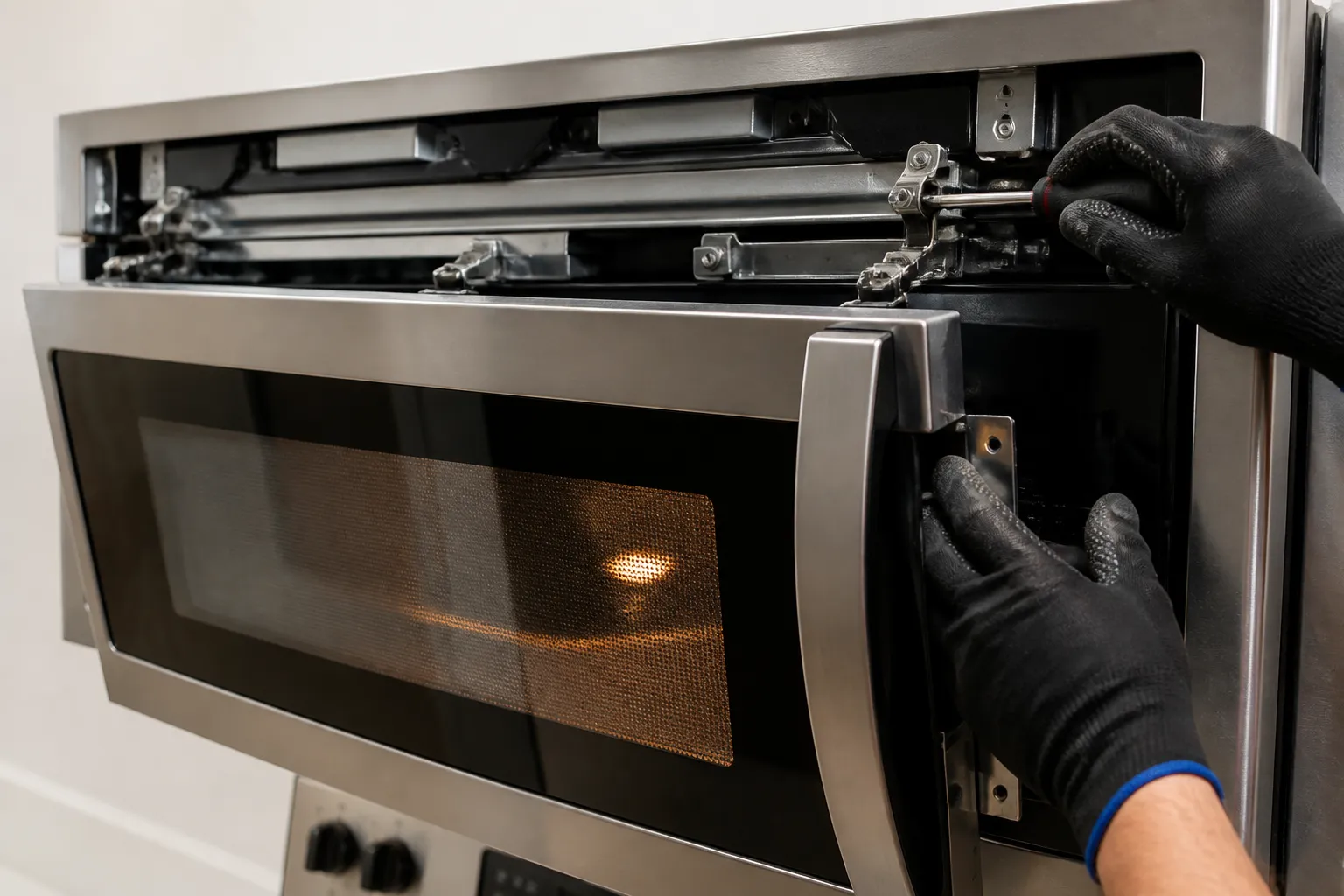
Open the microwave door fully and examine the two plastic latch hooks on the door’s right edge. Look for cracks, chips, or hooks that appear bent or rounded off. Manually press each hook; they should spring back firmly with no wobble. If a hook feels loose, moves sideways, or is visibly cracked, that’s likely your primary cause of the closing failure.Step 3: Remove the Door Panel
Open the door and locate the screws along the inner door perimeter — typically three to four Phillips screws hidden under the inner plastic liner. Remove those screws, then carefully separate the inner door panel from the outer door using a flat screwdriver to release the plastic retaining clips around the edge. Keep all clips and screws organized in a small container.Step 4: Replace the Door Latch Hook Assembly
With the door panel separated, the latch hook assembly is accessible and secured by one or two Phillips screws. Remove the screws, slide out the old assembly, and snap the new latch hook into position before re-securing the screws. Tug gently on the new hooks to confirm they are seated solidly and spring back when released.Step 5: Inspect and Replace the Door Spring
The door closing spring sits near the hinge side of the door and helps the latch engage cleanly. Use needle-nose pliers to unhook the old spring from its mounting posts and compare it to the replacement — a fatigued spring will appear stretched or deformed. Hook the new spring onto both posts and verify it holds tension when the door is moved through its open and close range.Step 6: Test the Door Interlock Switches
The WMH31017FS uses two or three interlock switches mounted behind the latch cavity on the microwave cabinet frame. These switches tell the unit the door is fully closed before allowing operation. Press each switch button manually with a screwdriver handle; you should hear a crisp click. A switch that feels mushy, doesn’t click, or is visibly cracked needs to be replaced with the interlock switch (W10269458) before reassembly.Step 7: Reassemble, Realign, and Test
Snap the inner door panel back onto the outer door, replace and tighten all screws, then rehang the door if you removed it. Plug the microwave back in, close the door firmly, and run a 30-second test cycle with a cup of water inside. The door should click shut cleanly, stay closed during operation, and the unit should run without a door-open error.How Much Does This Repair Cost?
| Repair route | Typical cost |
|---|---|
| Do it yourself | $15–$45 (parts) |
| Professional repair | $150–$300 (parts and labor) |
When to Call a Professional
Most of the repairs in this guide are within reach for a careful DIYer with basic tools. In my experience, the moment you find a burned or pitted primary interlock switch cavity, smell any scorching inside the switch housing, or notice that the door itself is warped and no longer sitting flush against the frame, it’s time to stop and call a certified technician — those conditions indicate arcing or a history of switch failure that needs a full safety evaluation before the unit goes back into service. When in doubt, a diagnostic service call typically costs $80–$120 and can save you from a misdiagnosis that costs more in parts.
The Door Switch Kit That Stops the WMH31017FS from Playing Dead
On this model, a door that physically closes but won’t latch or trigger the microwave to run is almost always a failed interlock switch, not a mechanical latch problem. Having a switch kit on hand before you start diagnostics saves you from ordering the wrong part and waiting another week.
What works
- The W10269458 switch is a direct fit for Whirlpool over-the-range units and snaps into the door frame without modification — I’ve never had a fitment issue on the WMH31017FS.
- Testing with a new switch installed takes literally two minutes and immediately confirms whether the electrical side is the problem, eliminating guesswork before you touch the mechanical latch.
- These switches wear out faster on units over busy stovetops because heat and grease migration age the contacts; replacing them at the first sign of closure trouble prevents the unit from becoming a dead weight above your range.
What doesn’t
- If the door physically won’t close at all due to a bent frame or broken closing spring, a new switch won’t fix it — you’ll still need the mechanical parts.
- The kit comes with multiple switch types, so you need to identify which contact style your WMH31017FS uses before installing; mismatching the switch type means the door will close but still won’t trigger power.
I can’t tell you how many times someone has ordered a new latch hook assembly first, spent two hours installing it, and still had a door that wouldn’t trigger — only to find the real culprit was a corroded switch that cost $15 to replace. Grab the W10269458 Whirlpool Microwave Door Switch and test it before you commit to a full mechanical teardown.
About This Article

Written by Dave Holt. Dave Holt has been taking apart and fixing household appliances since he was a teenager who couldn't leave a broken one alone. Eighteen years later, after fixing things for neighbors, friends, and anyone who'd let him, he's seen almost every failure mode there is. When he writes a repair guide here, it's based on the actual job, not a manufacturer overview. More about this site.
Scope and limits. Dave is a self-taught repairer, not a certified appliance technician. Unplug before you open anything, and leave sealed refrigeration systems, gas connections, and hardwired circuits to a qualified technician.