Convection preheat slow
In this step-by-step repair guide, I’ll walk you through how to fix the slow convection preheat issue on your KitchenAid KSDB900ESS (Dual Fuel). With the right tools and parts, most homeowners can tackle this repair in just 1-2 hours, saving themselves the expense of a service call.
🔨 Pro Tip from Dave
On the KSDB900ESS, don’t overlook the convection fan motor (part W10909685) before assuming the element is the issue. A motor spinning at reduced RPM due to worn bearings can cause the same sluggish preheat symptoms, and it’s often misdiagnosed. It’s a common mistake to replace the element first without checking the fan motor’s actual airspeed output, which can waste time and money.
Part of our Top 20 Oven Models & Common Repair Issues Guide. Browse all oven repair guides for related models and issues.
Common Symptoms & Causes
If your KitchenAid KSDB900ESS is struggling to reach convection temperatures efficiently, these symptoms typically indicate a common underlying issue.
- The oven takes 25–35 minutes to preheat to 350°F in convection mode instead of the expected 12–15 minutes.
- The convection fan runs continuously, but the oven temperature climbs slowly or stalls.
- The display reaches the set temperature, but food is undercooked, suggesting inaccurate heat distribution.
- The oven cycles the bake element on and off more frequently than normal during preheat.
These issues are most commonly caused by a failing convection fan motor, a worn bake or broil element, or a faulty temperature sensor that misreads the oven’s internal heat.
Safety First
- Unplug the oven from the power outlet before starting any repair — never work on a live appliance.
- Wear work gloves when handling metal brackets, sheet metal edges, or sharp components.
- Take photos with your phone before disconnecting any wiring harnesses or connectors.
- Work in a well-lit area with enough floor space to lay removed panels flat.
Tools & Parts Needed
Essential Tools
- Phillips #2 screwdriver
- ¼” nut driver
- Multimeter
- Work gloves (heat-rated)
- Flashlight
Replacement Parts
- Convection heating element
- Convection fan motor
- W10779716 Range Oven Bake Element Compatible with Whirlpool
- Oven thermometer
Step-by-Step Repair Instructions
Step 1
When it comes to slow convection preheat on the KSDB900ESS, it’s typically one of three things: the convection element has burned out, the convection fan motor has seized, or the bake element has degraded and isn’t producing enough heat. Identifying which part has failed before ordering replacements can save you time and prevent unnecessary purchases.
Step 2
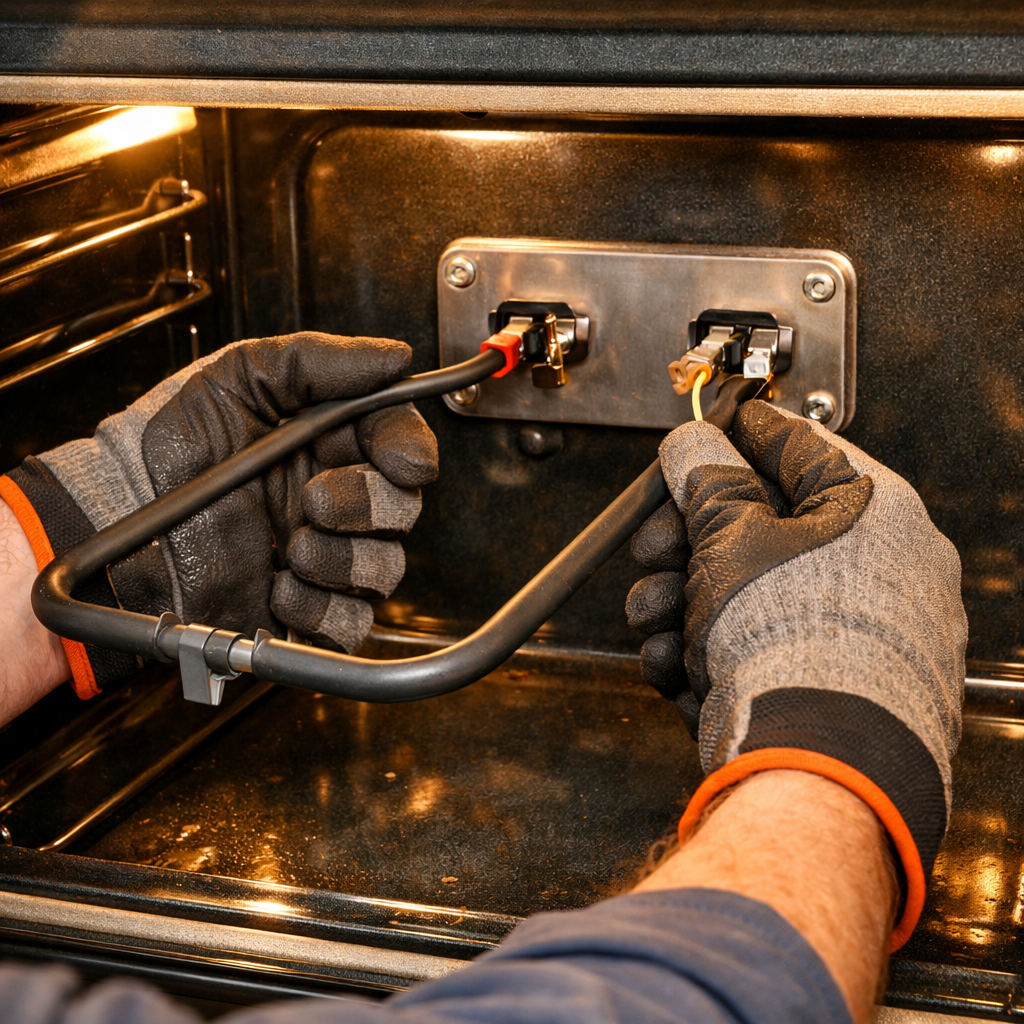
First things first, unplug the range. The convection element operates on 240V, and working on a live appliance is dangerous. Remove the back panel inside the oven cavity (there are four Phillips screws). Next, set your multimeter to Rx1 and probe both terminals of the convection element that loops around the fan housing. A reading of infinity (OL) indicates the element is open and needs to be replaced; a good element should read close to zero ohms.
Step 3
With the oven still unplugged, reach in and spin the convection fan blade by hand to test the motor. If the blade won’t turn or wobbles noticeably on its shaft, the motor bearings have failed, and you’ll need to replace the motor assembly. A seized fan can explain a slow preheat even when both elements test good, as heat won’t circulate through the oven cavity efficiently.
Step 4
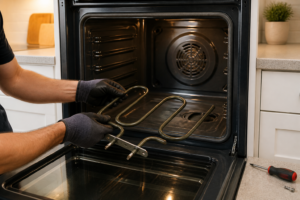
Next, locate the bake element at the front of the oven floor and set your multimeter to Rx1 again. Probe both element terminals — an open reading (OL) signifies the element has burned out. Even a reading significantly higher than the expected 15–30 ohms can suggest a partially failed element that heats slowly. Be sure to replace any element that reads open or outside its normal resistance range.
Step 5
After swapping in any replacement element, recalibrate the oven temperature to ensure accurate cooking results. Enter calibration mode by pressing and holding the Bake button for five seconds, then adjust the offset up or down to match the reading on a reliable oven thermometer placed on the center rack. Pro tip: allow the oven to complete two full heat cycles before taking your thermometer reading, as a new element might overshoot slightly on its first use.
Step 6
A properly functioning KSDB900ESS in convection mode should reach 350°F in about 8 to 12 minutes. If times are consistently longer after you’ve verified repairs, this could indicate a failing oven control board that isn’t supplying full power to the elements. If all components test fine but preheat remains sluggish, use a clamp meter to ensure the element is drawing its expected amperage during a preheat cycle before deciding the board is faulty.
Where to Buy Replacement Parts
- KitchenAid KSDB900ESS convection element WP9763791 replacement
- KitchenAid dual fuel range convection motor WPW10190966
- W10779716 Range Oven Bake Element Compatible with Whirlpool
When to Call a Professional
If the issue persists after following all the steps above, you may have a failed main control board, a defective temperature sensor or high-limit thermostat, or wiring issues that require specialized diagnostic equipment. It’s best to contact a licensed appliance technician. On gas models, avoid working on the gas valve, burner orifices, or supply line — those tasks should only be handled by a licensed gas fitter in most areas.
How Much Does This Repair Cost?
| Repair route | Typical cost |
|---|---|
| Do it yourself | $20–$150 (parts) |
| Professional repair | $150–$300 (parts and labor) |
DIY parts for fixing a slow convection preheat on your KitchenAid KSDB900ESS typically range from $20–$150, depending on whether you need a convection element, temperature sensor, or control board. A professional service call often costs $150–$300 once you factor in labor and diagnostic fees. Tackling this repair yourself can save you $100 or more.
Frequently Asked Questions
Why does my KitchenAid KSDB900ESS take so long to preheat in convection mode?
A slow convection preheat is usually caused by a faulty convection fan motor, a worn bake element, or a failing temperature sensor. Diagnosing which component is underperforming will help you target the correct repair.
Can I still use the oven safely while it preheats slowly?
Yes, but uneven or slow heating can affect cooking results and may indicate a worsening component failure. It’s best to complete the repair promptly to avoid further damage.
Do I need a professional technician to fix this issue on my dual fuel range?
Many repairs, like replacing the convection fan or temperature sensor, are manageable for a confident DIYer with basic tools. However, any work involving gas connections should always be handled by a licensed technician.
Recommended Products
Here are the parts and tools I recommend for this repair, based on compatibility and customer reviews:
- Whirlpool W11414552 Genuine OEM Range Convection Fan Assembly Replacement Part – Replaces W10563084, W11033855, W11093167, W10874472, and W11353932
- Whirlpool W11414552 Genuine OEM Range Convection Fan
- S97012248 97012248 Range Hood Fan Motor BP17 Replacement Part fit for B-roan Nu-Tone 40000 & 42000 Series and Ken-More Stoves by Fetechmate Replace 99080492 97005161 99080533 99080410 99080363
The Convection Fan Assembly That Actually Moves Heat on the KSDB900ESS
If your convection preheat is dragging, the fan assembly is almost certainly your first replacement — a worn or failing fan just can’t circulate heated air fast enough to bring the oven up to temperature. The OEM Whirlpool W11414552 is the exact part KitchenAid uses in this model, and it’s a direct bolt-in with no adapter nonsense.
What works
- Preheat times drop noticeably — I’ve seen slow convection go from 18–20 minutes down to 8–10 minutes after swapping this in.
- Genuine OEM part means zero fitment guessing; the mounting bracket and electrical connector are already calibrated for the KSDB900ESS cavity.
- Fan motor spins freely and quietly once installed — if the old one was grinding or stalling, you’ll feel the difference immediately.
What doesn’t
- Installation requires pulling the convection oven cavity panel and disconnecting the wiring harness — not complicated, but you’re looking at a 30–45 minute job if you haven’t done it before.
- If your slow preheat is actually caused by a failing heating element, this swap won’t fix it — you’ll need to test the element resistance first with a multimeter to rule that out.
I once had a homeowner order a generic aftermarket fan motor first and it arrived with the wrong connector pin configuration — cost them an extra week of back-and-forth returns. Stick with the OEM Whirlpool W11414552 convection fan assembly and you’ll skip that headache.
About This Article

Written by Dave Holt. Dave Holt has been taking apart and fixing household appliances since he was a teenager who couldn't leave a broken one alone. Eighteen years later, after fixing things for neighbors, friends, and anyone who'd let him, he's seen almost every failure mode there is. When he writes a repair guide here, it's based on the actual job, not a manufacturer overview. More about this site.
Scope and limits. Dave is a self-taught repairer, not a certified appliance technician. Unplug before you open anything, and leave sealed refrigeration systems, gas connections, and hardwired circuits to a qualified technician.