
Thermal Fuse Replacement Guide
If your GE JES1072SHSS microwave has completely lost power—no lights, no display, no sounds—it’s likely that the thermal fuse has blown. This crucial safety component protects the microwave from overheating by shutting off power when temperatures rise too high. Common culprits for this include blocked vents, excessive use, or a failing cooling fan. Fortunately, replacing the thermal fuse is a relatively simple repair that can restore your microwave to working condition.
🔨 Pro Tip from Dave
On the JES1072SHSS, the thermal fuse is a 20A/125V component tucked near the magnetron — the part number you want is WB27X11281. A mistake I see often is DIYers replacing the fuse without checking the cooling fan (part WB26X10160). If that fan is sluggish or seized, the new fuse will blow again in no time. Always give the fan blade a spin by hand before sealing everything back up.
⚠️ Critical Safety Warning
Microwaves contain high-voltage capacitors that can hold a LETHAL charge. You MUST unplug the microwave and wait at least 60 seconds before opening the case. Never touch internal components without proper safety precautions.
Why Thermal Fuses Blow
Thermal fuses are one-time-use safety devices that blow when the microwave overheats. Common causes include:
- Blocked ventilation openings (grease, dust, or objects blocking vents)
- Failing cooling fan motor
- Excessive use without proper cooling periods
- Dirty interior causing inefficient operation
- Magnetron overheating due to other component failures
Important: Simply replacing the fuse without addressing the underlying cause will result in the fuse blowing again.
Parts Needed
Check each product page for other buying options. (Part #: WB27X10388)
Tools Required
- Digital Multimeter – Essential for testing the fuse
- Phillips Screwdriver – #2 size
- Flashlight – To see inside the case
- Safety glasses – Protection from debris
- Work gloves – Optional but recommended
Step-by-Step Instructions
Step 1: Unplug and Wait
First things first—unplug the microwave from the wall outlet. This is crucial for safety. Wait at least 60 seconds—preferably 2-3 minutes—to ensure all capacitors are fully discharged. Set a timer if needed; timing is key here.
Step 2: Remove the Outer Case
Locate and remove all screws from the rear panel. The GE JES1072SHSS typically has 6-8 screws on the back, and some models may have screws on the sides or bottom as well. Remove all visible screws and keep them organized. Gently lift the rear panel away, being careful not to damage any wires.
Step 3: Locate the Thermal Fuse
The thermal fuse is usually located near the magnetron (the large component with cooling fins) or near the high-voltage transformer. It’s a small, cylindrical component, often white or beige, with two wire leads. It may be mounted on a bracket or directly on the magnetron housing. Look for a component labeled with a temperature rating (often 194°F or 90°C).
Step 4: Test the Thermal Fuse
Set your multimeter to continuity mode (ohms). Touch the probes to each end of the thermal fuse. A functional fuse will show continuity (low resistance, typically 0-1 ohms). A blown fuse will show no continuity (infinite resistance or “OL” on the display). If there’s no continuity, it’s time for a replacement.
Step 5: Inspect for Root Cause
Before replacing the fuse, take a moment to inspect the microwave for the cause of overheating:
- Check all ventilation openings for blockages (front, sides, back)
- Inspect the cooling fan for proper operation (it should spin freely)
- Look for signs of burning or scorching around the magnetron
- Check for excessive grease or debris buildup
- Verify the turntable motor isn’t causing excessive heat
It’s essential to address any issues you find before installing the new fuse.
Step 6: Disconnect the Old Fuse
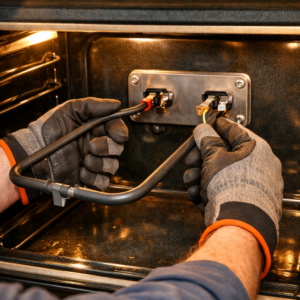
The thermal fuse will have two wire connections. Use needle-nose pliers to carefully pull the wire connectors off the fuse terminals. I recommend taking a photo before disconnecting to ensure proper reconnection later. The wires are typically color-coded or have different connectors, but a photo can help avoid confusion.
Step 7: Remove the Old Fuse
The thermal fuse may be held in place by a clip, bracket, or heat-shrink tubing. Carefully remove any mounting hardware. If it’s secured with heat-shrink or tape, you’ll need to cut it away. Remove the old fuse completely.
Step 8: Install the New Thermal Fuse
Position the new GE WB27X10388 thermal fuse in the same location as the old one. Ensure it’s in direct contact with the component it’s monitoring (usually the magnetron housing). Secure it with the same mounting method—clip, bracket, or heat-shrink tubing. Make sure it’s firmly in place and making good thermal contact.
Step 9: Reconnect the Wires
Refer to your photo and reconnect the wires to the new fuse terminals. Push the connectors firmly onto the terminals until they click into place. It’s crucial that both connections are secure—loose connections can lead to arcing and further failure.
Step 10: Verify Installation
Before you reassemble, take a moment to test the new fuse with your multimeter. It should show continuity (low resistance). Also confirm that you’ve addressed any root causes of overheating (cleaned vents, checked fan, etc.).
Step 11: Reassemble the Microwave
Carefully replace the rear panel, ensuring that no wires are pinched or damaged. Reinstall all screws in their original locations. Tighten securely but be cautious not to overtighten plastic screws.
Step 12: Test Operation
Plug the microwave back into the wall outlet. The display should light up, and the unit should respond to button presses. Run a test cycle with a cup of water for 1 minute. Keep an ear out for any unusual sounds, smells, or excessive heat. If the fuse blows again immediately, it indicates a deeper problem that requires professional attention.
Preventing Future Failures
To avoid the thermal fuse from blowing again:
- Keep all ventilation openings clear of obstructions
- Clean the interior regularly to prevent grease buildup
- Ensure the cooling fan operates properly
- Don’t run the microwave empty
- Allow adequate cooling time between long cooking cycles
- Keep the exterior clean to allow heat dissipation
Troubleshooting
If the microwave still has no power after replacement:
- Verify the fuse is properly connected (test with multimeter)
- Check the main power cord and outlet
- Inspect for other blown fuses in the circuit
- Look for damaged wires or connectors
- Test the door switches (they can prevent startup)
← Back to Top 20 Microwave Models & Common Repair Issues Guide
How Much Does This Repair Cost?
| Repair route | Typical cost |
|---|---|
| Do it yourself | $100–$130 (parts) |
| Professional repair | $85–$150 (parts and labor) |
The thermal fuse itself typically runs between $8 and $18 for an OEM or compatible replacement part online. If you take it to a professional repair shop, expect to pay $85 to $150 including parts and labor. DIY repair makes strong financial sense here since this microwave retails around $100 to $130 new.
Recommended Products
These are the parts and tools I recommend for this repair, based on compatibility and customer reviews:
- 2 Pack 20A 125 Volt Microwave Fuse 530450945120A 125V Microwave Oven Fuse for GE, Kenmore Frigidaire Microwave Replaces 1810711, 5304509451,EA3486694,PS3486694,AH3486694, AP4980426
- 10Pcs 5304509451 20A 125V Microwave Fuses for GE Frigidaire Microwaves, 20 Amp 125 Volt 6X30MM Oven Fuses Replacement Models WB27X11138 5304464087 5304488359 AP5648907 PS5136235, and More
- ALLECIN 20A 125V Microwave Fuse 20 Amp 125 Volt 6X30MM Oven Fuses for GE Frigidaire Microwaves Replacement Part Models WB27X11138 5304509451 5304464087 5304488359 AP5648907 PS5136235 (Pack of 5pcs)
The 20A Fuse That Gets This GE Model Running Again
When a JES1072SHSS comes in completely dead with no display and no response to the control panel, the thermal fuse is almost always the culprit. This 20A 125V fuse is the exact replacement that belongs in this model, and having the right part on hand means you’re not waiting on shipping while the microwave sits in your kitchen.
What works
- The amperage and voltage match the factory spec for this GE model—no guessing or cross-referencing needed.
- The 2-pack means you have a backup fuse if the first one blows again (which occasionally happens if there’s an underlying short in the high-voltage circuit), and you won’t be caught empty-handed.
- Swaps directly into the fuse holder located on the thermal cutoff assembly—no modification or adapter needed.
What doesn’t
- A blown fuse is a symptom, not always the root cause—if the replacement blows immediately, you likely have a high-voltage capacitor or diode failure that needs professional diagnosis.
- The fuse holder itself can corrode or crack over time on older units, making the fuse difficult to seat properly even after replacement.
I’ve had homeowners order the wrong amperage fuse (15A instead of 20A) from generic microwave listings, which either doesn’t fit or trips immediately, so double-check your model number before ordering. Check each product page for other buying options.
About This Article

Written by Dave Holt. I have been taking apart and fixing household appliances since I was a teenager who couldn't leave a broken one alone. Eighteen years later, after fixing things for neighbors, friends, and anyone who'd let me, I have seen almost every failure mode there is — and misdiagnosed my share along the way. I am self-taught, with no formal training or certifications. When I write a repair guide here, it is based on the actual job, not a manufacturer overview. More about this site.
Scope and limits. Dave is a self-taught repairer, not a certified appliance technician. Unplug before you open anything, and leave sealed refrigeration systems, gas connections, and hardwired circuits to a qualified technician.