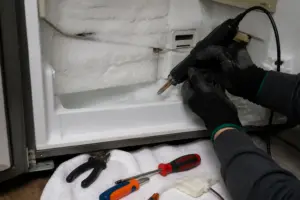
A few years in, I replaced a compressor on a Kenmore side-by-side that a technician had already said needed replacing. They said it was the compressor, I said it was the compressor, and we were both wrong. The real issue was a partially restricted dryer and a low refrigerant charge that had been gradually starving the system for months. That compressor was perfectly fine; we just couldn’t see past the noise of incorrect assumptions. After putting in a new compressor, charging the system, and then getting a call three weeks later about the same issue, I learned a hard lesson. It cost me money, it cost me time, and it cost me something that’s much harder to replace: confidence in my diagnostic process.
Since that day, I’ve made it a point never to skip my pre-replacement checklist. Not once. Not even when the compressor sounds like a lawnmower.
Why Refrigerator Compressor Replacement Gets Misdiagnosed So Often
The compressor is the most expensive component of a refrigerator. A genuine OEM compressor for a mid-range unit can cost anywhere from $150 to $400 in parts alone, and labor for a compressor swap—especially on a bottom-mount or built-in—can push the total job cost past $600. When people hear these numbers, they often choose to buy a new fridge instead. Sometimes that’s the right call, but often it’s based on a misdiagnosis.
🔨 Pro Tip from Dave
One thing many technicians overlook is the refrigerator’s filter drier. A clogged drier (part search: universal inline filter drier 1/4″ flare) can choke refrigerant flow and mimic a dead compressor almost perfectly. A common mistake is pulling amp readings on the compressor without first checking the drier for temperature differential across its inlet and outlet ports. If the drier is more than 3–4°F cooler on the outlet side, you’ve got a restriction, not a compressor failure.
The problem is that compressor failure looks like a lot of other failures. A fridge that isn’t cooling, a compressor that runs continuously, or a system that’s frosting up in all the wrong places—these symptoms can overlap with low refrigerant, a failed start relay, a defrost system stuck in one state, or a dirty condenser that’s been slowly suffocating the system for years. I’ve seen all of these issues misidentified as a bad compressor by technicians who didn’t dig deep enough.
Step One: Check the Start Relay First — Every Single Time
Before I even think about touching refrigerant or pulling a compressor, the first thing I do is remove the start relay. It’s typically located on the side of the compressor, usually clipped directly to the compressor pins. Accessing it takes about 45 seconds on most units.
I give it a shake. If it rattles, the internal element is broken, and it’s not starting the compressor reliably—or at all. A faulty start relay can mimic compressor failure almost perfectly. The compressor tries to start, can’t overcome the starting torque without assistance, clicks off on the overload protector, and the fridge stays warm. The compressor itself could be perfectly healthy.
Replacement relays are relatively inexpensive, running between $8 to $25 depending on the brand. I’ve replaced hundreds of them; it’s the single most valuable diagnostic step in this entire process, and it takes less than a minute.
Step Two: Test the Compressor Windings with a Multimeter
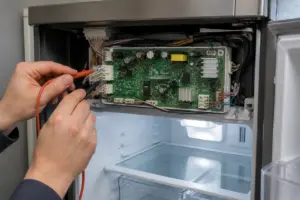
If the relay checks out, I move on to the compressor windings. This is where a reliable multimeter becomes essential. I pull the relay and overload off the compressor terminals—on most units, you’ll find three pins labeled C (common), S (start), and R (run). Using an ohmmeter, I check the resistance between each pair.
What I’m looking for: the resistance between S and R should equal the sum of C-to-S and C-to-R. If any reading is open (infinite resistance) or shows a dead short to ground, the compressor windings have failed. That’s a legitimate compressor condemnation.
However, it’s important to note that a compressor can pass winding tests and still be mechanically seized or have a failed valve. Electrical tests are necessary but not sufficient on their own. They rule out electrical failure before you move on to refrigerant diagnostics.
For this, reach for the PN109 Ohmmeter Voltmeter Tester with Backlit 4000 Count Multimeter. It’s a clean, accurate meter that provides stable resistance readings on compressor windings without a lot of noise in the measurement. This small detail can make a significant difference on low-resistance windings.
Step Three: Evaluate the Refrigerant Charge Before You Decide Anything
This is the step that many DIYers and even some technicians skip, and it’s the one that burned me when I was starting out. A low refrigerant charge due to a slow leak will make a compressor work harder, run hotter, cycle more frequently, and eventually fail—but the compressor is often not the first component to go. More commonly, you’ll find a system that runs but doesn’t cool adequately, or one where only part of the evaporator coil frosts up.
Most residential refrigerators manufactured since the mid-1990s use R134a. To get an accurate picture of what the system is doing, I connect a gauge set to the low-side process tube, observe the suction pressure relative to ambient temperature, and compare it against the expected operating range for that refrigerant. In a properly charged R134a system at 70°F ambient, you’d expect low-side pressures in the 0 to 2 PSI range at steady state, depending on the design.
If the system is short on refrigerant, you’ll see lower-than-expected pressures, and the compressor will be working against reduced suction—which often gets misinterpreted as weak pumping. I’ve diagnosed and corrected low refrigerant charges on units that three other technicians had already tagged for compressor replacement. Every one of those compressors was functioning perfectly.
Step Four: Check the Condenser Coils and Fan
I won’t call a compressor without first checking the condenser. On bottom-mount and side-by-side units, the condenser coils are situated underneath or behind the unit, collecting an astonishing amount of dust, pet hair, and debris. A completely blocked condenser can drive discharge temperatures high enough to cause the compressor’s thermal overload to trip repeatedly—again, this looks exactly like compressor failure from the outside.
I pull the lower access panel, inspect the condenser coils, and check that the condenser fan is spinning freely and moving air. This process takes about five minutes. I’ve seen condensers so clogged with compacted dog hair that I could scrape it off in sheets. Clean the coils, verify the fan, and retest before proceeding any further.
Tools for Refrigerant Diagnostics
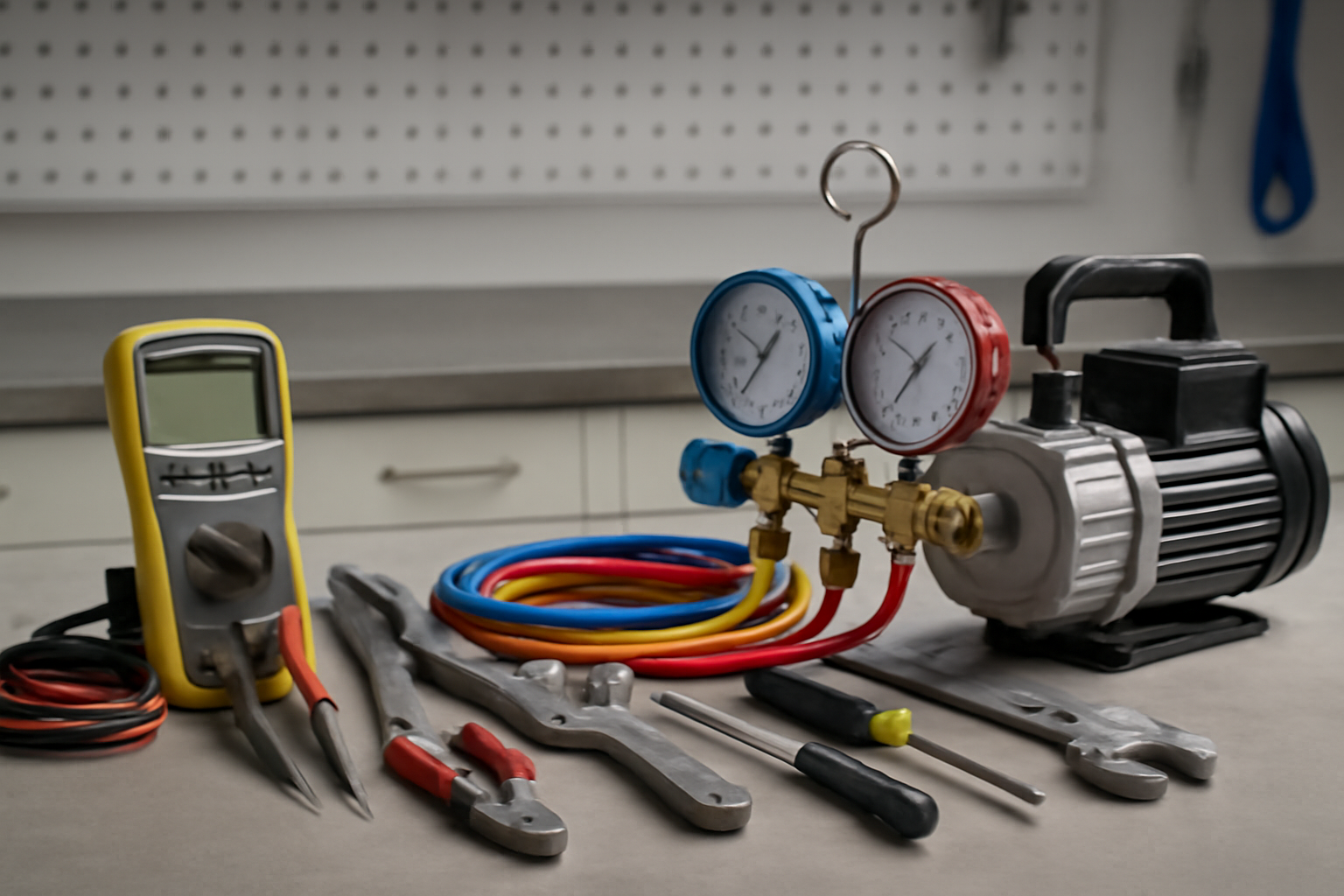
To assess the refrigerant side of a residential refrigerator, these are the tools worth having:
- R134A Refrigerator Freon Recharge Hose Kit with R134A AC Refrigerant Charging Hose Gauge, Bullet Piercing Valve, and R134a Self-Sealing Adapter — This kit covers the basics for accessing a sealed system on a residential fridge. The self-sealing adapter and piercing valve make it practical for units that don’t have accessible Schrader valves from the factory.
- Refrigerator Freon Recharge Hose Gauge Kit compatible with R134a, R12, R22, and R502 — includes BPV31 Bullet Piercing Tap Valve, Quick Coupler, and Self-Sealing Adapter — this one is worth a look when I’m working on older units or when I need the BPV31 piercing valve on a process tube that hasn’t been accessed before. Its multi-refrigerant compatibility makes it versatile across older commercial equipment as well.
Important caveat: If you are not EPA 608 certified, you are not legally permitted to purchase or handle refrigerants in most professional capacities in the United States. These tools are included here because this blog is read by technicians and serious DIYers working within their legal scope. Please know your local regulations before working on a sealed system.
When It Actually Is the Compressor
After 15 years in this business, I want to be upfront: compressors do fail. Certain platforms fail at higher rates than others—the linear compressors used in LG refrigerators from roughly 2014 to 2019 have a well-documented failure pattern that led to a class action settlement. Embraco and Secop compressors found in some budget units tend to have shorter service lives compared to the Tecumseh units you often see in older American-made refrigerators.
A compressor that hums loudly and trips the overload within seconds, shows an open winding during resistance testing, or has confirmed mechanical failure with normal refrigerant pressures—that’s a compressor issue. Confirm it, price the job honestly, and make an informed decision about repair versus replacement based on the age and value of the unit.
What I won’t do is call it a compressor failure just because it appears to be one from a distance.
The Checklist I Run Before Any Refrigerator Compressor Replacement
- Start relay: Pull and shake—replace if it rattles or shows open on the meter.
- Overload protector: Test for continuity at room temperature.
- Compressor windings: Measure C-S, C-R, S-R resistance—check for opens and shorts to ground.
- Condenser coils and fan: Clean and verify airflow.
- Defrost system: Confirm defrost heater, thermostat, and timer/control are functioning.
- Refrigerant charge: Assess low-side pressure relative to expected operating range.
- Confirm compressor failure: Document the specific failure mode before ordering parts.
Every item on that checklist has, at some point, turned out to be the actual problem on a machine someone else had written off as a dead compressor. Run this checklist. It saves money and it saves time.
How Much Does This Repair Cost?
| Repair route | Typical cost |
|---|---|
| Do it yourself | $15–$40 (filter drier) |
| Compressor replacement, if that is the fault | $300–$700 in parts plus $200–$400 in labor |
A replacement filter drier will typically run you $15–$40 in parts, and refrigerant recharge kits or professional recharge services usually add $50–$150 depending on your region. Compare that to a compressor replacement, which can run $300–$700 in parts alone plus $200–$400 in labor—getting the diagnosis right first can save you $500 or more.
Recommended Products
Here are the parts and tools I recommend for this repair, based on compatibility and customer reviews:
- BOJACK 1/4 in Liquid Line AC Filter Drier HVAC Refrigeration 032 SAE Flare Connection Universal Unidirectional DML-032
- Appli Parts Liquid Line Filter Drier 032 with 1/4 in SAE Flare Connection 4-1/2 in Long 1-3/4 in Wide APFD-032
- Appli Parts APFD-082 1/4 in Liquid Line Refrigerant AC Filter Drier HVAC Refrigeration 082 SAE Flare Connection Universal Unidirectional 6 in Long 2-1/4 in Wide
- RCO810 3 n’ 1 Hard Start Kit Compatible with Supco Refrigerator Freezers Relay Capacitor Overload 1/12-1/5 HP 110-125VAC Replaces TJ90RCO810 AP4503019 ERP810 HS8 HS810 RC100
Why I Test the Compressor Circuit Before Ordering a Replacement
Before you pull the trigger on a $300+ compressor replacement, you need to verify that the compressor is actually getting power and is capable of running. A multimeter is the only tool that tells you whether the compressor itself is dead or if the real issue is a failed relay, capacitor, or a wiring problem upstream.
What works
- The backlit display keeps you from guessing at readings in tight cabinet spaces where compressors hide—I’ve caught resistance readings I would’ve missed on a non-backlit meter.
- The 4000-count range is precise enough to catch weak capacitor readings and verify that compressor windings haven’t shorted, saving you from ordering a $400 part that wasn’t actually faulty.
- Testing continuity on the relay and start capacitor takes 90 seconds with this meter—three times I’ve found a $15 relay was the culprit, not the compressor.
What doesn’t
- This meter won’t diagnose refrigerant charge loss—you still need a gauge kit and piercing valve to check pressure, which is the second most common misdiagnosis.
- If you’re not comfortable testing voltage on a live compressor circuit, you shouldn’t be using this tool; a safety lesson I learned the hard way early on.
I’ve lost count of how many times a homeowner called me back saying they’d already ordered a compressor, only for me to discover that the start capacitor was open or the relay contacts were stuck—a $40 fix they could’ve caught first with a simple resistance check. Grab a PN109 Ohmmeter Voltmeter Tester with Backlit 4000 Count Multimeter and verify the compressor circuit before you order anything.
About This Article

Written by Dave Holt. Dave Holt has been taking apart and fixing household appliances since he was a teenager who couldn't leave a broken one alone. Eighteen years later, after fixing things for neighbors, friends, and anyone who'd let him, he's seen almost every failure mode there is. When he writes a repair guide here, it's based on the actual job, not a manufacturer overview. More about this site.
Scope and limits. Dave is a self-taught repairer, not a certified appliance technician. Unplug before you open anything, and leave sealed refrigeration systems, gas connections, and hardwired circuits to a qualified technician.