Not Making Ice
This guide covers the most common reasons your Frigidaire EFIC189 portable ice maker has stopped producing ice and walks you through diagnosing and fixing the problem yourself. Most homeowners with basic mechanical skills can complete this repair in 1 to 2 hours using standard household tools, saving significant money over a service call.
Common Symptoms & Causes
The EFIC189 can stop making ice for several distinct reasons — identifying your exact symptom helps narrow the fix quickly.
- Unit powers on but no ice forms after a full cycle
- Ice maker runs continuously but produces only partial or hollow ice cubes
- The “Add Water” indicator stays lit even when the reservoir is full
- Unit makes noise as if cycling but stops before completing the freeze process
The most typical root cause is a clogged or malfunctioning water pump that prevents adequate water from reaching the ice tray pins, though a faulty water sensor or low ambient temperature can also stop ice production entirely.
Safety First
- Unplug the unit from the wall outlet before opening any panels or touching internal components
- Wear work gloves to protect against sharp metal edges inside the housing
- Photograph all wiring and connector positions before disconnecting anything
- Work in a well-lit space so you can clearly see small components and wire routing
Tools & Parts Needed
Essential Tools
- Phillips head screwdriver (#1 and #2)
- Flathead screwdriver for prying clips
- Needle-nose pliers
- Multimeter for testing continuity and voltage
- Small flashlight or headlamp
Replacement Parts
Step-by-Step Repair Instructions
🔨 Pro Tip from Dave
On the EFIC189, mineral scale buildup on the evaporator fingers is almost always worse than it looks from the outside — even if the unit looks clean, pull the basket and shine a flashlight directly up at the fingers, because a thin invisible scale layer can insulate them enough to prevent proper ice formation and fool you into chasing an electrical fault that isn’t there. Run a full citric acid cleaning cycle before you replace any parts, and you’ll save yourself from a lot of unnecessary component swaps.
Step 1: Empty and Inspect the Unit
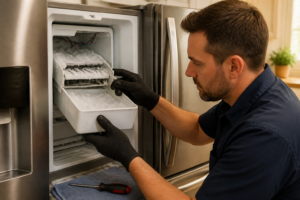
Remove the ice basket, drain all water from the reservoir through the drain plug at the bottom rear, and wipe the interior dry. Look for visible scale buildup, debris blocking the water inlet, or damage to the ice tray fingers. Heavy mineral deposits are a common culprit and may resolve with a simple cleaning cycle using a 1:1 white vinegar and water solution.
Step 2: Test the Water Pump
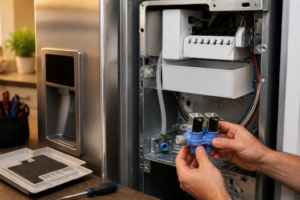
Refill the reservoir to the max line, plug in the unit, and start a cycle — listen for the pump to activate within the first 30 seconds. If you hear the compressor hum but no water movement sound, the pump is likely the failed component. Unplug the unit, remove the back panel with your Phillips screwdriver, locate the small submersible pump at the bottom of the reservoir, and use your multimeter to check for continuity across the pump terminals; a reading of OL (open loop) confirms a dead pump.
Step 3: Replace the Water Pump
Disconnect the two-wire harness connector from the pump and unclip the rubber mounting bracket holding it to the reservoir floor. Slide the new pump into the bracket, reconnect the harness, and ensure the pump intake faces downward into the water. Restore power briefly to confirm water is now circulating up through the distribution tube before reassembling the panel.
Step 4: Inspect and Test the Water Level Sensor
The water level sensor is a small float or infrared probe mounted on the reservoir wall that tells the control board when sufficient water is present. If the “Add Water” light stays on with a full reservoir, remove the sensor, clean any scale off the probe tip with vinegar, and test continuity with your multimeter. A failed sensor will show no continuity change when submerged and should be replaced.
Step 5: Check the Ice Tray and Ejector Mechanism
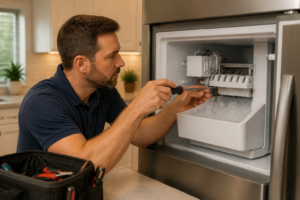
Manually inspect the bullet-shaped ice tray pins for cracks, bending, or ice jammed around the ejector rod. Rotate the ejector shaft by hand to confirm it moves freely without binding. If the shaft is seized, apply a small amount of food-safe silicone lubricant and work it free; a broken ejector rod requires replacing the tray assembly.
Step 6: Verify Operating Temperature
The EFIC189 requires an ambient room temperature between 50°F and 90°F to produce ice reliably; placing the unit in a cold garage or near an air conditioning vent can prevent the refrigeration cycle from completing. Confirm the room temperature is within range and ensure at least six inches of clearance around all vents. Relocating the unit to a warmer spot often resolves intermittent no-ice complaints without any parts replacement.
Step 7: Reassemble and Run a Test Cycle
Reinstall the back panel, refill the reservoir with fresh water, and power the unit on to run a full test cycle — the first batch of ice should drop within 7 to 15 minutes under normal conditions. If ice still does not form after two complete cycles, the issue may lie with the control board or refrigerant system. Document the symptoms carefully before moving forward.
How Much Does This Repair Cost?
DIY parts for this repair typically run between $10 and $45 depending on which component has failed — a replacement water pump costs roughly $10 to $18, a water level sensor runs $8 to $15, and a control board ranges from $25 to $45. Compare that to a professional appliance service call that typically costs $150 to $300 once labor and diagnostic fees are included. Tackling this repair yourself can save you $100 to $250, and for a portable ice maker that retails around $120, it can mean the difference between a simple fix and buying a new unit entirely.
Where to Buy Replacement Parts
Amazon is one of the most convenient sources for EFIC189 compatible parts with fast shipping. Search directly using these links to find compatible options:
- Frigidaire EFIC189 water pump replacement
- Frigidaire EFIC189 water level sensor replacement
- Frigidaire EFIC189 ice maker control board replacement
When to Call a Professional
Most of the repairs in this guide are within reach for a careful DIYer with basic tools. In my experience, if you’ve cleaned the unit, confirmed water flow, and the compressor is running but the evaporator fingers never get cold to the touch within the first 10 minutes of a cycle, you’re most likely looking at a refrigerant leak or a failed compressor — and at that point the repair cost on a portable unit this size will almost always exceed the machine’s replacement value, so a technician call is really just a paid second opinion before you buy new. When in doubt, a diagnostic service call typically costs $80–$120 and can save you from a misdiagnosis that costs more in parts.
Frequently Asked Questions
Why does my EFIC189 say “Add Water” when the reservoir is full?Before diving into the troubleshooting steps, it’s worth checking whether a worn or cracked ice basket is the root cause of your EFIC189’s ice production issues — a damaged basket can prevent the machine from cycling correctly. The Ice Basket Compatible with Magic Chef Ice Maker, Replacement Basket Compatible with Magic Chef, Compatible with Frigidaire Durable and No Assembly, No Tools Required, Easy To Replace is a direct-fit replacement that snaps in without any tools, making it one of the easiest first fixes to attempt. If your basket shows visible cracks or deformation, swapping it out takes less than a minute and could restore normal operation immediately. (As an Amazon Associate I earn from qualifying purchases.)
If you’ve worked through the basic checks and your Frigidaire still isn’t producing ice, the ice maker assembly itself may have failed — a common culprit in both portable and refrigerator-mounted units. The 241798231 241798224 241798211 Ice Maker Replacement, Compatible with Frigidaire Electrolux Kenmore Refrigerators, Replaces 241642511, 241642501 and 241798201 Ice Maker Assembly (Not Universal) is a model-specific replacement that fits a wide range of Frigidaire and Electrolux units, so confirm your model number before ordering. Replacing the full assembly is a straightforward DIY repair that eliminates multiple potential failure points — the thermostat, motor, and ejector arms — all in one swap.
Once your ice maker is back up and running, make sure the ice storage side of the equation is also in good shape — a cracked or warped ice bin can cause jams that trick the machine into thinking it’s full. The Post Views: 2