“`html
Self-clean door lock stuck
This guide walks you through diagnosing and fixing a self-clean door lock stuck on the LG LRE3061ST electric range. When the door latch engages during or after a self-clean cycle and refuses to release, your oven becomes completely unusable. Most homeowners with basic mechanical skills can complete this repair in 1 to 2 hours using common hand tools, saving significant money over a professional service call.
Common Symptoms & Causes
A stuck self-clean door lock on the LG LRE3061ST typically presents in several recognizable ways before or after a cleaning cycle.
- Door will not open after the self-clean cycle has completed and the oven has cooled
- Control panel displays a door lock error or “LOC” indicator that will not clear
- You can hear the latch motor attempting to cycle but the door remains locked
- Self-clean cycle starts but the door never fully latches, interrupting the cycle
The most common root cause is a failed or thermally warped door latch assembly, though a faulty door lock motor or a burned thermal fuse in the lock circuit can produce identical symptoms.
Safety First
- Unplug the range from the wall outlet or shut off the dedicated 240V breaker before starting any work
- Wear work gloves throughout the repair — interior oven components have sharp metal edges
- Photograph all wiring harness connections before disconnecting anything so you can reassemble correctly
- Work in a well-lit space and allow the oven to cool completely if it was recently used or ran a self-clean cycle
Tools & Parts Needed
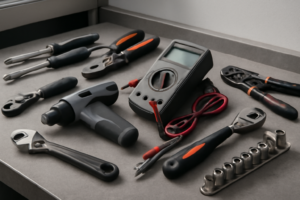
Essential Tools
- Phillips head screwdriver (#2)
- Flat-head screwdriver (for prying clips)
- 1/4-inch nut driver or socket set
- Multimeter (for testing continuity on the motor and fuse)
- Needle-nose pliers
Replacement Parts
- LG LRE3061ST Door Latch Assembly (Part #AEJ73945901)
- LG LRE3061ST Door Lock Motor Assembly
- LG LRE3061ST Thermal Fuse (Part #6931EL3003D)
Step-by-Step Repair Instructions
🔨 Pro Tip from Dave
On the LRE3061ST specifically, before you order a new lock motor assembly, unplug the range for a full 5 minutes and then reconnect power — I’ve seen the control board latch the lock relay in a stuck state after a power fluctuation mid-cycle, and a hard reset clears it about 20% of the time, saving you the part cost entirely. If the lock still won’t release after the reset, check the two-pin connector on the lock motor harness for heat damage before assuming the motor itself is dead, because that connector sits close to the oven cavity and the pins corrode or partially melt far more often than the motor actually fails.
Step 1: Disconnect Power and Access the Rear Panel
Unplug the range or switch off the 240V breaker, then slide the unit away from the wall to access the back panel. Remove the six to eight screws securing the rear access panel and set it aside. This gives you a clear view of the door latch assembly mounted at the top rear of the oven cavity.
Step 2: Manually Release the Latch (Temporary Access)
Locate the door latch arm at the top of the oven interior — it is a hooked metal rod connected to the lock motor. Using needle-nose pliers, gently slide the latch arm rearward (toward the back of the oven) to disengage it from the door strike. If the arm moves freely and the door opens, the motor is likely the failed component rather than the latch mechanism itself.
Step 3: Remove the Door Latch Assembly
With the rear panel removed, locate the two or three mounting screws securing the door latch assembly to the oven frame and remove them. Disconnect the wiring harness connector — this is where your earlier photograph becomes valuable. If the plastic latch housing appears discolored, cracked, or the hook is visibly bent, the entire assembly needs replacement.
Step 4: Test the Door Lock Motor with a Multimeter
Set your multimeter to the resistance (ohms) setting and probe the two terminals on the lock motor connector. A healthy motor reads between 1,000 and 1,500 ohms; an open reading (OL or infinity) confirms the motor winding has failed. If the motor tests good, proceed to check the thermal fuse before purchasing a replacement motor.
Step 5: Check the Door Lock Thermal Fuse
The thermal fuse is located on or near the latch assembly housing and is designed to blow if the lock circuit overheats during a self-clean cycle. Test it for continuity — a good fuse reads near zero ohms, while a blown fuse reads open. A blown thermal fuse is an inexpensive fix but always investigate why it failed to prevent a repeat failure.
Step 6: Install the Replacement Parts
Mount the new latch assembly or motor in the same orientation as the original and reconnect the wiring harness using your reference photographs. Secure all mounting screws firmly without overtightening, as the plastic housing can crack. If you replaced the thermal fuse only, ensure no wires are pinched against the oven cavity before reassembly.
Step 7: Reassemble and Test
Replace the rear access panel, slide the range back into position, and restore power. Press the self-clean button briefly to trigger the lock motor and confirm the latch engages and releases cleanly within 30 seconds. If the door locks, unlocks, and the error code is gone, the repair is complete.
How Much Does This Repair Cost?
Doing this repair yourself typically costs between $25 and $85 in parts, depending on whether you need only a thermal fuse ($10–$20), a door lock motor ($35–$55), or the full latch assembly ($50–$85). A professional appliance technician will charge $150 to $300 for the same repair once you factor in the service call fee, diagnostic charge, and labor. The DIY route puts $100 to $200 back in your pocket for a repair that genuinely takes under two hours.
When to Call a Professional
Most of the repairs in this guide are within reach for a careful DIYer with basic tools. In my experience, the moment you power up the range after reassembly and the lock motor runs continuously without stopping — or you measure 120V AC at the lock motor connector with the door already unlatched — you’re dealing with a control board feeding a constant signal to the lock relay, and that diagnosis and repair requires reading wiring schematics, live voltage testing under load, and potentially reflowing or replacing surface-mounted relay components that are well beyond a typical DIY repair. When in doubt, a diagnostic service call typically costs $80–$120 and can save you from a misdiagnosis that costs more in parts.
Where to Buy Replacement Parts
All three parts that commonly fail in this repair are available on Amazon with fast shipping. Search using these direct links to find compatible options for the LG LRE3061ST:
- LG LRE3061ST Door Latch Assembly (Part #AEJ73945901)
- LG LRE3061ST Door Lock Motor Assembly
- 𝟐𝟎𝟐𝟔 𝐍𝐄𝐖 EBF61315802 Washer Door Lock Switch & MFG63099101 Washer Door Lock Strike Assembly Compatible with LG Kenmore Washing Machine Door Switch (2 PACKS) is a solid option to keep in your toolkit, offering a two-pack value so you have a backup ready if needed. It’s compatible with LG and Kenmore models, making it a smart precaution to order before you start pulling panels. (As an Amazon Associate I earn from qualifying purchases.)
If you’ve worked through the diagnostic steps and confirmed the door lock switch itself has failed, you’ll want a direct-fit replacement that goes in without hassle. The BigHead EBF61315802 Washer Door Lock Switch & MFG63099101 Washer Door Lock Strike Assembly Compatible with LG Kenmore Washing Replaces WM3670HVA WM3770HVA WM8000HVA WM4000HWA WM3600HVA includes both the switch and the strike assembly, so you’re replacing the full locking mechanism in one shot rather than chasing down parts separately. The broad model compatibility and included strike assembly make this a particularly efficient choice for anyone doing a thorough repair.
As a final note before reassembling your range, if your specific unit uses an older lock switch assembly style, make sure your replacement part matches the correct part numbers for your production run. The Post Views: 0