Burner Not Igniting
This guide walks you through diagnosing and fixing a burner that won’t ignite on the Samsung NX58H5600SS gas range. We’ll cover the most common causes, the parts you’ll likely need, and clear step-by-step instructions to get your range firing again. Most homeowners with basic mechanical confidence can complete this repair in 1–2 hours without calling a technician.
Common Symptoms & Causes
Before diving in, confirm your situation matches one or more of these typical signs of an ignition problem on the NX58H5600SS:
- Burner clicks repeatedly but never lights
- No clicking sound at all when the knob is turned to ignite
- One burner fails while others work normally
- Burner lights intermittently or only after several attempts
The most common root cause is a fouled or cracked igniter electrode caused by food spills, grease buildup, or moisture — though a faulty spark module or damaged igniter wire can also be responsible.
Safety First
- Turn the range off and unplug it from the wall outlet before starting any work
- Shut off the gas supply valve behind or beneath the range
- Wear work gloves to protect against sharp metal edges inside the cooktop
- Photograph all wiring connections before disconnecting anything
- Work in a well-lit space so you can clearly see igniter tips and wire routing
Tools & Parts Needed
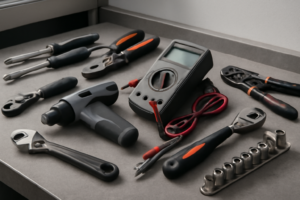
Essential Tools
- Phillips head screwdriver (#2)
- Flat-head screwdriver
- Needle-nose pliers
- Multimeter (to test igniter continuity)
- Soft toothbrush and mild degreaser (for cleaning electrodes)
Replacement Parts
Step-by-Step Repair Instructions
🔨 Pro Tip from Dave
On the NX58H5600SS, the surface igniter module is shared across multiple burners, so if more than one burner is clicking constantly but not sparking, don’t waste time replacing individual igniters — the problem is almost always a single faulty spark module or a ground issue, not multiple failed igniters at once. Before ordering any parts, press and hold one burner knob and watch whether ALL the igniters try to fire simultaneously; if they don’t, you’ve already narrowed it down to that burner’s specific igniter wire connection rather than the module itself.
Step 1: Remove Grates and Burner Caps
Lift off the cast-iron grates and set them aside, then remove the burner caps by simply lifting them straight up — they are not fastened. Inspect each cap for cracks or heavy carbon deposits that could block the gas ports. Damaged caps should be replaced even if the igniter itself is fine.
Step 2: Clean the Igniter Electrodes
Locate the ceramic igniter tip beside each burner head. Use a soft toothbrush and a small amount of rubbing alcohol or mild degreaser to scrub away any grease, food residue, or white mineral buildup from the tip. A dirty electrode is the single most common cause of ignition failure on this model — many repairs end right here.
Step 3: Test the Igniter Electrode
Set your multimeter to the resistance (Ohms) setting and test the igniter electrode leads. A healthy electrode typically reads between 1,000 and 4,000 ohms; an open circuit (OL or infinite resistance) indicates a failed electrode that must be replaced. Visually inspect the ceramic body for hairline cracks, which also cause intermittent ignition failure.
Step 4: Access and Inspect the Spark Module
Remove the cooktop panel by unscrewing the fasteners along the front edge, then carefully lift the top and prop it open. Locate the spark module — a small black box typically mounted near the front of the chassis with wires running to each burner igniter. Check all wire harness connectors for corrosion, burn marks, or loose terminals and reseat any that look suspect.
Step 5: Replace the Igniter Electrode (If Defective)
Disconnect the igniter wire from the old electrode and remove the mounting screw holding it to the burner base. Slide the new electrode into position, secure it with the screw, and reconnect the wire — referencing your earlier photograph to confirm correct terminal placement. Reassemble the cooktop, restore power, and test ignition with the gas supply still off; you should hear a sharp, consistent click.
Step 6: Replace the Spark Module (If Multiple Burners Fail)
If two or more burners fail to spark after cleaning and electrode testing, the spark ignition module is the likely culprit. Disconnect all igniter wires and the module’s power connector, remove the mounting screws, and swap in the new module. Reconnect wires in the same order as the original — the module ports are typically labeled by burner position.
Step 7: Reassemble and Final Test
Replace the cooktop panel, reinstall burner caps and grates, restore the gas supply, and plug the range back in. Turn each knob to ignite and confirm a clean, consistent flame on every burner within two seconds. If a burner still won’t light after all steps above, proceed to the professional help section below.
How Much Does This Repair Cost?
DIY parts for this repair typically run between $15 and $75 depending on what needs replacing — a single igniter electrode is usually $15–$30, while a full spark module runs $40–$75. Compare that to a professional service call on the Samsung NX58H5600SS, which averages $150–$300 once you factor in the diagnostic fee, labor, and parts markup. Completing this repair yourself can save you $100–$250 and keeps your range out of a service queue that can stretch days or weeks.
When to Call a Professional
Most of the repairs in this guide are within reach for a careful DIYer with basic tools. In my experience, the moment you detect the smell of gas after reassembly, hear a hissing from the valve area, or find that the burner valve itself feels stiff or was disturbed during the repair, that job needs to stop immediately and be handed to a licensed gas appliance technician — gas valve integrity is not something to test with trial and error. When in doubt, a diagnostic service call typically costs $80–$120 and can save you from a misdiagnosis that costs more in parts.
Where to Buy Replacement Parts
All three parts most commonly needed for this repair are readily available on Amazon with fast shipping. Search for the exact items below to find compatible replacements for the Samsung NX58H5600SS:
- Samsung NX58H5600SS Surface Burner Igniter Electrode Replacement
- Samsung NX58H5600SS Spark Ignition Module Replacement
- Samsung NX58H5600SS Burner Igniter Switch Replacement
Before you dive into the repair, know that the most common culprit behind a burner that won’t ignite on the NX58H5600SS is a failed oven igniter — and replacing it yourself is straightforward with the right part. The DG94-00520A Gas Range Oven Igniter Replacement Compatible with Samsung NX58F5500SS NX58H5600SS NX58H9500WS is a direct-fit replacement built specifically for your model, so you won’t have to worry about compatibility or modification. Swapping it in takes about 20–30 minutes and requires only basic tools. (As an Amazon Associate I earn from qualifying purchases.)
If you want a more versatile option that covers a wider range of appliances in your home, the Upgraded DG94-00520A Gas Range Oven Igniter Fit for Samsung NX58H5600SS NX58H9500WS Replacement for GE Whirlpool Hotpoint 2692271 AP5577941 WB13K21 Norton 501a W10918546 Range Oven by BOGDA is worth considering — it’s cross-compatible with Samsung, GE, Whirlpool, and Hotpoint models, making it a solid choice if you have multiple brands under one roof. The upgraded design is engineered to meet or exceed OEM specs, so you’re not sacrificing quality for versatility.
Once you’ve confirmed the igniter is the faulty component and you’re ready to order your replacement, the DG94-00520A Range Oven Igniter