Lid Lock Error
This guide walks you through diagnosing and fixing a lid lock error on the Maytag MVWC465HW top-load washing machine. The lid lock error prevents the washer from starting or advancing through a cycle and is one of the most common complaints on this model. Most homeowners with basic mechanical confidence can complete this repair in 1–2 hours using standard household tools, saving significant money over a service call.
Common Symptoms & Causes
The lid lock error on the MVWC465HW typically presents in several recognizable ways before the washer stops working entirely.
- The control panel displays an “Lid” error code or the lid lock indicator light flashes continuously
- The washer fills with water but stops before agitating or spinning
- You hear a repeated clicking sound as the lid lock attempts to engage but fails
- The cycle pauses mid-wash and will not resume even after opening and closing the lid
The most common root cause is a failed lid lock assembly or a broken actuator strike, though a faulty wiring harness connection or a worn door latch strike can also trigger the same error code.
Safety First
- Unplug the washer from the wall outlet before removing any panels or touching internal components
- Wear work gloves to protect your hands from sharp metal cabinet edges
- Photograph all wiring connections and harness routing before disconnecting anything
- Work in a well-lit space so you can clearly see connector tabs, screws, and lock alignment
Tools & Parts Needed
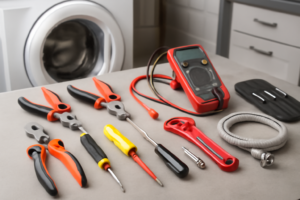
Essential Tools
- Phillips head screwdriver (#2)
- Flat-head screwdriver for prying clips
- ¼-inch nut driver or socket set
- Needle-nose pliers
- Multimeter for continuity testing
Replacement Parts
- Lid Lock Assembly (W10404050)
- Lid Lock Actuator Strike (W10328425)
- Lid Lock Wiring Harness Connector
Step-by-Step Repair Instructions
🔨 Pro Tip from Dave
On the MVWC465HW, the lid lock connector is notorious for developing a micro-corrosion film on the terminals that causes intermittent lock errors even when the harness looks perfectly fine — before you condemn the lock assembly, unplug the connector and hit both sides with a shot of electrical contact cleaner, then firmly reseat it, because I’ve closed out more than a few of these calls without replacing a single part. Skipping this step and going straight to parts is the most common — and most expensive — mistake I see DIYers make on this model.
Step 1: Run a Reset
Before disassembling anything, unplug the washer for 60 seconds, then plug it back in and lift and lower the lid six times within 12 seconds to reset the lid lock sensor. Start a new cycle to see if the error clears. If the error returns immediately, the mechanical or electrical component has failed and must be replaced.
Step 2: Inspect the Lid Strike
Open the lid and visually examine the plastic actuator strike mounted on the underside of the lid. Look for cracks, breakage, or missing plastic tabs that prevent the strike from fully engaging the lock mechanism. A broken strike is inexpensive and is the first part you should replace if you see visible damage.
Step 3: Access the Lid Lock Assembly
Unplug the machine and remove the two screws securing the control panel, then tilt it back to expose the cabinet clips. Use a flat-head screwdriver to release the spring clips on the front of the top panel and lift it off. The lid lock assembly is mounted at the front-right of the cabinet opening and secured with two screws.
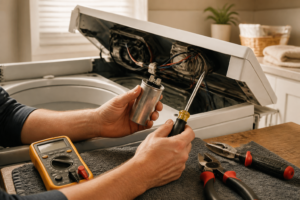
Step 4: Test the Lid Lock with a Multimeter
Disconnect the wiring harness from the lid lock assembly and set your multimeter to the continuity or Ohms setting. Test across the lock terminals — a functioning lid lock will show continuity when manually actuated and an open circuit when released. If you get no continuity in either position or no change at all, the lock assembly has failed.
Step 5: Check the Wiring Harness
Inspect the connector plug for burned contacts, corrosion, or broken locking tabs that allow the connector to pull loose during the spin cycle vibration. Gently tug each wire at the connector to check for loose crimps. A damaged harness connection can mimic a failed lock assembly and should be repaired or replaced before installing a new lock.
Step 6: Install the Replacement Lid Lock
Position the new lid lock assembly into the bracket opening and secure it with the two mounting screws — do not overtighten, as the housing is plastic. Reconnect the wiring harness until you hear the connector click firmly into place. Reinstall the top panel, secure the cabinet clips, and reattach the control panel screws.
Step 7: Test the Repair
Plug the washer back in and run a short cycle such as a quick wash or rinse-and-spin. Listen for the audible click of the lid lock engaging within a few seconds of starting the cycle. If the machine advances through all stages without displaying the error code, the repair is complete and successful.
How Much Does This Repair Cost?
Replacing the lid lock assembly on the Maytag MVWC465HW typically costs between $20 and $45 in parts when sourced online. The actuator strike alone costs under $10. Compare that to a professional appliance service call, which generally runs $150–$300 including labor and parts markup, and the DIY savings become clear. Even if you purchase all three replacement parts listed above as a precaution, you will likely spend less than $60 total.
Where to Buy Replacement Parts
All parts for this repair are readily available on Amazon with fast shipping. Use the links below to find compatible components for your Maytag MVWC465HW:
- Maytag MVWC465HW Lid Lock Assembly W10404050 replacement
- Maytag MVWC465HW Lid Lock Actuator Strike W10328425 replacement
- Maytag MVWC465HW Lid Lock Wiring Harness Connector replacement
Before you dive into diagnosing the issue, you’ll want to have a replacement lid lock on hand — these parts fail more often than any other component in this error sequence. The Washer Door Lid Lock Latch Switch Replace For Maytag MVWC415EW1 MVWC415EW2 MVWC416FW0 MVWC416FW1 MVWC465HW0 MVWC465HW1 MVWC465HW2 MVWC465HW3 7MMVWC416FW0 7MMVWC417FW0 MVWC415EW MVWC416FW MVWC465HW is a direct-fit replacement that covers the full MVWC465HW production run, so you’re not guessing at compatibility. It’s a plug-and-play swap with no wiring modifications required, which keeps the repair straightforward even if this is your first time opening up a top-load washer. (As an Amazon Associate I earn from qualifying purchases.)
If your unit is a later build — specifically an MVWC465HW3 or HW4 — or you’re also troubleshooting a related Maytag or Amana model in your home, you’ll need a lid lock rated for the updated harness connector used in those versions. The Lid Lock Switch Fit For Maytag MVWC465HW3 MVWC465HW4 MVWC555DW1 MVWC565FW0 MVWC565FW2 MVWC565FW3 MVWX655DW1 MVWX655DW2 NTW4516FW3 NTW4519JW0 NTW4519JW1 Washer covers those later serial ranges and cross-references several Am