Lid lock error
This step-by-step repair guide walks you through fixing lid lock error on your GE GTW720BSNWS (Top Load). With the right tools and parts, most homeowners can complete this repair in 1–2 hours and avoid a costly service call.
🔨 Pro Tip from Dave
On the GTW720BSNWS, always check the wiring harness connector at the lid lock before replacing the part — the connector (part WH12X10468) is notorious for developing a loose connection that mimics a full lid lock failure. A common mistake I see is techs replacing the entire lock assembly when simply reseating or cleaning that connector with electrical contact cleaner solves the problem. Also inspect the lid strike tab; if it’s cracked or misaligned, the new lock still won’t engage properly.
Part of our Top 20 Washing machine Models & Common Repair Issues Guide. Browse all washing machine repair guides for related models and issues.
“`html
Common Symptoms & Causes
The following symptoms typically point to a lid lock error on the GE GTW720BSNWS washing machine.
- The washer display shows an “E5” or “Lid” error code during a cycle
- The machine stops mid-cycle and refuses to continue or spin
- The lid lock light flashes repeatedly and the washer won’t start
- You hear a clicking sound but the lid never locks or unlocks
These issues are most commonly caused by a faulty lid lock assembly, a broken actuator switch, or worn wiring connections that prevent the lock mechanism from signaling the control board correctly.
“`
Safety First
- Unplug the washing machine from the power outlet before starting any repair — never work on a live appliance.
- Shut off the water supply valve before disconnecting any water lines or hoses.
- Wear work gloves when handling metal brackets, sheet metal edges, or sharp components.
- Take photos with your phone before disconnecting any wiring harnesses or connectors.
- Work in a well-lit area with enough floor space to lay removed panels flat.
Tools & Parts Needed
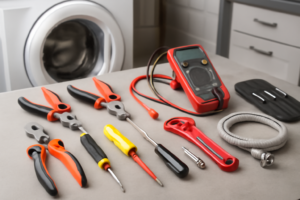
Essential Tools
- Phillips #2 screwdriver
- ¼” nut driver
- Torx T20 screwdriver
- Multimeter
- Bucket and towels
Replacement Parts
- Lid lock assembly
- lid strike
- Phillips screwdriver
- multimeter
Step-by-Step Repair Instructions
Step 1
Unplug the washer before doing anything, then firmly close and reopen the lid to check if the lock engages — lint or debris on the strike area can prevent the lock from seating properly, triggering a false error. Clean the strike recess with a dry cloth or compressed air and restore power to see if the error clears. Pro tip: this simple reset resolves the error in a surprising number of cases and costs nothing.
Step 2
Inspect the lid strike — the small plastic tab that the lock mechanism physically catches — for cracks, chips, or a sheared mounting point, because a damaged strike cannot fully engage the lock sensor regardless of how good the lock assembly itself is. If damaged, replace it by removing the single Phillips screw securing it to the lid. Always unplug the machine before handling any components, even small plastic parts.
Step 3
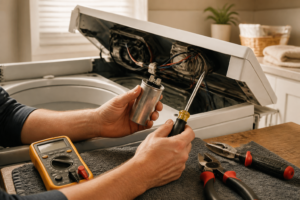
With the washer unplugged, disconnect the wiring harness from the lid lock assembly, which is mounted inside the top panel near the lid opening, and test the lock solenoid on Rx1 with a multimeter — a reading of open (OL/infinite resistance) means the solenoid coil has failed and the entire lock assembly must be replaced. This test confirms whether the lock itself is the fault rather than the signal coming to it. Safety note: never test continuity on a live circuit; always confirm power is disconnected before probing.
Step 4
Check that the lid closes flush and level, because if the hinges are loose or bent, the lid shifts slightly out of alignment and the strike misses the lock receiver — causing intermittent or persistent lid lock errors even when all electrical components are fine. Tighten the two T20 Torx screws on each hinge and retest lid alignment before going further. A straightedge or simply watching for even gap around the lid perimeter helps confirm proper alignment.
Step 5
If the lock assembly and strike both check out, the problem may be upstream: the control board may not be sending the 120V signal needed to actuate the lock. Using the GE service sheet for this model, activate technician mode and initiate a cycle while using a multimeter or non-contact voltage tester at the lock harness connector to confirm 120V is present when the cycle attempts to start — no voltage at this point with a known-good lock assembly points to control board failure. Pro tip: board replacement is the most expensive outcome, so exhaust all other steps and double-check wiring harness continuity before condemning the board.
Step 6
Restore power and run a complete test cycle, listening for an audible click from the lid lock within approximately three seconds of pressing Start — that click confirms the solenoid has actuated and the control system has recognized lid closure. If the lock engages, the error is resolved; if the error code returns, document at which point in the cycle it appears, as that information will help a technician pinpoint whether the fault is intermittent wiring, a marginal lock assembly, or a control board issue.
Where to Buy Replacement Parts
Find genuine OEM and aftermarket replacement parts for your GE GTW720BSNWS (Top Load) on Amazon:
- GE GTW720BSNWS lid lock assembly WH01X10310 replacement
- GE top load washer lid switch replacement
- GE washer lid lock strike replacement
When to Call a Professional
If the issue persists after completing all steps above, the problem may involve the sealed refrigerant system, a failed main control board, or wiring that requires specialized diagnostic equipment. Contact a licensed appliance technician — attempting sealed-system repairs without EPA 608 certification is illegal and unsafe.
“`html
How Much Does This Repair Cost?
DIY repair typically costs $10–$50 for a replacement lid lock assembly on the GE GTW720BSNWS. A professional service call, by comparison, runs $150–$300 once you factor in labor and parts. Tackling this repair yourself can save you $100–$250, making it a worthwhile fix for most homeowners.
“`
Frequently Asked Questions
Can I reset the lid lock error on my GE GTW720BSNWS without replacing any parts?
Yes, unplug the washer for one minute and plug it back in to reset the control board. If the error returns, the lid lock assembly likely needs replacement.
How do I know if the lid lock or the control board is causing the error?
Test the lid lock switch for continuity using a multimeter. If it reads properly but the error persists, the control board may be the root cause.
Is it safe to bypass the lid lock to finish a cycle?
Bypassing the lid lock is not recommended, as it disables a key safety feature that prevents injuries during spinning. Always repair or replace the faulty component before running the washer.
Recommended Products
These are the parts and tools we recommend for this repair, based on compatibility and customer reviews:
- WH08X32657 Washer lid Lock and Harness for GE, Replace WH08X31222 4963152 AP7033485 PD00070146 PS16619254, for Model GTW335ASN2WW GTW465ASN2WW GTW465ASN9WW HTW240ASK6WS GTW220ACK7WW GTW465ASN3WW
- EATAKWARD WH08X32697 Washer Lid Lock Switch Assembly, Replacement for GE GTW220ACK GTW330ASK GTW460AMJ GTW460ASJ GTW485ASJ GTW490ACJ Series, Replace WH01X24114 WH01X26114
- WH08X32657 WH08X31222 WH08X37937 Washer lid lock and harness for GE, replace 4963152 AP7033485 PD00070146. For Model GTW220ACK7WW GTW335ASN2WW GTW465ASN2WW GTW465ASN3WW GTW465ASN9WW HTW240ASK6WS
As an Amazon Associate, I earn from qualifying purchases.