My cookies kept burning, my roasted vegetables came out soggy, and my homemade bread wouldn’t brown properly. I blamed everything from my recipes to the flour I was using. Eighteen years of fixing appliances and it still took a friend’s suggestion to check the oven temperature before I thought to test the machine itself. What I discovered about oven thermometer accuracy was genuinely surprising — oven temperature drift is incredibly common, and most home cooks, myself included, never check for it.
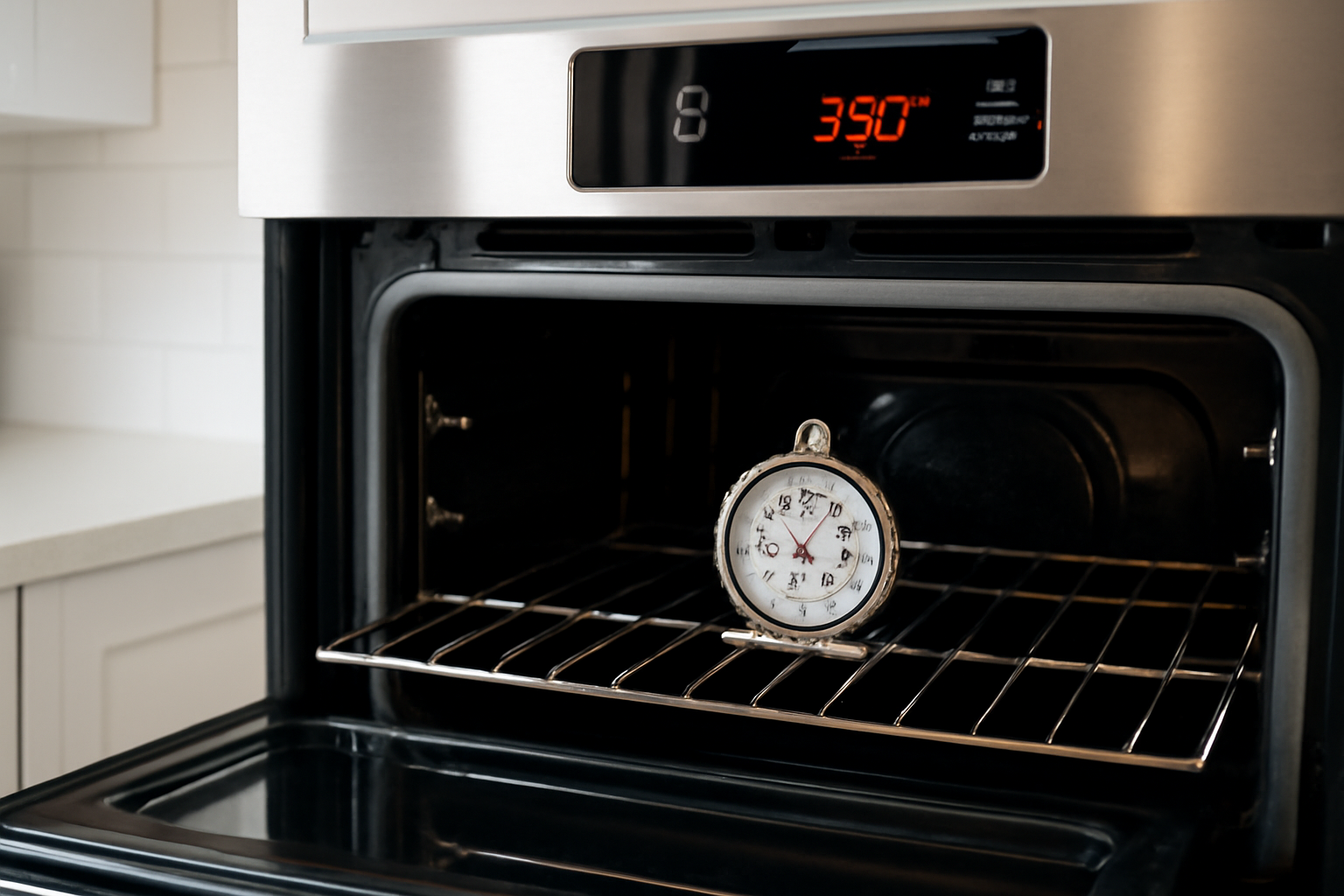
I decided to grab an AcuRite 00620A2 Stainless Steel Oven Thermometer for about $12, expecting it to confirm that my oven was in good shape and that my baking skills were lacking. Instead, I was shocked to find a staggering 40-degree discrepancy between the oven’s claimed temperature and the actual heat inside. That revelation changed everything about how I approach cooking.
This is a review based on three months of real daily use. I’ll dive into what I found, what improved, what didn’t, and whether this thermometer is worth your hard-earned cash. Spoiler alert: it probably is.
Why I Chose the AcuRite 00620A2 Stainless Steel Oven Thermometer
After reading through countless reviews and threads on Reddit, a few things became apparent. First, many budget digital oven thermometers have issues with battery reliability. Second, a straightforward analog dial thermometer was frequently recommended by both home bakers and appliance repair experts. The AcuRite name consistently rose to the top in those conversations.
I compared it with a few alternatives. Some cheaper models had dials that fogged up in the oven, while others had awkward mounting designs. The AcuRite 00620A2 offers a wide temperature range — from 150°F to 600°F — that covers everything from slow roasting to high-heat pizza baking, which is crucial for someone like me who cooks a variety of dishes.
Beyond the range, I appreciated the durability of the stainless steel construction. There are no plastic parts near the heat or batteries to fail at inconvenient times. The dual-use hook and stand design lets me place it on the oven rack or hang it from the rack above, depending on what I’m cooking. At just $12, it felt like a low-risk investment with a high potential reward.
First Impressions Out of the Box
The thermometer arrived in simple packaging — nothing fancy, just the thermometer itself. I was pleasantly surprised by how solid it felt for the price.
The dial face is clean and easy to read, with clear temperature markings in both Fahrenheit and Celsius. The needle moves smoothly and doesn’t feel loose. Holding it for the first time, it had a satisfying weight — not too heavy, but definitely not flimsy. There were no rough edges or cheap-looking seams on the stainless steel body.
One concern I had initially was the size of the dial face. It’s not huge — about two inches across. Reading it through a dark oven window without opening the door requires a bit of squinting. However, I usually open the door to check anyway, so it hasn’t been a significant issue. My first impressions were positive; it looked like a tool that would hold up over time.
My Testing Protocol — Three Months of Real Use
I didn’t just pop this thermometer in once and call it a review. Here’s how I genuinely tested it over three months.
Week One: Baseline Testing
During the first week, I ran my oven at five different set temperatures: 300°F, 325°F, 350°F, 375°F, and 425°F. At each setting, I let the oven preheat for a full 20 minutes — not just until the preheat beep, but a complete 20 minutes past it — and then checked the thermometer readings.
The results were eye-opening. At 350°F — the most common baking temperature — my oven was actually running at around 310°F. That’s a 40-degree difference. At 425°F, I was closer, with the thermometer reading around 400°F. At lower temps like 300°F, it was running cold by almost 30 degrees. I was consistently undercooking everything. Mystery solved.
Weeks Two Through Four: Cooking Adjustments
Armed with that data, I started adjusting my oven dial upward by 40–50 degrees when recipes called for standard temperatures. The results were immediate. My cookies browned beautifully. Roasted carrots caramelized perfectly. A chicken breast I had been consistently undercooking finally came out just right within the expected time.
I kept the AcuRite 00620A2 Stainless Steel Oven Thermometer on the center rack during most cooking sessions. Occasionally, I moved it to the lower rack to compare readings. There was a slight variation — about 10–15 degrees hotter near the bottom element during preheating, which stabilized after 15 minutes. It was great to have that information.
Month Two and Three: Long-Term Reliability
After two months, the thermometer still read consistently. It hadn’t fogged up, the dial hadn’t shifted, and the needle hadn’t stuck. I used it during high-heat roasting sessions at 500°F and slow braises at 250°F. Its performance has remained steady throughout.
There was one moment of doubt around the six-week mark. The readings seemed about 15 degrees higher than usual at 350°F. I wondered if it was malfunctioning. After some investigation, I realized my oven’s heating element cycling pattern was the issue — the thermometer was catching a spike right after the element turned on. Waiting a full 25-minute preheat resolved that inconsistency.
What Actually Changed in My Cooking
Let’s get straight to the point: this $12 thermometer has improved my cooking results more than any cookbook I’ve purchased in the last two years. Here’s what changed specifically.
- Baked goods: Cookies, muffins, and quick breads now bake in the expected time. No more adjusting racks mid-bake to compensate for uneven browning.
- Roasted meats: Chicken and pork now reach safe internal temperatures without any guesswork.
- Vegetables: High-heat roasting at 425°F actually means 425°F now. The caramelization happens as it should.
- Bread: My sourdough crust finally developed properly once I stopped trusting my oven’s built-in display.
- Confidence: I no longer second-guess recipe timing. When a recipe says 25 minutes at 375°F, I know exactly what that means in my oven.
That last point may seem small, but in practice, it’s transformative. Cooking no longer feels like a guessing game; it’s become a reliable process.
The Downsides — Let’s Be Honest
No product is perfect. Here are the limitations I’ve encountered with the AcuRite 00620A2 Stainless Steel Oven Thermometer over the past three months.
The Dial Is Small
Reading the thermometer through the oven door window without opening it can be a challenge. The dial face is compact, and if your oven has a tinted or small viewing window, you’ll likely need to open the door to get an accurate read — which lets heat escape. It’s a minor annoyance but not a dealbreaker.
No Memory or Logging
This thermometer is purely analog. It shows you the current temperature and nothing else. There’s no max/min memory, no app connectivity, and no data logging. If you need trend data or precise calibration documentation for a professional kitchen, you’ll want something more sophisticated. But for home use, its simplicity is often a feature, not a flaw.
Placement Affects Readings
Where you position the thermometer matters. Near the heating element, readings can spike, while too close to the door can cause readings to drop. Center rack placement offers the most useful average temperature. It took me about a week of experimentation to find the sweet spot in my oven, so that’s worth noting.
It Doesn’t Fix Your Oven
This is crucial. A thermometer tells you what’s wrong; it doesn’t repair anything. My oven still runs 40 degrees cold. I’ve adjusted my cooking habits accordingly. Eventually, I’ll need a professional to recalibrate or repair the temperature sensor. The thermometer serves as a diagnostic tool and a workaround, not a permanent solution. If your oven has a serious malfunction beyond simple calibration drift, a tool like this will reveal the problem but won’t fix it.
Final Verdict — Oven Thermometer Accuracy Calibration Review
After three months of daily use, my verdict is straightforward: buy this thermometer. The AcuRite 00620A2 is reliable, well-built for the price, and genuinely useful. At $12, it costs less than a single failed baking experiment.
The $12 Oven Thermometer That Exposed My Oven’s Temperature Lie
Before you rush off to order a new heating element or call a technician, grab an independent oven thermometer and actually verify what temperature your oven is truly running at. This is the quickest way to determine whether your baking troubles stem from a calibration issue you can tackle yourself or a genuine heating component failure requiring parts replacement.
What works
- The dial is large and easy to read at a glance through the oven window — you don’t have to open the door repeatedly and lose oven heat while squinting at tiny numbers.
- Stainless steel construction means it won’t rust or degrade after months of sitting in a hot oven, and it’s heavy enough that it won’t tip over on a rack.
- The hook design lets you hang it from an oven rack at mid-height, providing the most accurate reading of the actual temperature your food is experiencing — not just the air near the top or bottom.
What doesn’t
- Analog dial thermometers can drift slightly over years of use, so this isn’t a certified calibration tool — it’s a practical diagnostic, not a lab instrument.
- If your oven has a convection fan, the thermometer reading will fluctuate more than in a standard oven, so you need to let it stabilize for 15–20 minutes before trusting the number.
My mistake was assuming my oven dial was correct for the first six months — I wasted ingredients and blamed my technique before I even thought to check. The AcuRite 00620A2 Stainless Steel Oven Thermometer took just five minutes to show me that my oven was running 40 degrees cold, allowing me to either recalibrate the dial (if my model permitted) or adjust every recipe by that offset going forward.
About This Article

Written by Dave Holt. Dave Holt has been taking apart and fixing household appliances since he was a teenager who couldn't leave a broken one alone. Eighteen years later, after fixing things for neighbors, friends, and anyone who'd let him, he's seen almost every failure mode there is. When he writes a repair guide here, it's based on the actual job, not a manufacturer overview. More about this site.
Scope and limits. Dave is a self-taught repairer, not a certified appliance technician. Unplug before you open anything, and leave sealed refrigeration systems, gas connections, and hardwired circuits to a qualified technician.