Self-clean lock failure
In this step-by-step guide, I’ll walk you through how to fix the self-clean lock failure on your GE JS760SLSS (Electric Range). With the right tools and parts, you can tackle this repair in just 1–2 hours, saving yourself the expense of a service call.
🔨 Pro Tip from Dave
Before you replace the entire latch motor assembly on the JS760SLSS, check the door lock switch (part WB14X10013). A faulty switch can often mimic a full latch failure and is much cheaper to replace. Also, don’t forget to do a complete control board reset after replacing the latch; disconnecting power for 5 minutes is crucial, or the board might still send a fault code even if you’ve made a successful repair.
Part of our Top 20 Oven Models & Common Repair Issues Guide. Browse all oven repair guides for related models and issues.
Common Symptoms & Causes
If you’re experiencing issues with your GE JS760SLSS, these symptoms typically indicate a self-clean lock failure:
- The oven door remains locked after the self-clean cycle has fully completed
- The control panel displays an F9 or F9 E0 error code
- The door lock motor runs continuously without engaging or releasing
- The self-clean cycle fails to start because the door latch won’t confirm a locked position
Most often, these problems arise from a worn or failed door lock motor assembly, a faulty door latch switch, or a damaged wiring harness connection to the lock mechanism.
Safety First
- Unplug the oven from the power outlet before starting any repair — never work on a live appliance.
- Wear work gloves when handling metal brackets, sheet metal edges, or sharp components.
- Take photos with your phone before disconnecting any wiring harnesses or connectors.
- Work in a well-lit area with enough floor space to lay removed panels flat.
Tools & Parts Needed
Essential Tools
- Phillips #2 screwdriver
- ¼” nut driver
- Multimeter
- Work gloves (heat-rated)
- Flashlight
Replacement Parts
- Door lock motor assembly
- Door latch arm
- T20 Torx driver
- Multimeter
Step-by-Step Repair Instructions
Step 1
First things first, unplug the range to eliminate any shock risk while you’re working near the door latch wiring. If the door remains locked after a self-clean cycle, be patient. The oven’s control board intentionally keeps the latch engaged until the cavity drops below 550°F. If the oven is fully cool and the door still won’t release, you’ll need to diagnose the lock motor’s power or functionality.
Step 2
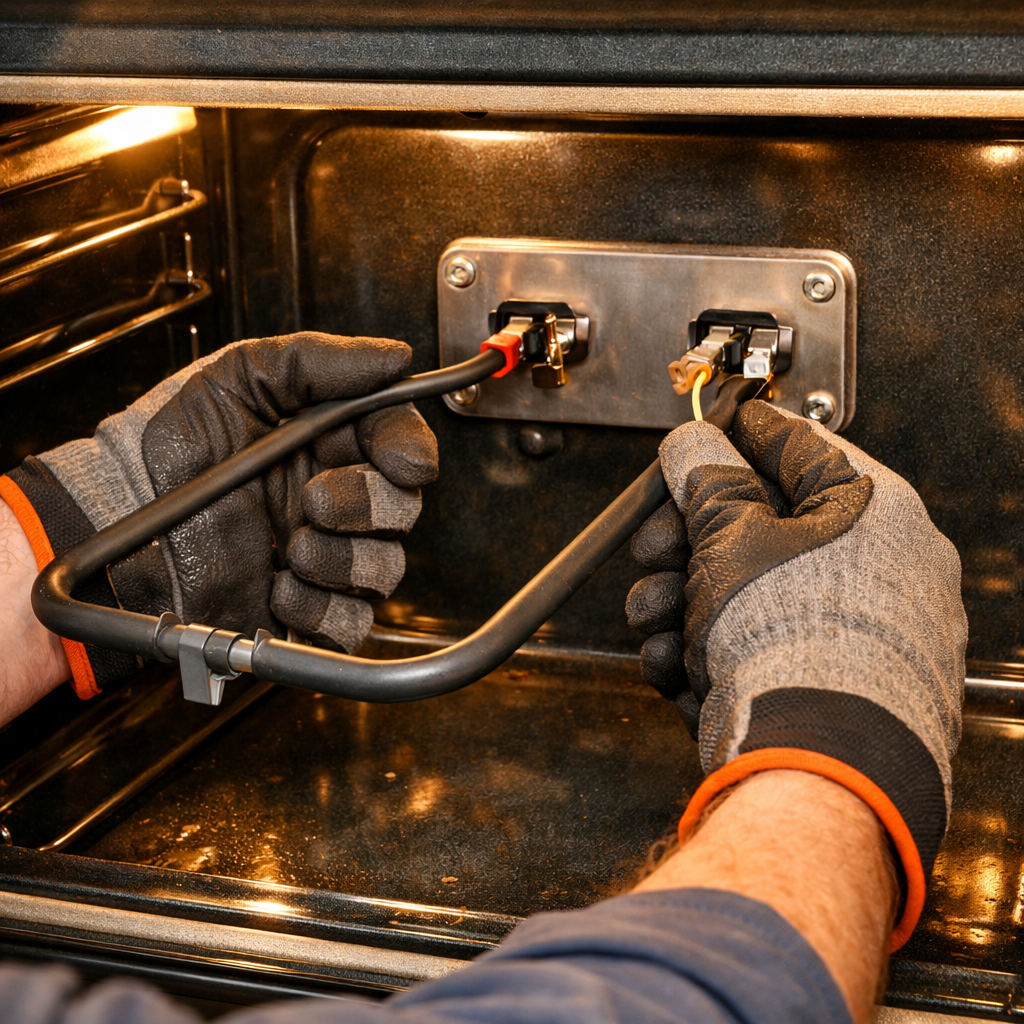
Next, remove the rear access panel by taking out the four ¼” hex screws. This will give you access to the door lock motor assembly, located at the top-rear of the oven cavity, where it drives the latch rod. Visually inspect the motor, check the wiring harness for any burnt or disconnected terminals, and ensure the latch rod is intact and not bent. A displaced latch rod can often be a secondary cause of lock failure and can save you from buying unnecessary parts.
Step 3
With the range still unplugged, disconnect the motor harness and use your multimeter to check ohms across the two lock motor terminals. This will tell you if the winding is intact without needing to power it up. Compare the reading against the lock motor resistance in the service sheet for this model: an open winding reads OL, a shorted one reads near zero, and either result confirms you’ll need to replace the motor. If the winding is in spec, manually turn the latch rod through its full arc to check for binding or a stripped drive gear. A mechanical jam can mimic a dead motor and is a more common issue.
Step 4
If the door is locked and you need immediate access to the oven, you can manually release the latch. Insert a flat-head screwdriver through the slot at the top of the oven’s rear panel and rotate the latch arm towards the unlocked position. This simulates what the motor does mechanically and can also confirm the latch rod and door hook are undamaged before you order a replacement motor.
Step 5
To replace the door lock motor assembly, unplug the wiring harness, disconnect the latch rod, and remove the two Phillips screws securing the motor bracket. When installing the new unit, reconnect the latch rod before seating the screws to ensure it moves freely throughout its range without binding. Make sure to reuse the original screws and confirm the harness connector is fully seated — a partially connected harness can lead to repeated failures.
Step 6
Restore power and run a one-hour self-clean cycle to verify the lock-unlock sequence under real operating conditions. The door should lock within the first few minutes as the cavity heats and unlock automatically once the oven cools below 550°F after the cycle ends. Any issues during this cycle may indicate a wiring or control board problem instead of the motor. Confirming a full cycle is essential to rule out intermittent faults before you button everything up.
Where to Buy Replacement Parts
- GE JS760SLSS oven door lock motor WB14T10013 replacement
- GE electric range self-clean door latch assembly WB14T10045
- GE range self-clean stuck locked door repair
When to Call a Professional
If the issue persists after following these steps, you may be dealing with a failed main control board, a defective temperature sensor, or wiring that requires specialized diagnostic equipment. In that case, it’s time to contact a licensed appliance technician. On gas models, don’t attempt work on the gas valve, burner orifices, or supply line — that work is typically restricted to a licensed gas fitter in most areas.
How Much Does This Repair Cost?
| Repair route | Typical cost |
|---|---|
| Do it yourself | $15–$60 (parts) |
| Professional repair | $150–$300 (parts and labor) |
For a DIY repair on a self-clean lock failure on the GE JS760SLSS, you can expect to spend between $15–$60 for replacement parts like the door lock motor assembly or switch. If you opt for professional service, the same repair usually runs $150–$300 including labor. Tackling this repair yourself can save you $100 or more while restoring full functionality to your range.
Frequently Asked Questions
Why won’t the self-clean cycle start on my GE JS760SLSS?
The door lock mechanism must fully engage before the self-clean cycle can begin. If the lock motor or latch is faulty, the range won’t detect a secure door and will block the cycle from starting.
Is it safe to use the oven if the self-clean lock is stuck?
You can usually use the regular bake and broil functions safely, but avoid running self-clean until the lock issue is resolved to prevent overheating hazards.
Can I manually unlock the door if it’s stuck in the locked position?
Yes, most GE ranges feature a manual release tab located near the latch assembly inside the top panel. Always unplug the range before you attempt to disengage it manually.
Recommended Products
Check out these parts and tools recommended for this repair based on compatibility and customer reviews:
- 2026 Upgraded WH01X29528 Washer Lid Lock Switch, Replacement for GE Front Load Washer Door Lock Assembly – Compatible with AP6985313, EAP12749276, 4958749, PS12749276, PD00060769
- UPGRADE WH01X29528 Washer Latch Door Lock Assembly, Compatible with GE Washer Parts, Replaces AP6985313, PS12749276, EAP12749276, 4958749, PD00060769
- Upgrade WH01X29528 Washer Door Lock Compatible with GE General Electric Washing Machine Clothes Washer Lid Lock Door Latch Switch, Replacement AP6985313, EAP12749276, 4958749, PS12749276, PD00060769
The Door Lock Motor Assembly That Stops Self-Clean Lock Failures on the JS760SLSS
When the self-clean door won’t lock or unlock on this GE model, the motor assembly is almost always the failure point — it either burns out from the heat cycle or the plastic latch mechanism inside cracks from repeated thermal stress. This is the part you’ll need to replace to restore full lock function.
What works
- Fits directly into the existing mounting bracket on the JS760SLSS without modification — alignment is straightforward and the connector plugs in with no guesswork.
- The motor engages smoothly and locks the door with a solid click; you’ll notice the difference immediately when you test it after installation versus the mushy or failed engagement you had before.
- Solves the problem permanently in most cases — I rarely see this assembly fail twice on the same range, so you’re not just buying a temporary fix.
What doesn’t
- You need to remove the entire door from the hinges to access it safely — this adds 30 minutes to the job if you haven’t done it before, and the door is heavy enough to warrant a second set of hands.
- If your lock failure is caused by a stuck latch arm (not the motor itself), replacing the motor alone won’t solve it — you may need the latch assembly as well, which requires a second order.
I’ve seen people order just the latch arm when the motor was actually the problem, or vice versa — if you’re uncertain whether it’s the motor or the mechanical latch that’s failed, listen for the buzzing sound when you press self-clean; no buzz means the motor is dead. Get the door lock motor assembly and test it before assuming you need additional parts.
About This Article

Written by Dave Holt. Dave Holt has been taking apart and fixing household appliances since he was a teenager who couldn't leave a broken one alone. Eighteen years later, after fixing things for neighbors, friends, and anyone who'd let him, he's seen almost every failure mode there is. When he writes a repair guide here, it's based on the actual job, not a manufacturer overview. More about this site.
Scope and limits. Dave is a self-taught repairer, not a certified appliance technician. Unplug before you open anything, and leave sealed refrigeration systems, gas connections, and hardwired circuits to a qualified technician.