Not Cleaning Dishes
In this guide, I’m going to walk you through diagnosing and fixing a Whirlpool WDT730PAHZ built-in dishwasher that isn’t cleaning dishes properly. I’ll cover the most common culprits, from a clogged spray arm to a failing wash pump, and provide you with clear, actionable steps to restore your dishwasher’s performance. If you’re comfortable with basic tools, you can handle this repair in about 1 to 2 hours.
Common Symptoms & Causes
Before diving into repairs, let’s confirm your dishwasher matches one or more of these symptoms:
- Dishes emerge with food residue or a greasy film after a full cycle
- The bottom rack cleans poorly while the top rack appears cleaner, or vice versa
- Standing water or gritty debris remains in the bottom of the tub after the cycle ends
- The dishwasher runs a full cycle but dishes feel as though they were never sprayed with water
In my experience, the most common issue with the WDT730PAHZ is a blocked or damaged spray arm combined with a clogged filter assembly. This restriction hampers water flow and pressure during the wash cycle.
Safety First
- Unplug the dishwasher from the wall outlet or switch off the dedicated circuit breaker before beginning any work
- Wear work gloves to protect your hands from sharp metal edges inside the tub and door panel
- Photograph all wiring connections before disconnecting anything so you can reassemble correctly
- Work in a well-lit space and keep a dry towel nearby to absorb residual water in the sump area
Tools & Parts Needed
Essential Tools
- Phillips head screwdriver (#2)
- Torx T20 screwdriver bit
- Needle-nose pliers
- Small soft-bristle brush or old toothbrush for cleaning ports
- Multimeter for testing the wash motor and water inlet valve
Replacement Parts
- Upper and Lower Spray Arm Assembly
- Fine Mesh Filter and Ultra-Fine Filter Assembly (W10872845)
- Circulation Pump and Wash Motor Assembly (W11032770)
Step-by-Step Repair Instructions
🔨 Pro Tip from Dave
On the WDT730PAHZ, the middle spray arm feeds through a tower that clips into the upper rack — homeowners often overlook it when cleaning spray arms, mistaking the clog for an upper rack alignment issue. Pull that rack all the way out and spin the tower spray arm by hand; if it’s stiff or won’t rotate freely, that arm alone can kill wash performance on the entire top and middle zones.
Step 1: Remove and Inspect the Filter Assembly
Start by pulling out the lower rack and locating the cylindrical filter in the center of the tub floor. Twist the upper filter counterclockwise and lift it out along with the flat mesh screen beneath it. Rinse both pieces under warm running water and use a soft brush to clear any packed food debris from the mesh. If the mesh is torn or the plastic housing is cracked, it’s time to replace the filter assembly. A damaged filter lets food particles recirculate and coat your dishes.
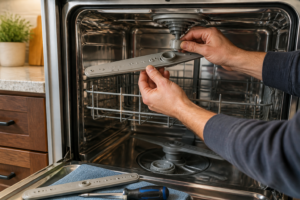
Step 2: Clean the Lower Spray Arm
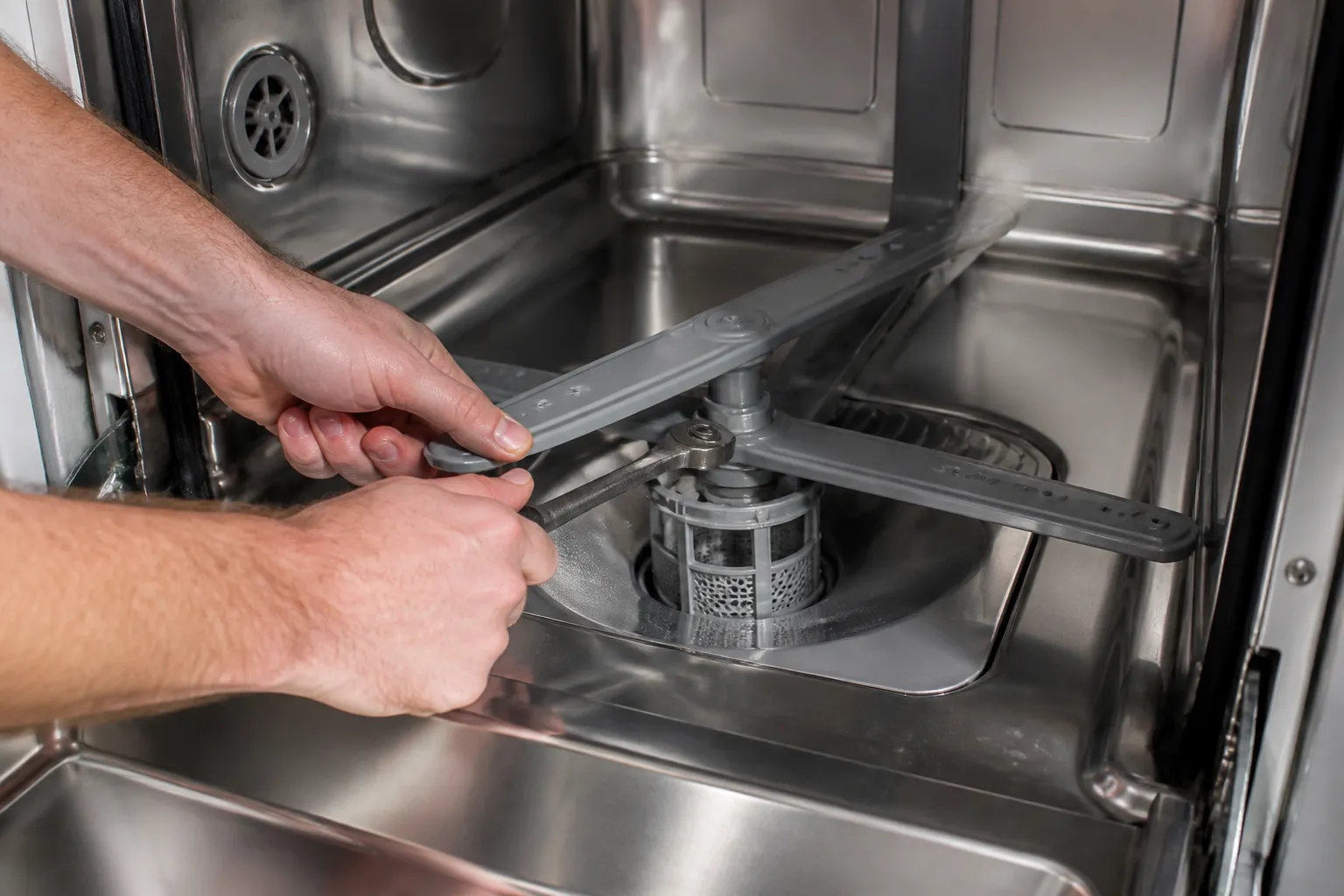
Lift the lower spray arm straight up off its center post — it snaps off without tools on the WDT730PAHZ. Hold it up to a light source and look through each spray nozzle hole; blocked holes will show no light. Use a toothpick or thin wire to clear each port, then flush water through the arm. If the arm is cracked or wobbles excessively on its post, you’ll need to replace it to restore even water distribution across the lower rack.
Step 3: Clean the Upper Spray Arm and Delivery Tube
Next, remove the upper rack entirely, then unscrew the upper spray arm by turning the center nut clockwise (it’s reverse-threaded). Check all nozzle ports and the delivery tube connection at the back of the tub for lime scale buildup. If mineral deposits are heavy, soak the arm in white vinegar for 20 minutes, then rinse and reinstall. A restricted upper spray arm often causes poor cleaning specifically on the top rack.
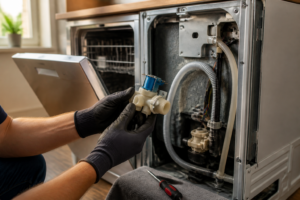
Step 4: Check the Water Inlet Valve
Shut off the water supply and disconnect the inlet line at the bottom left of the dishwasher cabinet. Visually inspect the inlet screen inside the valve port for sediment buildup and clean it if necessary. Use your multimeter to test the solenoid coil — a healthy valve reads between 500 and 1500 ohms; an open or shorted reading indicates the valve is faulty and needs replacement, as inadequate water fill volume directly causes poor wash performance.
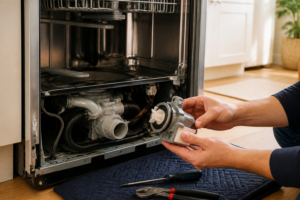
Step 5: Test the Circulation Pump Motor
Access the circulation pump by removing the lower access panel and tilting the dishwasher back slightly. Disconnect the pump motor wiring harness and test the motor windings with your multimeter — expect a resistance reading of roughly 4 to 6 ohms on a good motor. If the reading is infinite (open circuit) or zero (short), the wash pump assembly needs replacement; a weak pump produces very low spray pressure even when the filter and spray arms are perfectly clean.
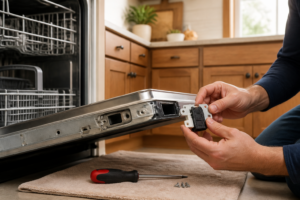
Step 6: Verify Detergent Dispenser Operation
Open the door and manually actuate the detergent dispenser lid to confirm it snaps open freely and isn’t sticky or warped. Run a short wash cycle and check mid-cycle whether the door has released — a stuck dispenser means detergent never enters the wash water, leaving dishes unclean regardless of water pressure. If the spring or latch is broken, the dispenser assembly (part W10224430) is inexpensive and straightforward to swap out.
Step 7: Run a Test Cycle and Verify Results
After reassembling all components, restore power and water, and run a heavy-duty cycle with a fresh detergent pod and a rinse aid dispenser filled to the max line. Check dishes immediately after the cycle ends — they should come out clean, with no residue and no standing water in the tub. If cleaning remains poor after completing all steps, it may be time to seek professional guidance.
How Much Does This Repair Cost?
| Repair route | Typical cost |
|---|---|
| Do it yourself | $15–$120 (parts) |
| Professional repair | $150–$300 (parts and labor) |
DIY parts for this repair typically run between $15 and $120 depending on which component is at fault. A replacement filter assembly costs around $15 to $25, new spray arms run $20 to $40, and a full circulation pump assembly is the largest expense at $70 to $120. Compare that to a professional service call on the WDT730PAHZ, which averages $150 to $300 including labor and parts markup. Doing the repair yourself saves $100 to $200 or more and can be completed in a single afternoon.
When to Call a Professional
Most of the repairs in this guide are manageable for a careful DIYer with basic tools. From my experience, if you’ve cleaned the filter, cleared the spray arms, and confirmed water is filling properly but the wash pump runs loudly, pulses, or hums without building pressure, you’re likely facing a pump motor failure or a seized impeller. This requires proper diagnosis with a multimeter and safe pump disassembly — that’s when it’s best to call a certified tech to avoid risking damage to the sump assembly. When in doubt, a diagnostic service call typically costs $80–$120 and can save you from a misdiagnosis that costs more in parts.
The Lower Wash Arm That Actually Fixes Most WDT730PAHZ Cleaning Problems
If your filter is clean but dishes are still coming out spotty or cloudy, the lower wash arm is usually the next culprit—it either won’t spin freely because of mineral buildup, or the spray holes are completely blocked. Replacing it is faster and cheaper than guessing whether it’s a pump problem.
What works
- OEM fit means it drops in without adapter fussing—the connection point and bolt holes line up exactly on the WDT730PAHZ, no surprises during installation.
- The spray holes come factory-clean, so you immediately see the difference in water distribution when you run a test cycle—no more weak or one-sided spray patterns.
- It’s one of the few parts you can swap in under 10 minutes without draining the sump or removing the entire tub assembly.
What doesn’t
- If your water pressure is genuinely low (a pump or inlet valve issue), a new arm won’t fix it—you’ll swap the part and still get weak cleaning because the water volume itself is the problem.
- You have to pull the lower rack and filter assembly to access it, which means a few extra steps if you’re not used to taking apart the interior.
I’ve seen plenty of folks order a new pump motor first because they assume poor cleaning means weak water flow, when really it’s just a clogged or worn arm that spins half-speed—so don’t skip the visual inspection of that lower arm before you order anything. Whirlpool WPW10491331 Genuine OEM Dishwasher Lower Wash Arm Assembly Replacement Part – Replaces W10491331
About This Article

Written by Dave Holt. Dave Holt has been taking apart and fixing household appliances since he was a teenager who couldn't leave a broken one alone. Eighteen years later, after fixing things for neighbors, friends, and anyone who'd let him, he's seen almost every failure mode there is. When he writes a repair guide here, it's based on the actual job, not a manufacturer overview. More about this site.
Scope and limits. Dave is a self-taught repairer, not a certified appliance technician. Unplug before you open anything, and leave sealed refrigeration systems, gas connections, and hardwired circuits to a qualified technician.