E1 Error Code
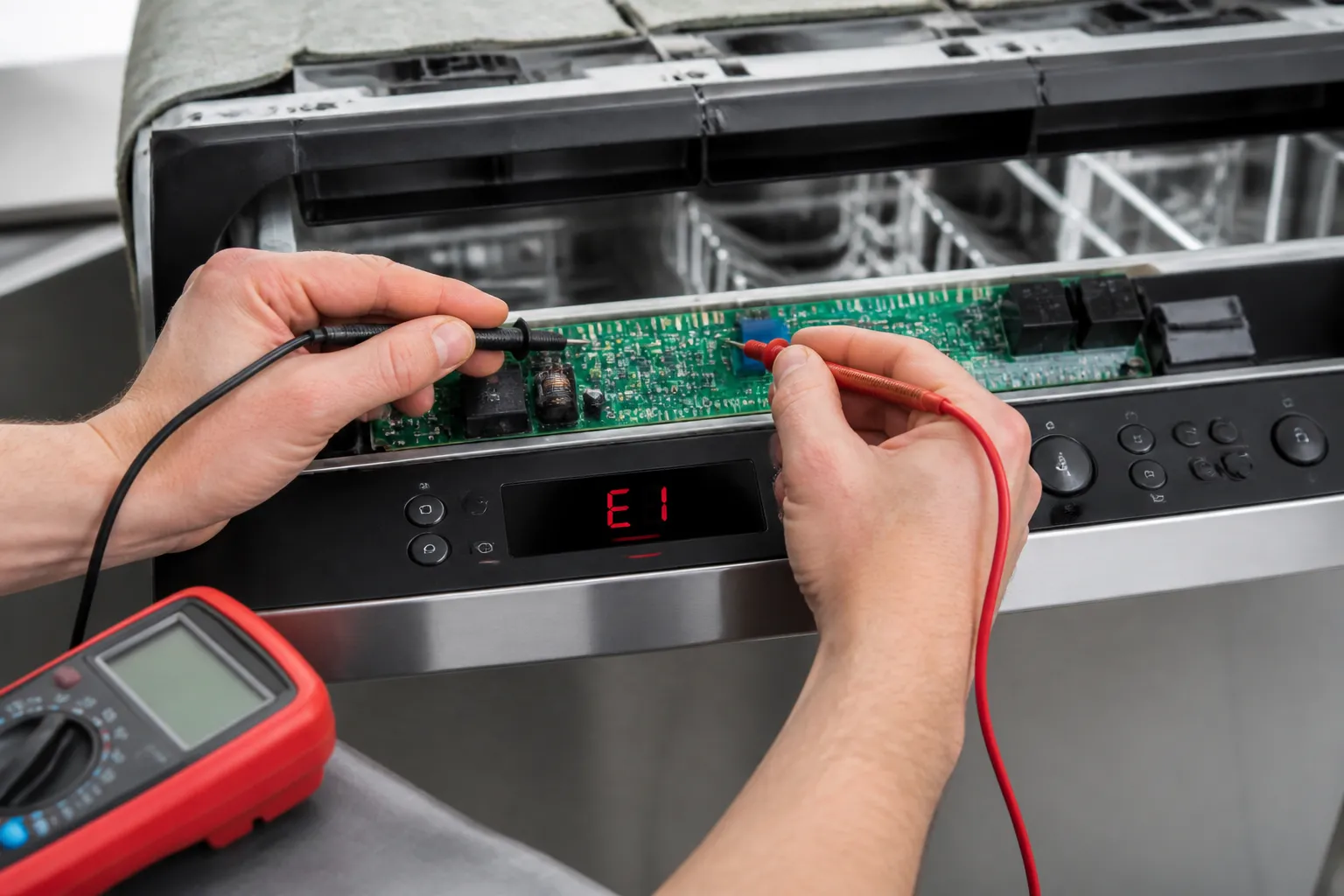
In this guide, I’ll walk you through diagnosing and fixing the E1 error code on your Bosch SHPM88Z75N built-in dishwasher. When you see this E1 code, it’s indicating a water heating fault. Simply put, your dishwasher isn’t heating the water to the target temperature within the expected time frame. If you have a bit of mechanical confidence, you can tackle this repair in about 1–2 hours with common household tools, saving yourself hundreds of dollars compared to a professional service call.
Common Symptoms & Causes
Before diving into repairs, let’s confirm that your dishwasher is showing these telltale signs of an E1 fault:
- E1 error code displayed on the control panel mid-cycle or at cycle start
- Dishes coming out cold, wet, or with detergent residue still present
- Dishwasher stops running and refuses to complete a full wash cycle
- Heating indicator light flashing or control panel becoming unresponsive
In my experience, the most common causes of the E1 code on the SHPM88Z75N are usually a failed heating element or a faulty NTC temperature sensor that incorrectly reports water temperature to the control board.
Safety First
- Unplug the dishwasher from the wall outlet or switch off the dedicated circuit breaker before beginning any work
- Wear work gloves throughout the repair to protect against sharp metal edges inside the appliance
- Photograph all wire harness connections before disconnecting anything so you can reassemble correctly
- Work in a well-lit space and use a flashlight or headlamp when inspecting components beneath the unit
Tools & Parts Needed
Essential Tools
- Phillips head screwdriver (#2)
- Torx T20 screwdriver bit
- Digital multimeter for continuity and resistance testing
- Needle-nose pliers for wire connector removal
- Towels and a shallow pan to catch residual water
Replacement Parts
- Bosch SHPM88Z75N Heating Element (Part #00778785)
- Bosch SHPM88Z75N NTC Temperature Sensor (Part #00611316)
- Bosch SHPM88Z75N Electronic Control Board (Part #00746361)
Step-by-Step Repair Instructions
🔨 Pro Tip from Dave
On the SHPM88Z75N specifically, always check the wire harness connector at the heating element for heat-related corrosion before condemning the element itself. I’ve seen units throw a persistent E1 code where the element tested fine, but a corroded terminal was breaking the circuit under load. A light sand with fine emery cloth and dielectric grease on that connector has saved more than a few people an unnecessary $80 part.
Step 1: Reset the Error Code
Start by performing a hard reset: hold the Start button for 3 seconds to cancel the current cycle, then power down the dishwasher at the breaker for 5 minutes before restoring power. Run a short test cycle to see if the E1 code returns. If it clears, a temporary sensor glitch was likely the culprit; if it comes back, continue to Step 2.
Step 2: Access the Dishwasher Interior
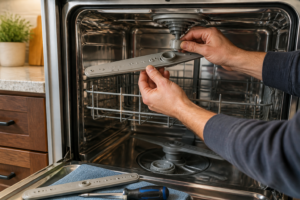
Open the dishwasher door fully and remove both dish racks to clear your workspace. Use your Phillips screwdriver to remove the lower spray arm by unscrewing the center retaining nut counterclockwise. Set all components aside on a clean towel to avoid losing small parts.
Step 3: Remove the Filter Assembly and Sump Cover
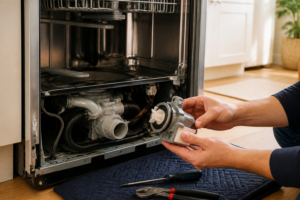
Twist and lift the cylindrical filter, then remove the flat mesh filter beneath it. Unscrew the sump cover to expose the heating element and temperature sensor at the base of the tub. Have your towels ready, as a small amount of water will drain from the sump when the cover is removed.
Step 4: Test the NTC Temperature Sensor
Locate the NTC sensor clipped near the heating element and disconnect its two-wire harness. Set your multimeter to resistance (Ω) mode and probe both terminals — at room temperature, you should read approximately 10,000–12,000 ohms. If you get a reading of zero or infinite resistance, the sensor is faulty and needs to be replaced.
Step 5: Test the Heating Element
Disconnect the heating element’s wire leads and set your multimeter to continuity mode. Touch the probes to each terminal on the element; a healthy element will show continuity with a resistance of roughly 20–30 ohms. No continuity or a reading outside this range means the element has burned out and needs replacement.
Step 6: Replace the Faulty Component
If the sensor failed, unclip it from its bracket, slide the new NTC sensor into place, and reconnect the wire harness — no sealant is required. If the heating element failed, use your Torx T20 bit to remove the two mounting screws securing the element flange to the tub floor. Pull the element free, press the new element into position, secure it with the mounting screws, and reconnect the wire leads.
Step 7: Reassemble and Test
Reinstall the sump cover, both filter layers, and the lower spray arm, ensuring all components are firmly seated and the spray arm spins freely by hand. Restore power at the breaker, select a Normal wash cycle, and monitor the first 10 minutes of the cycle to confirm the machine heats water without triggering the E1 code. If the error does not return, you’ve successfully completed the repair.
How Much Does This Repair Cost?
| Repair route | Typical cost |
|---|---|
| Do it yourself | $15–$35 (parts) |
| Professional repair | $150–$300 (parts and labor) |
When you replace the NTC temperature sensor yourself, you’re looking at a cost of around $15–$35 for the part alone. A new heating element will run you about $40–$80 depending on where you shop. Even if you decide to replace both components, your total DIY cost stays well under $120. Compare that to a professional appliance service call, which typically runs $150–$300 just for the visit and labor. That means this repair can save you anywhere from $100 to $250 or more.
When to Call a Professional
Most of the repairs in this guide are well within reach for a careful DIYer with basic tools. In my experience, if you’ve already replaced the heating element and NTC sensor and the E1 code returns within a few cycles, that’s your signal to stop. At that point, the fault is almost certainly in the control module or an intermittent wiring issue deeper in the harness that requires proper diagnostic equipment and hands-on inspection to isolate safely. When in doubt, a diagnostic service call typically costs $80–$120 and can save you from a misdiagnosis that could cost even more in parts.
The Heating Element That Stops the E1 Code Cold
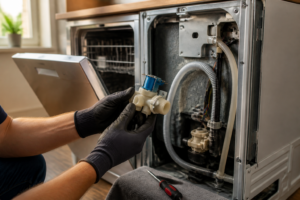
When you’ve ruled out water inlet issues and the E1 error persists, the heating element is the one to grab next—it’s the most common failure point after the inlet valve, and a dead element will throw this code because the dishwasher can’t reach its target temperature during the cycle.
What works
- Direct OEM replacement for the SHPM88Z75N with no adapter fiddling—it bolts in where the failed element came out and the connector seats flush.
- Easy continuity check before you even pull this part; if your multimeter reads open circuit across the element terminals, you know you’ve found your culprit and can order with confidence.
- Installation takes about 20 minutes once you access the tub from underneath—no control board reprogramming or sensor calibration headaches afterward.
What doesn’t
- Sometimes the E1 code is actually the NTC temperature sensor reporting a bad reading, not the element itself failing—if you replace the element and the error comes right back, you’ll need to test the sensor next.
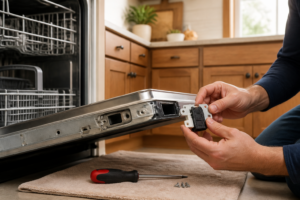
- Access requires dropping the kickplate and tub collar, which means water spillage risk if the tub isn’t fully drained first—I’ve learned to run a drain cycle and open the door to let evaporation happen before I crawl underneath.
The real friction point I see is homeowners jumping straight to this part when the inlet valve was actually the problem. I’ve had calls where someone replaced a perfectly good heating element because they skipped the pressure switch test. Start with the inlet valve diagnosis in the main section, confirm with your multimeter on the heating element, and then grab the Bosch SHPM88Z75N Heating Element (Part #00778785) when that continuity test shows an open circuit.
About This Article

Written by Dave Holt. Dave Holt has been taking apart and fixing household appliances since he was a teenager who couldn't leave a broken one alone. Eighteen years later, after fixing things for neighbors, friends, and anyone who'd let him, he's seen almost every failure mode there is. When he writes a repair guide here, it's based on the actual job, not a manufacturer overview. More about this site.
Scope and limits. Dave is a self-taught repairer, not a certified appliance technician. Unplug before you open anything, and leave sealed refrigeration systems, gas connections, and hardwired circuits to a qualified technician.