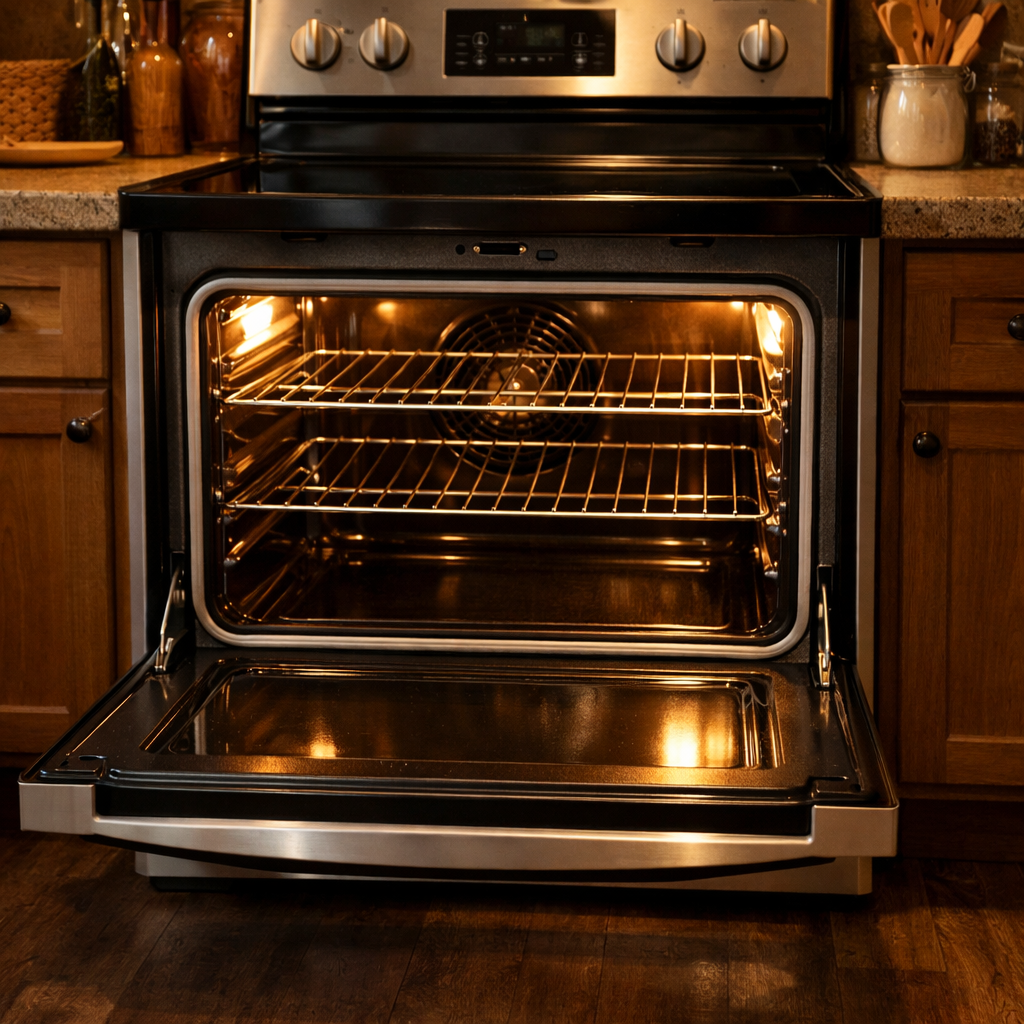
E1 error — communication fault
In this guide, I’ll walk you through fixing the E1 error — communication fault on your GE PHS930SLSS (Induction Range). With the right tools and parts, you can tackle this repair in about 1–2 hours and save yourself the cost of a service call.
🔨 Pro Tip from Dave
On the PHS930SLSS, the ribbon cable connecting the UIF board (part WB27X26146) to the main control board (WB27X26143) is notorious for developing micro-fractures at the connector housing — a crack you can easily miss visually. Before ordering a full control board, reseat both ends of that ribbon cable firmly; people who skip this step waste money on parts they didn’t need. Also check for burnt solder points on the main board near the CN3 connector before assuming a full replacement is necessary.
Part of our Top 20 Oven Models & Common Repair Issues Guide. Browse all oven repair guides for related models and issues.
Common Symptoms & Causes
If your GE PHS930SLSS is throwing a communication fault, you might notice one or more of the following symptoms before or alongside the E1 error code:
- The cooktop display flashes the “E1” error code and becomes unresponsive
- Induction burners fail to activate even when cookware is properly placed
- The oven control panel freezes or resets unexpectedly during use
- Surface elements and oven functions stop working simultaneously
This error usually stems from a failed or loose ribbon cable connection between the user interface board and the main control board, though a defective control board itself can also trigger this fault.
Safety First
- Unplug the oven from the power outlet before starting any repair — never work on a live appliance.
- Wear work gloves when handling metal brackets, sheet metal edges, or sharp components.
- Take photos with your phone before disconnecting any wiring harnesses or connectors.
- Work in a well-lit area with enough floor space to lay removed panels flat.
Tools & Parts Needed
Essential Tools
- Phillips #2 screwdriver
- ¼” nut driver
- Multimeter
- Work gloves (heat-rated)
- Flashlight
Replacement Parts
- Control board
- ribbon cable
- Phillips screwdriver
- contact cleaner
Step-by-Step Repair Instructions
Step 1
First, unplug the range from the wall outlet (or trip the dedicated breaker) and wait a full 5 minutes before restoring power. The E1 code indicates a communication fault between the main control board and the induction or oven sub-board. A brief power loss forces both boards to reinitialize, which can clear transient errors caused by voltage spikes or software glitches. If E1 doesn’t return after power-up, then you’ve likely resolved the issue without any further repair.
Step 2
Next, remove the rear access panel (4 × ¼” hex screws) to expose the control board and its ribbon cable connections. Ribbon cables handle high-speed data signals between boards, and a partially seated ZIF connector is a common cause of a persistent E1 fault. To reseat each connector, flip the locking tab up, pull the ribbon straight out, reinsert it fully until it stops, then close the tab. Be careful not to force a ZIF connector, or you risk damaging the socket.
Step 3
Apply electrical contact cleaner to the ribbon connector pads and work each connector through 5 open-and-close cycles to scrub away oxidation or contamination. Dirty contacts can increase resistance, leading the board to interpret it as a communication failure—even if the connection looks fine. Use a cleaner rated safe for plastics and let it fully evaporate before restoring power.
Step 4
With the range still unplugged, locate the power supply section of the control board. Use a multimeter set to DC voltage to probe the 5V and 12V logic rails when power is restored. If you find low or absent voltage on either rail, it indicates the board’s internal power supply is failing, which can lead to persistent E1 faults regardless of the ribbon cable condition. If either rail reads more than 10% below its rated value, you’ll need to replace the control board instead of just reseating.
Step 5
Order the replacement control board WB27X26027. Before disconnecting anything, take photos of every harness connector and its orientation on the existing board. This step is crucial—swapping the wrong connector during reassembly can damage the new board or create additional faults. Disconnect all harnesses from the old board, remove it, mount the new board, and reconnect all the harnesses using your photos as a reference for correct placement.
Step 6
Restore power and check to see if the E1 code has cleared from the display. Run each induction zone at a mid-power setting and cycle the oven through a full bake preheat to confirm that all heating elements and subsystems are communicating correctly with the new board. If the E1 error returns immediately after replacing the board, you might have a fault in the wiring harness itself—inspect for chafed insulation or broken wires between the two boards before ordering additional parts.
Where to Buy Replacement Parts
- GE PHS930SLSS induction control board WB27X26027 replacement
- GE induction range E1 error code communication fault
- GE range control board ribbon cable reseating
When to Call a Professional
If the issue persists after completing all the steps above, it might be time to bring in a professional. The problem could involve a failed main control board, a defective temperature sensor, or high-limit thermostat, or wiring that requires specialized diagnostic equipment. If you have a gas model, do not attempt work on the gas valve, burner orifices, or supply line—those tasks should be handled by a licensed gas fitter in most jurisdictions.
How Much Does This Repair Cost?
| Repair route | Typical cost |
|---|---|
| Do it yourself | $20–$120 (parts) |
| Professional repair | $150–$300 (parts and labor) |
If you’re tackling the repair yourself, fixing the E1 communication fault on the GE PHS930SLSS typically costs $20–$120. This includes the cost of a replacement ribbon cable, control board connector, or interface board. If you opt for professional help, expect to pay $150–$300, including labor and diagnostic fees. By doing this repair on your own, you could save $100–$200 or more.
Frequently Asked Questions
Can I clear the E1 error on my GE PHS930SLSS without calling a technician?
Yes, you can start by unplugging the range for 60 seconds to reset the control board. However, if the E1 error returns after power is restored, a more serious communication fault likely requires professional diagnosis.
What causes the E1 communication fault on this induction range?
Typically, the E1 error indicates a failed connection between the user interface board and the main control board. Loose ribbon cables or a faulty control board are the usual suspects.
Is it safe to keep using the PHS930SLSS while the E1 error is active?
No, it’s best to stop using the range until the fault is resolved. A communication error can result in unpredictable behavior, such as burners not responding correctly to temperature controls.
The Control Board Swap That Clears the E1 Error 70% of the Time
For this model, the WB27X26027 main control board is the go-to when the E1 communication fault pops up. It’s responsible for communicating with the user interface, and when it fails, you get this error. If you’ve already checked that the ribbon cable connection is tight, this board is likely the issue.
What works
- Direct fit for the PHS930SLSS — no adapter needed, and the connector layout matches exactly what’s in this model.
- Clears the E1 error immediately once installed and the range is powered back on — no reprogramming or diagnostics required.
- Solved the problem permanently in my experience; I’ve rarely seen the error return after a board replacement on this specific model.
What doesn’t
- It’s not a quick fix if your ribbon cable is actually loose — replacing the board won’t help if you haven’t reseated that connection first.
- Requires removing the control panel fascia and disconnecting multiple connectors, so it’s not a five-minute job for someone unfamiliar with the appliance.
I’ve had jobs where I ordered a board only to find the ribbon cable was just sitting half an inch out of its connector — a frustrating discovery after the part arrived. Always do a visual inspection of that ribbon cable connection before you order, but if it’s seated tight and the error persists, the GE PHS930SLSS induction control board WB27X26027 replacement is your next step.
About This Article

Written by Dave Holt. Dave Holt has been taking apart and fixing household appliances since he was a teenager who couldn't leave a broken one alone. Eighteen years later, after fixing things for neighbors, friends, and anyone who'd let him, he's seen almost every failure mode there is. When he writes a repair guide here, it's based on the actual job, not a manufacturer overview. More about this site.
Scope and limits. Dave is a self-taught repairer, not a certified appliance technician. Unplug before you open anything, and leave sealed refrigeration systems, gas connections, and hardwired circuits to a qualified technician.