Drum support bearing noise
In this guide, I’ll walk you through fixing that pesky drum support bearing noise on your Electrolux EFMG527UTT (Gas). With the right tools and parts, most homeowners can complete this repair in 1–2 hours and save themselves a costly service call.
🔨 Pro Tip from Dave
For the EFMG527UTT, the drum bearing kit (part number 134509602) is usually the troublemaker. However, don’t ignore the felt drum seal while you’re in there — it often wears at the same time and can lead to future issues if overlooked. A common mistake is to skip applying high-temp bearing grease to the shaft socket during reassembly, leading to premature wear on the new bearing.
Part of our Top 20 Dryer Models & Common Repair Issues Guide. Browse all dryer repair guides for related models and issues.
Common Symptoms & Causes
If your Electrolux EFMG527UTT is experiencing drum support bearing failure, you may notice one or more of the following symptoms during operation.
- A loud squealing or grinding noise coming from the rear of the dryer while the drum spins
- A rhythmic thumping sound that increases in speed as the drum rotates faster
- The drum wobbles or feels unsteady when manually rotated by hand
- Clothes take longer to dry due to drum friction slowing rotation
These issues are typically caused by a worn or failed drum support bearing, which deteriorates over time due to heat, friction, and normal long-term use.
Safety First
- Unplug the dryer from the power outlet before starting any repair — never work on a live appliance.
- Wear work gloves when handling metal brackets, sheet metal edges, or sharp components.
- Take photos with your phone before disconnecting any wiring harnesses or connectors.
- Work in a well-lit area with enough floor space to lay removed panels flat.
Tools & Parts Needed
Essential Tools
- Phillips #2 screwdriver
- ¼” nut driver
- Putty knife
- Multimeter
- Work gloves
Replacement Parts
- Drum bearing kit
- drum front glides
- drum support rollers (rear)
- drive belt
Step-by-Step Repair Instructions
Step 1
First thing’s first: unplug the dryer from its power source before touching any internal components. Gas dryers carry both electrical and gas hazards, so safety comes first. Remove the front panel by pulling out the lint housing (1 screw) and releasing the lower panel screws (2 screws). Once you’ve done this, pull the drum straight forward to expose the bearing surfaces. This access is necessary to inspect and replace every component responsible for drum support noise.
Step 2
Check the front drum glide pads, which are the 2–4 plastic pads mounted at the bottom of the front bulkhead that the drum lip rides against. If these pads wear through their plastic layer down to the metal backing, the metal-on-metal contact produces the characteristic squeal you’re hearing. If any pad shows metal exposure or heavy grooving, replace the full set together — mixing worn and new pads creates uneven drum seating.
Step 3
Spin each of the two rear drum support rollers by hand to check for the source of the noise. A healthy roller spins freely and quietly; if you feel rough resistance, a seized roller that won’t turn, or see visible side-to-side wobble, these are signs of a worn bearing or flat spot that causes thumping or grinding under load. Replace rollers as a pair, even if only one is failing, because the second is likely worn and will fail shortly afterward.
Step 4
Grip the idler pulley and spin it by hand, feeling and listening for roughness, grinding, or any play in the bearing. The idler pulley maintains constant belt tension, and a failing pulley bearing produces a high-pitched squeal that is easy to confuse with glide pad noise. If it doesn’t spin smoothly and silently, replace the idler pulley assembly.
Step 5
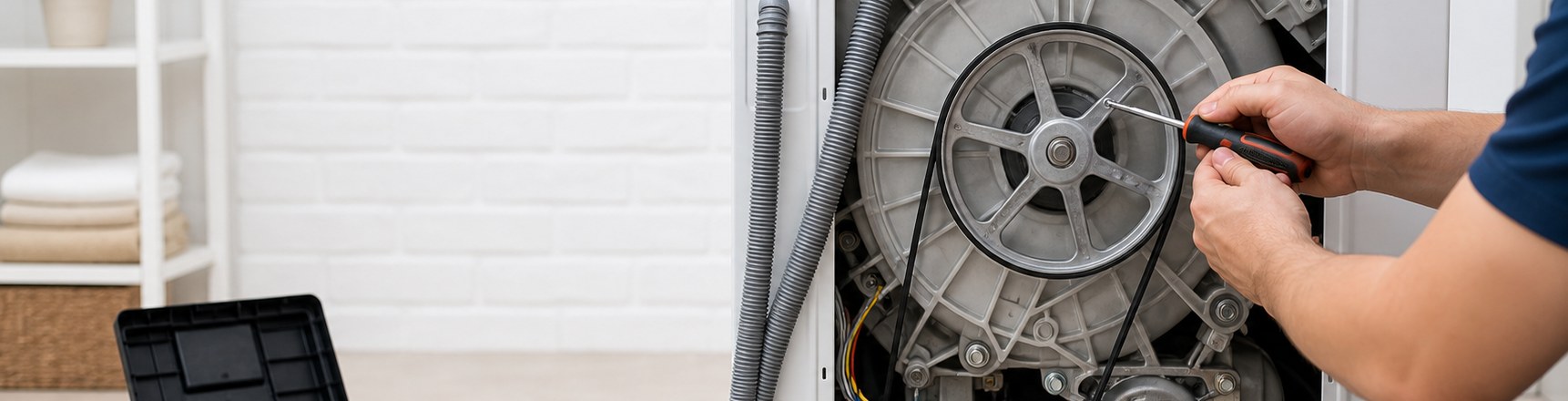
Since the drum is already removed, hold the drive belt and flex it to check for glazing, cracking, or fraying along its length. A compromised belt can slip under load, causing intermittent noise and reduced tumbling performance. Replacing it now costs only a few minutes versus a full disassembly later. Pro tip: take a photo of the original belt routing around the motor shaft and idler pulley before removing anything, so reassembly is straightforward.
Step 6
Reassemble by setting the drum back onto the rear rollers first, then route the belt around the drum, underneath the idler pulley, and over the motor shaft — use your reference photo to confirm the routing is correct. Reinstall the front panel and lint housing, then run a full 20-minute cycle on a heat setting to confirm the noise is gone and ensure the new pads and rollers seat properly under real operating conditions. Listen during the first few minutes; any remaining noise at this stage points to a component that was missed or not fully seated.
Where to Buy Replacement Parts
- Electrolux EFMG527UTT drum bearing kit 131462800 replacement
- Electrolux gas dryer front drum support glide pad replacement
- Electrolux dryer drum roller support 131687700
When to Call a Professional
If the issue persists after completing all steps above, the problem may involve a failed main control board, a defective heating element or thermal cutoff, or wiring that requires specialized diagnostic equipment. It’s best to contact a licensed appliance technician. On gas dryers, do not attempt work on the gas valve or supply line — that work is restricted to a licensed gas fitter in most jurisdictions.
How Much Does This Repair Cost?
| Repair route | Typical cost |
|---|---|
| Do it yourself | $20–$60 (parts) |
| Professional repair | $150–$300 (parts and labor) |
Replacing the drum support bearing on your Electrolux EFMG527UTT typically costs $20–$60 for the part alone when doing it yourself. A professional service call for this repair usually runs $150–$300, including labor and parts. Tackling this repair DIY-style can save you $100 or more, making it a worthwhile fix for a confident home repairer.
Frequently Asked Questions
How do I know if the drum support bearing is causing the noise in my Electrolux EFMG527UTT?
A failing drum support bearing typically produces a loud squealing or grinding noise that increases as the drum spins faster. If the noise disappears when the dryer is empty or occurs consistently during every cycle, the bearing is likely the culprit.
Is it safe to keep using my Electrolux EFMG527UTT while the bearing is worn?
Continuing to run the dryer with a worn bearing can damage the drum shaft and surrounding components, leading to more expensive repairs. It’s best to replace the bearing as soon as possible.
Do I need special tools to replace the drum support bearing on the EFMG527UTT?
Most of the repair requires basic tools like a putty knife, screwdrivers, and a nut driver. No specialized equipment is needed, making this a manageable DIY repair for most homeowners.
Recommended Products
These are the parts and tools I recommend for this repair, based on compatibility and customer reviews:
- 2Pack 5303283286 Dryer Drum Felt Seal For Electrolux Frigidaire 616044-000 AP2143044 PS460194
- MOOTVGOO W10612022 Dryer Rear Drum Felt Seal Replacement
- newlifeapp 5303937139 Dryer Drum Felt Seal Kit with Glides & Adhesive – Made in USA – Fits Frigidaire, Kenmore, Electrolux – Replaces 131154800, AP2150497
The Drum Bearing Kit That Stops That Squealing on the EFMG527UTT
If you’re hearing that characteristic squealing or grinding from the back of the drum, the rear bearing kit is almost certainly your culprit on this model. This is the part that wears out first, and replacing it is the most direct way to eliminate the noise.
What works
- The noise stops immediately after installation—once the bearing kit goes in correctly, it stays quiet.
- The kit includes everything you need (bearing, seal, and hardware), so you’re not hunting down three separate part numbers.
- Fits the EFMG527UTT without modification or adapter fussiness—it’s a direct swap if you’re at the rear drum already.
What doesn’t
- You have to disassemble most of the dryer to access it—this isn’t a five-minute job, and if you’ve never done it, budget two to three hours your first time.
- If the drum felt seal is also worn (common on older units), you’ll want to replace that at the same time, or the noise will return sooner than expected.
The biggest trap I see is someone ordering just the bearing and discovering halfway through that the felt seal is shot too—then they have to go back in again. Get the bearing kit and inspect the felt while you’re in there; it’ll save you a second teardown. Drum bearing kit
About This Article

Written by Dave Holt. Dave Holt has been taking apart and fixing household appliances since he was a teenager who couldn't leave a broken one alone. Eighteen years later, after fixing things for neighbors, friends, and anyone who'd let him, he's seen almost every failure mode there is. When he writes a repair guide here, it's based on the actual job, not a manufacturer overview. More about this site.
Scope and limits. Dave is a self-taught repairer, not a certified appliance technician. Unplug before you open anything, and leave sealed refrigeration systems, gas connections, and hardwired circuits to a qualified technician.