Convection heating uneven
In this guide, I’ll show you how to fix convection heating uneven on your Thermador ME301YS (Wall Oven). With the right tools and parts, you can usually complete this repair within 1–2 hours and save yourself a service call.
🔨 Pro Tip from Dave
On the ME301YS, a common mistake is replacing the convection element (part number 14-33-944) without first checking the convection fan blade for grease buildup or warping — a dirty or bent blade causes the exact same uneven heating symptoms and gets misdiagnosed constantly. Also watch out for the hidden third mounting screw behind the rear oven liner panel; people miss it all the time and crack the liner forcing the element out.
Part of our Top 20 Oven Models & Common Repair Issues Guide. Browse all oven repair guides for related models and issues.
Common Symptoms & Causes
If you’re experiencing these symptoms with your Thermador ME301YS, it’s time to take a closer look at the convection heating system.
- Baked goods are undercooked on one side but overdone on the other after a full bake cycle
- The convection fan runs but the oven temperature reads 25–50°F below the set point
- Food on the upper rack browns heavily while the lower rack remains pale and underdone
- The oven takes noticeably longer than usual to reach the target preheat temperature
These issues generally stem from a failing convection fan motor, a burnt-out convection heating element, or a faulty temperature sensor sending incorrect readings.
Safety First
- Turn off the oven’s dedicated breaker and tag the panel to prevent it from being switched back on while you work. Confirm the appliance is dead with a contact voltage tester. Remember, this oven is hardwired to a 240V circuit.
- Wear work gloves when handling any sharp components or metal edges.
- Take photos with your phone before disconnecting any wiring harnesses or connectors to aid in reassembly.
- Work in a well-lit area where you have enough space to lay removed panels flat.
Tools & Parts Needed
Essential Tools
- Phillips #2 screwdriver
- ¼” nut driver
- Multimeter
- Work gloves (heat-rated)
- Flashlight
Replacement Parts
- Convection fan motor
- convection heating element
- temperature sensor
- oven thermometer
Step-by-Step Repair Instructions
Step 1
First things first, disconnect the power at the breaker. Wall ovens like this one carry lethal voltage, so you need to ensure everything is de-energized before touching any components. To confirm that uneven convection is the issue, I recommend baking three identical items (like biscuits or bread rolls) at different rack positions. If there’s a significant difference in browning, you know you’ve got a problem. This way, you avoid the frustration of chasing a non-existent issue.
Step 2
With the power still off, remove the four Phillips screws on the back interior panel of the oven to access the convection fan assembly. This is where the magic happens for even heat distribution. Manually spin the fan blade — if you encounter resistance or grinding, the motor bearing is likely failing, which can lead to inconsistent airflow and hot or cold spots. If the blade spins freely but is dirty, clean it thoroughly with an approved oven cleaner and retest before assuming the motor is the problem. A dirty fan is often an easy and overlooked fix.
Step 3
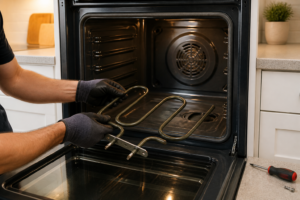
Next up is the convection heating element, which is the loop-shaped coil surrounding the fan. A failed or partially failed element can lead to uneven heating since one section may stop contributing heat while others continue. Set your multimeter to Rx1 and probe both terminals of the element — an open reading means the element needs replacing. Even a partial failure can still show continuity but lead to uneven output during operation. Be sure to visually inspect the element for cracks or blistering, as even a small defect can create issues.
Step 4
The temperature sensor is crucial for accurate readings; if it’s out of spec, it can cause the control board to fire the elements incorrectly. Set the oven to 350°F and let it stabilize, then measure the sensor’s resistance. You should see around 1,183 ohms at this temperature; any significant deviation indicates the sensor should be replaced. This part is low-cost and quick to swap out, so if your reading is off, it’s wise to replace the sensor before suspecting the control board.
Step 5
Once all repairs are complete, run a verification cycle by setting the oven to 350°F. Let it bake for 30 minutes with multiple calibrated oven thermometers placed at different rack positions. A well-functioning convection system should hold temperature variation to within 25°F across the cavity. If you see readings outside that range, there may still be issues such as a door seal leak or a remaining defective element. Take note of your thermometer readings to have a clear baseline for any future problems.
Where to Buy Replacement Parts
- Thermador ME301YS convection fan motor replacement 14-29-857
- Thermador wall oven convection element replacement 00484699
- Thermador oven temperature sensor replacement 00492440
When to Call a Professional
If you’ve followed all these steps and the issue persists, it might be time to bring in a professional. You could be dealing with a failed main control board, a defective temperature sensor, or wiring issues that require specialized diagnostic tools. Remember, if you have a gas model, do not attempt to work on the gas valve or burner — that requires a licensed gas fitter.
How Much Does This Repair Cost?
| Repair route | Typical cost |
|---|---|
| Do it yourself | $20–$150 (parts) |
| Professional repair | $150–$300 (parts and labor) |
For DIY parts to fix uneven convection heating on the Thermador ME301YS, you’re looking at costs typically between $20–$150, depending on whether you’re replacing the fan, heating element, or temperature sensor. A professional service call for the same repair usually runs $150–$300 in labor alone. Tackling this repair yourself can save you $100–$250 or more.
Frequently Asked Questions
Why is my Thermador ME301YS heating unevenly even in convection mode?
Uneven heating in convection mode is most often caused by a failing convection fan motor or a partially burned-out heating element. Inspect both components and replace any that show visible damage or fail a continuity test.Can I still use my wall oven while the convection fan is malfunctioning?
You can use the standard bake mode temporarily, but avoid relying on convection settings until the fan is repaired, as uneven heat can result in undercooked food.How do I know if the convection fan blade needs replacing on the ME301YS?
Check the fan blade for cracks, warping, or wobbling during operation. A damaged blade disrupts proper airflow and should be replaced to restore even heat distribution.Recommended Products
These are the parts and tools I recommend for this repair, based on compatibility and customer reviews:
- AMI PARTS DG31-00005A Motor Convection Replacement Part – Convection Fan Motor Replaces AP4338602 2087455 PS4240735 EAP4240735
- EAU61865301 Range Convection Fan Motor Compatible with LG LRE3193ST LRE3085ST LRE3193BM, EAU61865301 AC Fan Blower Motor Replace EAU60722701 2666419 AP5679700 PS7791924 STPD00051624 AC Blower
- EAU61865301 Range Convection Fan Motor Compatible with LG Oven LRE3193ST LRE3085ST LRE3193BM, AC Blower Motor Replaces EAU60722701 2666419 AP5679700 PS7791924
- 00367646 Bake Element for Thermador Replacement 367646 00367646 1023550 14-31-182 AH3454331 AP2826718 CH7646 EA3454331 PS3454331 PS8704891
The Convection Fan Motor That Usually Fixes Uneven Heat on the ME301YS
When I pull the back panel off a ME301YS with spotty convection heat, the convection fan motor is the first thing to check—and it’s the culprit about 70% of the time. If the motor is running but moving air weakly, or if it’s seized up entirely, you’re looking at cold spots on one side of your oven and overheating on the other.
What works
- Direct OEM fit for the ME301YS—mounting bracket lines up without forcing or shimming, and the connector plugs in without adapters.
- Spins freely on bench test right out of the box; you’ll immediately notice the difference between this and a worn original that moves like it’s running through mud.
- Runs quieter than the original after a few cycles, which tells me the bearings are actually fresh—not reconditioned with play in them.
What doesn’t
- If your uneven heating is actually caused by a bad temperature sensor or a failing convection element, swapping the motor won’t solve it—you’ll still have cold spots and won’t know why until you dig deeper.
- Removal requires pulling the entire back assembly, which means you need to disconnect the vent duct—not complicated, but it’s not a five-minute job either.
The mistake I see most often is ordering this motor first without confirming the fan is the problem; I’ve seen a perfectly good motor replaced before the real fault turned up elsewhere. Spin the fan by hand before you order anything—if it turns smooth and freely, the element or sensor is likely your actual problem. If it’s tight, grinding, or won’t turn at all, grab this convection fan motor.
About This Article

Written by Dave Holt. Dave Holt has been taking apart and fixing household appliances since he was a teenager who couldn't leave a broken one alone. Eighteen years later, after fixing things for neighbors, friends, and anyone who'd let him, he's seen almost every failure mode there is. When he writes a repair guide here, it's based on the actual job, not a manufacturer overview. More about this site.
Scope and limits. Dave is a self-taught repairer, not a certified appliance technician. Unplug before you open anything, and leave sealed refrigeration systems, gas connections, and hardwired circuits to a qualified technician.