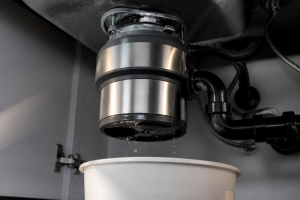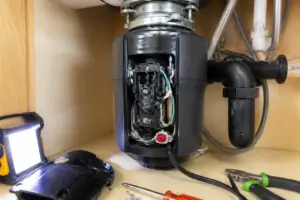

This repair guide will help you fix your garbage disposal.
Need a Replacement Garbage Disposal?
InSinkErator Badger 5 Garbage Disposal, Standard Series 1/2 HP Continuous Feed Food Waste Disposer, Black, Set of 1
Price: $114.00
Common Symptoms & Causes
These signs typically point to a failing or improperly sealed sink flange on your garbage disposal.
🔨 Pro Tip from Dave
On the Badger 5, I’ve found that the snap ring locking the lower mounting assembly often slips out of its groove during reinstallation. This mistake can lead to leaks as the unit drops back down. Always use a flathead screwdriver to seat the snap ring firmly into all three grooves of the flange before tightening the mounting screws. Also, check part number 12001685 (the fiber gasket) for compression damage, as a worn gasket can often be the silent culprit behind a persistent flange leak.
- Water pooling under the sink directly below the disposal unit
- Visible moisture or rust staining around the sink drain opening
- A slow drip that worsens when the disposal is running
- Plumber’s putty or old sealant visible and crumbling around the flange rim
This issue is most commonly caused by deteriorated plumber’s putty, a loose mounting assembly, or corrosion on the flange itself from years of normal use.
How Much Does This Repair Cost?
| Repair route | Typical cost |
|---|---|
| Do it yourself | $5–$20 (parts) |
| Professional repair | $150–$300 (parts and labor) |
Fixing a sink flange leak yourself typically costs between $5 and $20 for a new flange, plumber’s putty, and mounting hardware. Hiring a professional plumber or appliance technician usually runs $150 to $300 once you factor in the service call and labor fees. Tackling this repair as a DIY project can save you well over $100.
Frequently Asked Questions
How do I know if my garbage disposal leak is coming from the sink flange?
Look for water pooling directly beneath the sink flange where the disposal meets the sink basin. If the leak appears at the very top of the unit rather than the sides or bottom, a failed flange seal is almost certainly the cause.
Do I need to replace the entire garbage disposal to fix a flange leak?
No, you typically only need to reseal or replace the sink flange itself. This is a straightforward repair that leaves the disposal unit intact.
What type of plumber’s putty should I use when resealing the sink flange?
Use a standard, non-staining plumber’s putty for most kitchen sinks. If your sink is made of granite or composite material, choose a silicone-based sealant instead to avoid discoloration.
Recommended Products
These are the parts and tools I recommend for this repair, based on compatibility and customer reviews:
- InSinkErator Quick Lock Mounting Flange, Stainless Steel, QLM-00
- InSinkErator in-Sink-Erator Standard Mounting Gasket, Black Color
- IN-SINK-ERATOR 05298 Flange Body
- 1470 Garbage Disposal Gasket for In-Sink Erator, fit for InSinkEerator Models 333,17 and 77 Garbage Disposer, Replacement for In Sink Erator Division (INSJU) 1470 Gasket
The Gasket That Actually Stops the Badger 5 Flange From Weeping
The mounting gasket is what seals the flange to the sink basket, and on the Badger 5, it degrades faster than people expect. If you’re reseating the flange and the leak persists, a worn or compressed gasket is almost always the culprit—this is the part to go to before ordering a whole new mounting assembly.
What works
- Direct fit for the Badger 5 and compatible InSinkErator models—no guessing on part compatibility.
- Black rubber material compresses evenly and maintains a tight seal against the sink basin, even after multiple tighten-loosen cycles.
- Inexpensive enough that you can replace it as preventive maintenance without hesitation, which saves repeat service calls down the road.
What doesn’t
- Won’t fix a cracked or warped flange body itself—if the flange is damaged, the gasket alone won’t stop the leak.
- Requires removing the entire mounting assembly to access, so this isn’t a quick swap if you’re already halfway through the repair.
I’ve seen homeowners order a complete new disposal unit thinking the whole thing was shot when really they just needed a fresh gasket and some new plumber’s putty. Don’t make that mistake—grab InSinkErator in-Sink-Erator Standard Mounting Gasket, Black Color and test it before you go bigger.
About This Article

Written by Dave Holt. I have been taking apart and fixing household appliances since I was a teenager who couldn't leave a broken one alone. Eighteen years later, after fixing things for neighbors, friends, and anyone who'd let me, I have seen almost every failure mode there is — and misdiagnosed my share along the way. I am self-taught, with no formal training or certifications. When I write a repair guide here, it is based on the actual job, not a manufacturer overview. More about this site.
Scope and limits. Dave is a self-taught repairer, not a certified appliance technician. Unplug before you open anything, and leave sealed refrigeration systems, gas connections, and hardwired circuits to a qualified technician.