“`html
Oven not reaching temperature
This guide walks you through diagnosing and fixing an oven that won’t reach the set temperature on the GE JB655SKSS electric range. We’ll cover the most common causes, the parts most likely to blame, and clear repair steps you can follow at home. Most homeowners with basic mechanical confidence can complete this repair in 1–2 hours, saving hundreds of dollars over a professional service call.
Common Symptoms & Causes
Before diving in, confirm your situation matches one or more of these common signs of a temperature problem on the GE JB655SKSS:
- Oven preheats very slowly or never reaches the set temperature
- Baked foods are consistently undercooked even after extended cook times
- Oven shuts off early or cycles off before reaching the target temperature
- Oven display shows the correct temperature, but the interior remains noticeably cooler
The most typical root cause on this model is a failed bake element or a faulty oven temperature sensor, either of which can prevent the oven cavity from reaching or maintaining the correct heat level.
Safety First
- Unplug the range from the wall outlet or shut off the circuit breaker before beginning any work
- Wear insulated work gloves when handling internal components with sharp edges
- Photograph all wiring connections before disconnecting anything so you can reassemble correctly
- Work in a well-lit space so you can clearly see connections, scorch marks, and component conditions
Tools & Parts Needed
Essential Tools
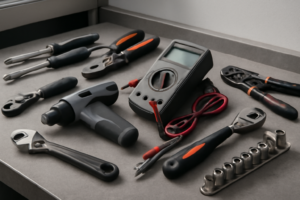
- Phillips-head and flat-head screwdrivers
- 1/4-inch nut driver or socket set
- Digital multimeter (for continuity and resistance testing)
- Needle-nose pliers
- Flashlight or headlamp
Replacement Parts
Step-by-Step Repair Instructions
🔨 Pro Tip from Dave
On the JB655SKSS, the oven temperature sensor probe runs along the back wall and has a connector tucked behind the rear panel that is notorious for developing a loose or corroded pin connection — before you condemn the sensor itself based on a bad resistance reading, pull that connector apart, inspect the pins, and reseat it firmly, because I’ve seen that single step bring a ‘failed’ sensor back to life and save the customer an unnecessary part purchase.
Step 1: Disconnect Power and Access the Oven Interior
Unplug the range or turn off the dedicated 240V breaker at your electrical panel. Open the oven door fully and remove the oven racks to give yourself clear access to the oven floor and back wall. Never skip this step — the bake element carries 240 volts during normal operation.
Step 2: Visually Inspect the Bake Element
Look at the bake element along the oven floor for any visible cracks, blisters, burn holes, or areas where the element appears separated. A failed element often shows a visible break or a scorched spot. If the element looks intact, move on to multimeter testing before ordering parts.
Step 3: Test the Bake Element with a Multimeter
Remove the two screws securing the bake element to the back wall and gently pull it forward to expose the two wire terminals. Disconnect the wires and set your multimeter to the Ohms (Ω) setting, then touch one probe to each terminal. A healthy bake element on this model should read between 19 and 22 ohms; an open or infinite reading confirms the element has failed and needs replacement.
Step 4: Test the Oven Temperature Sensor
The temperature sensor is located at the upper-left or upper-right rear corner of the oven cavity, secured by one or two screws. Disconnect its wiring harness and measure resistance across the sensor terminals — at room temperature (approximately 70°F), the GE WB21X5243 sensor should read close to 1,080 ohms. A reading significantly higher, lower, or open indicates the sensor is faulty and causing the control board to misread oven temperature.
Step 5: Replace the Faulty Component
Install the new bake element by sliding the terminals through the back wall, reconnecting the wires securely, and fastening the mounting screws. For the sensor, plug in the new harness connector, position the sensor probe into the oven cavity, and tighten its mounting screw. Refer to the photos you took earlier to ensure all wiring is restored correctly.
Step 6: Restore Power and Run a Test Cycle
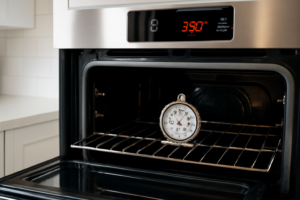
Plug the range back in or restore the breaker, then set the oven to 350°F and allow at least 20 minutes for it to preheat fully. Use an independent oven thermometer placed in the center of the rack to verify the actual temperature matches the set point within ±25°F. If the oven still fails to reach temperature, the issue may lie with the electronic oven control board.
Step 7: Calibrate the Oven if Needed
The GE JB655SKSS allows user temperature calibration of up to ±35°F through the Settings menu — consult your owner’s manual for the exact button sequence. If your thermometer shows a consistent offset after replacing the sensor, a quick calibration adjustment will bring the oven into accurate range. This step is not a substitute for replacing a defective sensor but is useful for fine-tuning after a successful repair.
How Much Does This Repair Cost?
A replacement bake element for the GE JB655SKSS typically costs $25–$55, and a new temperature sensor runs $15–$35, bringing your total DIY parts cost to roughly $25–$90 depending on which component needs replacing. Compare that to a typical appliance service call of $150–$300 — which often doesn’t include parts — and the potential savings of $100 to $250 or more make the DIY route well worth the effort for most homeowners.
When to Call a Professional
Most of the repairs in this guide are within reach for a careful DIYer with basic tools. In my experience, if you’ve already replaced the bake element and the oven temperature sensor and the oven still won’t reach temperature — or if your multimeter is showing voltage present at the element terminals but the element won’t heat — that points to a control board or relay board fault that requires component-level diagnosis and live-voltage testing that should be handled by a certified technician. When in doubt, a diagnostic service call typically costs $80–$120 and can save you from a misdiagnosis that costs more in parts.
Where to Buy Replacement Parts
The parts listed below are available on Amazon with fast shipping. Search these links to find the correct replacements for your GE JB655SKSS:
- GE Bake Element WB44T10011 replacement
- GE Oven Temperature Sensor WB21X5243 replacement
- WB44k10005 Oven Bake Element WB44K10001 Fit for G-E Hot-Point Oven Element Replacement RB787WH1WW RB757BH1WH RB787WH1WW, Replaces AP2030964 824269 AH249238 EA249238 PS249238 WB30X46987 by AMI PARTS is a direct-fit replacement compatible with a wide range of GE and Hotpoint models, making it a reliable first choice when you’ve confirmed the bake element has burned out or is no longer glowing. It’s a plug-and-play swap that requires no special tools beyond a screwdriver, so most DIYers can have the oven back up to temperature within 30 minutes. (As an Amazon Associate I earn from qualifying purchases.)
Once you’ve removed the old element and confirmed the mounting terminals match, you’ll want a part that installs without modification — and the 【Upgraded】WB44K10005 WB44K10001 Oven Bake Element Suitable for GE Hotpoint Americana Oven model RB526H3WW,RB757BH1WH,RB787WH1WW,RB787CH2CC,JBS03H2WH,36291114101,ABS200P1WW, JB14Y1DC,etc. by Beaquicy delivers exactly that, with an upgraded build designed to meet or exceed OEM specs for consistent, even heat distribution. Its broad model compatibility across GE, Hotpoint, and Americana ranges makes it a solid option if you’re not 100% certain of your exact part number.