Freezer Not Freezing
This guide walks you through diagnosing and repairing a freezer that has stopped freezing on the GE GSS25GYPFS side-by-side refrigerator. We cover the most common causes — from a failed evaporator fan motor to a faulty defrost heater — and provide clear steps most homeowners can complete in 1–2 hours with basic tools. No special HVAC certification is required for these repairs.
Common Symptoms & Causes
Before diving into repairs, confirm your unit is displaying one or more of these telltale signs:
- Freezer compartment is warm or only slightly cool (above 10°F)
- Ice maker has stopped producing ice or output has dropped significantly
- Frost or ice buildup visible on the back wall of the freezer compartment
- Refrigerator side is also warming, suggesting a shared airflow problem
The most common root cause on the GE GSS25GYPFS is a failed defrost system — either a burned-out defrost heater or a defective defrost thermostat — which allows frost to block the evaporator coils and choke off cold airflow to both compartments.
Safety First
- Unplug the refrigerator from the wall outlet before removing any panels or touching internal components
- Wear work gloves when handling metal panels and evaporator coils to avoid cuts
- Photograph all wiring harness connections before disconnecting anything so you can reassemble correctly
- Work in a well-lit space and use a flashlight or headlamp inside the freezer cabinet
Tools & Parts Needed
Essential Tools
- Phillips and flat-head screwdrivers
- ¼-inch nut driver or socket set
- Multimeter (for continuity and resistance testing)
- Hair dryer or heat gun (to manually defrost coils if heavily iced over)
- Needle-nose pliers
>
Replacement Parts
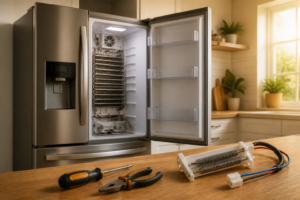
- GE Defrost Heater (WR51X10055)
- GE Defrost Thermostat (WR50X10068)
- GE Evaporator Fan Motor (WR60X10220)
Step-by-Step Repair Instructions
🔨 Pro Tip from Dave
On the GSS25GYPFS, the defrost thermal limiter (the small one-shot fuse clipped directly to the evaporator) fails far more often than techs expect and is almost always overlooked because the defrost heater itself tests fine — always check continuity on that limiter separately before you declare the heater good. A lot of DIYers and even newer technicians replace the heater, button everything back up, and find themselves with the same frozen coil problem two weeks later because that $6 limiter was the real villain all along.
Step 1: Unplug and Empty the Freezer
Disconnect the refrigerator from power and remove all food and shelving from the freezer compartment. Store frozen items in a cooler with ice to keep them safe during the repair. This gives you clear access to the back panel where the evaporator assembly is located.
Step 2: Remove the Freezer Back Panel
Remove the screws securing the interior back panel of the freezer — typically 4–6 Phillips screws along the edges. Carefully pull the panel forward; it may be held in place by frost if the defrost system has failed. Use a hair dryer on low heat to gently melt any ice bonding the panel before forcing it free.
Step 3: Inspect the Evaporator Coils
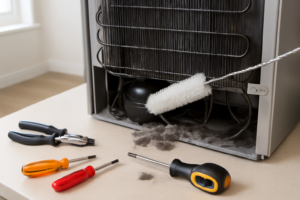
With the back panel removed, look at the evaporator coils. If they are encased in a solid block of frost or ice, the defrost system is definitively the culprit. Use your hair dryer to thaw the coils completely before testing any components — frozen components will give false multimeter readings.
Step 4: Test the Defrost Heater
Disconnect the defrost heater wire terminals and set your multimeter to the ohms (Ω) setting. Touch the probes to the heater terminals — a working heater reads approximately 30–90 ohms; an open reading (OL or infinite resistance) means the heater has burned out and must be replaced. A failed heater is the single most common cause of this issue on the GSS25GYPFS.
Step 5: Test the Defrost Thermostat
The defrost thermostat (also called a thermal limiter) is clipped to the evaporator coil and has two wire leads. With the thermostat at freezer temperature, test for continuity — it should show continuity (closed circuit) when cold. If your meter reads OL when the thermostat is cold, it has failed and needs to be replaced alongside the heater.
Step 6: Check the Evaporator Fan Motor
The evaporator fan motor sits beside the coils and circulates cold air through both the freezer and refrigerator sections. Spin the fan blade by hand — it should turn freely with no grinding. Reconnect power briefly and listen for the fan to run; if it hums but doesn’t spin, or makes no noise at all, test the motor for continuity and replace it if it shows an open circuit.
Step 7: Reassemble and Test
Install your replacement parts, reconnect all wire harnesses (referencing your photos from Step 1), and reattach the back panel. Plug the refrigerator back in and allow 4–6 hours for the freezer to reach its target temperature of 0°F. If temperatures stabilize and the ice maker resumes production, the repair is complete.
How Much Does This Repair Cost?
Doing this repair yourself typically costs between $20 and $75 in parts — a defrost heater runs $25–$40, a defrost thermostat around $15–$25, and an evaporator fan motor $30–$65. Compare that to a professional appliance service call, which typically runs $150–$300 including labor and markup on the same parts. DIY repairs on this model can save you $100 or more, and most homeowners complete the job in under two hours.
When to Call a Professional
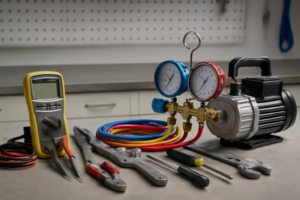
Most of the repairs in this guide are within reach for a careful DIYer with basic tools. In my experience, the moment your diagnosis points to a refrigerant leak — meaning the evaporator coils are clear of frost, the fans and defrost system all check out, yet the freezer still won’t get below 20°F — that repair requires EPA 608 certification and specialized recovery equipment, and it’s time to call a licensed technician rather than proceed on your own. When in doubt, a diagnostic service call typically costs $80–$120 and can save you from a misdiagnosis that costs more in parts.
Where to Buy Replacement Parts
All three parts are readily available on Amazon with fast shipping. Search for these exact terms to find compatible components for the GE GSS25GYPFS:
- GE GSS25GYPFS Defrost Heater WR51X10055 Replacement
- GE GSS25GYPFS Defrost Thermostat WR50X10068 Replacement
- BlueStars Upgraded WR55X10025 Refrigerator Temperature Sensor Replacement – Compatible with G.E & Hotpoint Refrigerators – Replaces 914093 AP3185407 PS304103 WR50X10027 is a popular aftermarket option that fits this model directly and includes an upgraded design intended to outlast the original. Grabbing the correct part number before you start disassembly will save you a second trip and keep the repair moving. (As an Amazon Associate I earn from qualifying purchases.)
Once you’ve confirmed the sensor is reading out of range with your multimeter, you’re ready to order a replacement and complete the swap. If you prefer to go with an OEM component, the General Electric WR55X10025 Refrigerator Temperature Sensor is the factory-original part and guarantees a direct fit for the GSS25GYPFS with no guesswork on compatibility. Using a genuine GE part can be the right call if your unit is still relatively new or if you want to match the original specs exactly.
Before you button everything back up and call it done, it’s worth keeping a spare sensor on hand — these components can fail again over time, especially in older units running long defrost cycles. The WR55X10025 Refrigerator Temperature Sensor by Seentech – Compatible with GE, Hotpoint Refrigerators & Freezers – Replaces AP3