No Heat
This guide covers how to diagnose and fix a no-heat problem on the Whirlpool WED4815EW electric dryer. A dryer that runs but produces no heat is one of the most common appliance complaints, and in most cases the fix involves replacing an inexpensive component rather than buying a new machine. Most homeowners with basic mechanical skills can complete this repair in 1–2 hours using standard household tools.
Common Symptoms & Causes
Before pulling out your tools, confirm that your dryer matches one or more of these specific symptoms:
- Drum spins normally but clothes come out cold or damp after a full cycle
- Dryer runs continuously without shutting off because the moisture sensor never detects heat
- Timed dry cycles complete but laundry remains wet
- No warm air is felt at the exhaust vent during operation
The most common root cause on the WED4815EW is a failed heating element or a blown thermal fuse — both of which interrupt the electrical circuit that powers the heating coil.
Safety First
- Unplug the dryer from the wall outlet before beginning any disassembly
- Wear work gloves to protect against sharp sheet-metal edges inside the cabinet
- Photograph all wiring harnesses and terminal connections before disconnecting anything
- Work in a well-lit space so you can clearly see small components and wire routing
Tools & Parts Needed
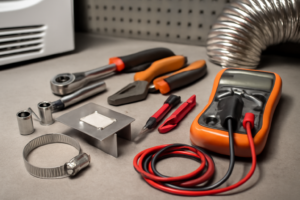
Essential Tools
- Phillips-head screwdriver
- Flathead screwdriver
- ¼-inch nut driver or socket set
- Digital multimeter (for continuity testing)
- Needle-nose pliers
Replacement Parts
Step-by-Step Repair Instructions
🔨 Pro Tip from Dave
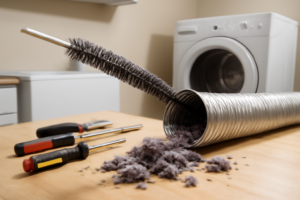
On the WED4815EW, the thermal fuse sits on the exhaust duct inside the cabinet, but before you slap a new one in, always check your vent line all the way to the exterior termination cap — a restricted or crushed duct is what killed the fuse in the first place, and skipping that step means your brand-new fuse will blow again within weeks. I’ve gone back to re-repair these dryers for customers who replaced the fuse themselves but never cleared the clog, so do yourself a favor and run a vent brush through the full length of duct before you close the machine back up.
Step 1: Unplug and Access the Rear Panel
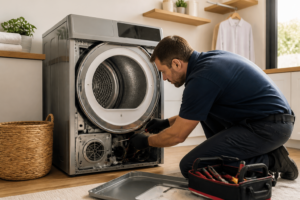
Pull the dryer away from the wall and unplug the power cord from the 240-volt outlet. Remove the screws securing the rear access panel using your ¼-inch nut driver. On the WED4815EW, the heating element housing and thermal fuse are both mounted on the back panel, making this your primary work area.
Step 2: Locate and Test the Thermal Fuse
The thermal fuse (WP3392519) is a small, white, one-time-use safety device mounted on the exhaust duct near the heating element housing. Set your multimeter to the continuity or resistance setting and place one probe on each terminal. A working thermal fuse reads near zero ohms; a failed fuse reads as open (infinite resistance) and must be replaced.
Step 3: Test the High-Limit Thermostat
The high-limit thermostat sits directly on the heating element housing and acts as a secondary safety cutoff. Use your multimeter to check continuity across its two terminals at room temperature — it should show continuity. If it reads open, replace it before moving on, as a faulty thermostat can cause a new heating element to fail prematurely.
Step 4: Inspect and Test the Heating Element
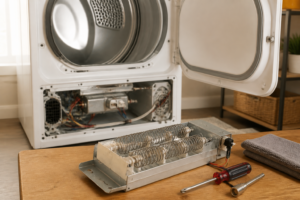
Disconnect the two wire leads from the heating element (WP8544771) and test across its terminals with your multimeter — a good element reads between 8 and 12 ohms of resistance. Visually inspect the coil inside the housing for any visible breaks or burn marks; a broken coil will confirm the element has failed and needs replacement.
Step 5: Replace the Failed Component
Remove the mounting screws holding the defective part and carefully disconnect the wire terminals, referencing your earlier photos to ensure correct reinstallation. Slide the new part into position, secure the mounting screws, and reconnect each wire terminal until it clicks firmly in place. Always replace the thermal fuse any time you replace the heating element, since a failed element is often the reason the fuse blew in the first place.
Step 6: Check the Exhaust Vent for Blockage
A clogged exhaust vent is the leading cause of repeated thermal fuse failures — clear it before reassembling. Disconnect the vent hose from the back of the dryer and check the entire run to the exterior wall for lint buildup. A dryer vent brush kit makes this job easy and prevents the same no-heat problem from recurring in a few months.
Step 7: Reassemble and Test
Reattach the rear panel, push the dryer back into place, and plug it in. Run a timed dry cycle on high heat for 10–15 minutes and verify warm air is flowing from the exhaust vent. If heat is restored and the drum temperature feels normal, the repair is complete.
How Much Does This Repair Cost?
Doing this repair yourself typically costs between $15 and $60 in parts, depending on whether you need the thermal fuse alone (~$5–$10), the heating element (~$30–$50), or both together. Hiring a technician for the same diagnosis and repair usually runs $150–$300 once you factor in the service call fee and labor. That means a straightforward DIY fix can save you $100 to $250 on a repair that takes less than two hours.
Where to Buy Replacement Parts
The three parts most likely to cause a no-heat condition on the Whirlpool WED4815EW are all readily available on Amazon with fast shipping. Search for these exact items to find compatible replacements:
- Whirlpool WED4815EW Heating Element WP8544771 Replacement
- Whirlpool WED4815EW Thermal Fuse WP3392519 Replacement
- Whirlpool WED4815EW High-Limit Thermostat WP8318314 Replacement
Frequently Asked Questions
Why does my
Before you dive into diagnosing the exact cause, it helps to have a replacement part ready to go — most no-heat issues on the WED4815EW come down to a failed heating element. The Heating Element Replacement For Whirlpool WED4616FW0 WED4800XQ1 WED6200SW1 WED4815EW1 WED4800BQ1 WED4950HW0 WED5000DW2 WED5600SQ0 WED5590VQ0 WED7000DW2 WED7300DW1 WED4900XW0 WED49STBW1 is a direct-fit option that covers a wide range of Whirlpool electric dryer models, so you can be confident it will seat and wire up correctly without modification. Ordering it ahead of time means you won’t have to pause mid-repair waiting on shipping. (As an Amazon Associate I earn from qualifying purchases.)
Once you’ve removed the back panel and confirmed the old heating element has a visible break or fails a continuity test with your multimeter, it’s time to swap it out. The Heating Element for Whirlpool Dryer WED4815EW1 WED5300SQ0 WED5000DW2 WED4800BQ1 WED5100VQ1 WED5300SQ0, Dryer Heating Element for Kenmore 70 Series, 80 Series Dryer Model 110 11065132410 11061202011 is a solid pick here because it’s cross-compatible with both Whirlpool and Kenmore models that share the same platform, making it a versatile option if you’re working on more than one machine. It installs using the same mounting bracket and terminal connections as the original, so the swap is straightforward.
%%