Upper rack not cleaning
This step-by-step repair guide walks you through fixing upper rack not cleaning on your KitchenAid KDTE334GPS. With the right tools and parts, most homeowners can complete this repair in 1–2 hours and avoid a costly service call.
🔨 Pro Tip from Dave
On the KDTE334GPS, a lot of techs overlook the upper wash arm bearing ring (part W10082862) — it wears out and allows the arm to wobble instead of spin properly. I’ve seen homeowners replace the entire wash arm when a $6 bearing ring was the real problem. Also check the spray arm retainer nut; cross-threading is incredibly common on this model during reassembly and will kill water flow instantly.
Part of our Top 20 Dishwasher Models & Common Repair Issues Guide. Browse all dishwasher repair guides for related models and issues.
“`html
Common Symptoms & Causes
These signs typically point to an upper rack cleaning failure on the KitchenAid KDTE334GPS dishwasher.
- Dishes and glasses on the upper rack come out with dried food residue still attached
- White filmy deposits remain on cups and bowls after a full wash cycle
- The upper spray arm spins poorly or stays completely still during operation
- Water pressure noticeably weaker at the top rack compared to the lower rack
This issue is most commonly caused by a clogged or cracked upper spray arm, a blocked water supply tube, a worn-out wash pump, or mineral buildup restricting water flow through the upper rack system.
“`
Safety First
- Unplug the dishwasher from the power outlet before starting any repair — never work on a live appliance.
- Shut off the water supply valve before disconnecting any water lines or hoses.
- Wear work gloves when handling metal brackets, sheet metal edges, or sharp components.
- Take photos with your phone before disconnecting any wiring harnesses or connectors.
- Work in a well-lit area with enough floor space to lay removed panels flat.
Tools & Parts Needed
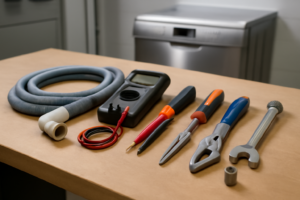
Essential Tools
- Phillips #2 screwdriver
- Torx T20 screwdriver
- Needle-nose pliers
- Multimeter
- Flashlight
Replacement Parts
Step-by-Step Repair Instructions
Step 1
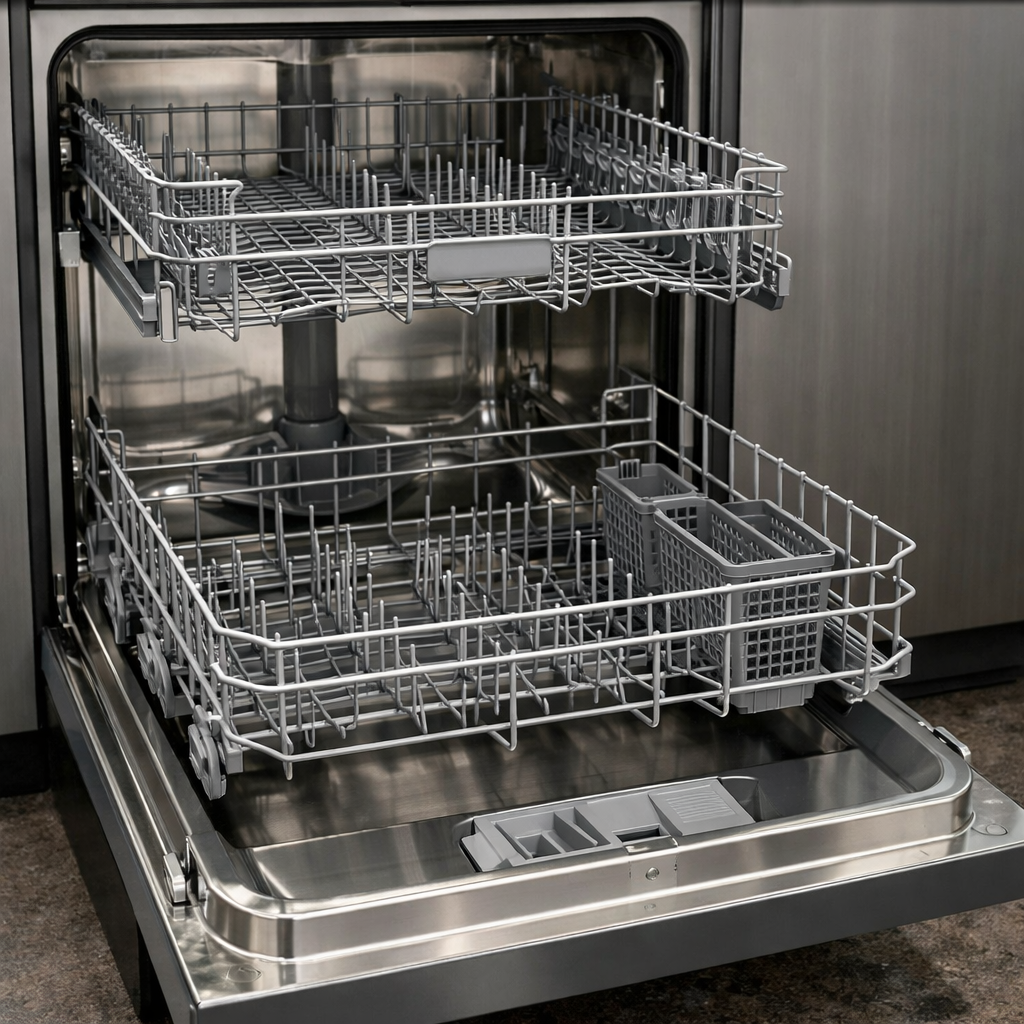
Remove the upper rack completely and detach the upper spray arm by twisting it counter-clockwise off the supply nozzle — this gives you direct access to inspect it for clogs, which are the most common cause of poor upper-rack cleaning. Hold the arm up to a light source and look through each nozzle hole; clogged holes will appear as dark spots rather than letting light pass through cleanly. Pro tip: take a photo of the arm’s position before removal so you know exactly how it was oriented when you reinstall it.
Step 2
Clear every blocked nozzle hole with a toothpick, being careful not to enlarge the opening, since even partial clogs reduce water pressure enough to leave dishes dirty. Soak the entire arm in undiluted white vinegar for 30 minutes to dissolve mineral deposits and grease buildup that a toothpick alone can’t reach, then rinse it under a strong tap or hose stream to flush debris out completely. Safety note: never use bleach to clean spray arms — it can degrade the plastic and may react with vinegar if residue remains.
Step 3
Inspect the upper spray arm supply tube, which runs from the center of the tub up to the nozzle where the arm attaches, because a cracked or misaligned tube bleeds water pressure before it ever reaches the spray arm. Look for visible cracks, and run a short cycle while watching for water jetting sideways or spraying in an unexpected direction rather than feeding up into the arm. If you find damage, replace the supply tube — this is a relatively inexpensive part but a critical one, and continuing to run the dishwasher with a cracked tube wastes water pressure and won’t improve cleaning results.
Step 4
Check the bearing ring at the point where the spray arm connects to the supply nozzle, because this small ring is what allows the arm to spin smoothly and at the correct angle during the wash cycle. Grip the arm gently and test for wobble — if it rocks side to side rather than sitting flush and stable, the bearing ring is worn or missing, causing the arm to spray off-angle and miss dishes entirely. Replace the bearing ring if it shows any play, as a loose arm is one of the most overlooked causes of chronic upper-rack cleaning failures.
Step 5
Reinstall the spray arm by pressing it onto the supply nozzle and rotating it clockwise until you feel and hear a distinct click, confirming it is locked in place. Give the arm a gentle spin by hand to verify it rotates freely through a full 360 degrees with no wobble, drag, or contact with the rack above — restricted movement will prevent even water distribution across the entire upper rack. Pro tip: also check that the rack itself glides fully back into the dishwasher without the spray arm catching on any loaded items before you close the door.
Step 6
Load the upper rack according to KitchenAid’s guidelines — cups and bowls face downward, angled toward the spray arm, with no items nested inside each other — because improper loading physically blocks water from reaching dish surfaces regardless of how well the spray arm is functioning. Run a full Heavy cycle and inspect every item on the upper rack when it finishes; everything should come out spotless if the spray arm, supply tube, and bearing ring are all in good condition. If one area of the rack still isn’t cleaning, recheck whether tall items on the lower rack are blocking the spray arm’s rotation during the cycle.
Where to Buy Replacement Parts
Find genuine OEM and aftermarket replacement parts for your KitchenAid KDTE334GPS on Amazon:
- KitchenAid KDTE334GPS upper spray arm 9001671 replacement
- KitchenAid dishwasher upper rack water supply tube replacement W10254672
- KitchenAid dishwasher spray arm bearing ring W10082853
When to Call a Professional
If the issue persists after completing all steps above, the problem may involve the sealed refrigerant system, a failed main control board, or wiring that requires specialized diagnostic equipment. Contact a licensed appliance technician — attempting sealed-system repairs without EPA 608 certification is illegal and unsafe.
“`html
How Much Does This Repair Cost?
DIY parts for fixing the upper rack not cleaning on your KitchenAid KDTE334GPS typically run between $15–$75, depending on whether you need a new spray arm, wash arm bearing, or water inlet valve. A professional service call usually costs $150–$300 including labor. Tackling this repair yourself can save you over $100 or more.
“`
Frequently Asked Questions
Why is only my upper rack not cleaning on my KitchenAid KDTE334GPS?
The upper spray arm is likely clogged or the water pressure reaching it is too low. Check the spray arm holes for debris and ensure the water inlet valve is functioning properly.
How do I remove the upper spray arm to clean it?
Twist the spray arm counterclockwise and pull it down to detach it from the mount. Rinse it under warm water and use a toothpick to clear any blocked holes.
Could low water temperature cause poor upper rack cleaning?
Yes, water below 120°F reduces cleaning effectiveness significantly. Run your hot water tap before starting a cycle to ensure the dishwasher fills with already-hot water.
Recommended Products
These are the parts and tools we recommend for this repair, based on compatibility and customer reviews:
- Upgraded WPW10546503 Dishwasher Top Rack Adjuster For Kitchenaid Dishwasher Parts Upper Rack W10546503 Dishwasher Replacement Parts For Whirlpool Kenmore Dishwasher Upper Rack KDTE334GPS0 KDTM354DSS4
- Dishwasher Middle Spray Arm WPW10498900 W10498900 Dishwasher Center Wash Arm Assembly compatible with Amana Maytag Whirlpool Dishwasher Parts Replaces W10448645 AP6022331 2312929 PS11755664
- 8193504 Dishwasher Upper Spray Arm, Compatible with Whirlpool Kenmore Maytag KitchenAid, Top Rack Wash Arm Replacement Parts Replaces 8268298 8538389 5493481 5493399
- 5304506740 Dishwasher Center Wash Arm Assembly,Dishwasher Spray Arm for Frigidaire Dishwasher -Replaces 5304498136 PS11770527
As an Amazon Associate, I earn from qualifying purchases.