Pump motor error
This step-by-step repair guide walks you through fixing pump motor error on your KitchenAid KDTE334GPS. With the right tools and parts, most homeowners can complete this repair in 1–2 hours and avoid a costly service call.
🔨 Pro Tip from Dave
On the KDTE334GPS, before you replace anything, pull the lower spray arm and check the pump filter housing for broken glass or debris jammed against the impeller — this model’s filter is notorious for trapping small fragments that mimic a motor failure. The correct replacement wash pump motor assembly is part number W11032770, and a common mistake is forgetting to disconnect the small ground wire tucked behind the pump bracket before pulling the unit, which can tear the harness.
Part of our Top 20 Dishwasher Models & Common Repair Issues Guide. Browse all dishwasher repair guides for related models and issues.
“`html
Common Symptoms & Causes
The following symptoms typically indicate a pump motor error on your KitchenAid KDTE334GPS dishwasher.
- The control panel displays error code 6-2 or F6E2 during or after a wash cycle
- The dishwasher fills with water but stops before completing the wash cycle
- You hear a humming noise from beneath the unit but no water circulation occurs
- Standing water remains at the bottom of the dishwasher tub after the cycle ends
These issues are most commonly caused by a failed or seized wash pump motor, worn motor bearings, a clogged pump impeller, or a faulty motor control board that can no longer deliver proper voltage to the pump assembly.
“`
Safety First
- Unplug the dishwasher from the power outlet before starting any repair — never work on a live appliance.
- Shut off the water supply valve before disconnecting any water lines or hoses.
- Wear work gloves when handling metal brackets, sheet metal edges, or sharp components.
- Take photos with your phone before disconnecting any wiring harnesses or connectors.
- Work in a well-lit area with enough floor space to lay removed panels flat.
Tools & Parts Needed
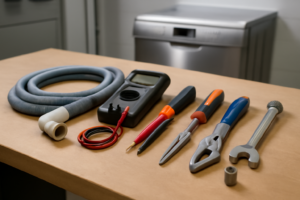
Essential Tools
- Phillips #2 screwdriver
- Torx T20 screwdriver
- Needle-nose pliers
- Multimeter
- Flashlight
Replacement Parts
Step-by-Step Repair Instructions
Step 1
Disconnect power at the breaker or by unplugging the unit before touching anything inside the dishwasher. Remove the lower rack and filter assembly, then reach into the sump and try to spin the wash impeller by hand — it should rotate freely. If it feels bound or seized, the motor bearings have likely failed and the motor will need replacement.
Step 2
Locate the start capacitor at the motor terminals and test it with a capacitor meter against the manufacturer’s specification printed on the capacitor body. A reading outside spec, or a visibly bulging or leaking capacitor, means the capacitor has failed and should be replaced before condemning the motor itself — a bad capacitor can mimic a dead motor by preventing startup. Replacing the capacitor first is a lower-cost diagnostic step that can save you from an unnecessary motor purchase.
Step 3
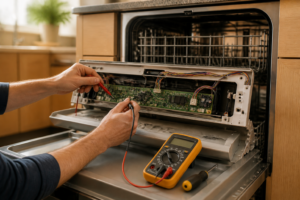
Set your multimeter to Rx1 and probe both motor windings at the harness connector, with the harness unplugged to avoid a false reading from the control board. Both windings should return a measurable resistance value; an open reading (OL or infinite resistance) on either winding confirms the motor coil has failed internally. If one or both windings are open, the motor must be replaced — this fault cannot be repaired.
Step 4
Tilt the dishwasher backward carefully and support it so it won’t fall, giving you access to the underside of the sump where the motor mounts. Remove the three motor mounting screws, unplug the wiring harness, and pull the motor and impeller assembly out as a unit. Install the new motor, reconnect the harness, and confirm the impeller seats properly — a loose impeller is a common cause of poor wash performance after a motor swap.
Step 5
Reinstall the filter assembly and spray arm, making sure the filter locks into place and the spray arm spins freely, because a loose filter can allow debris to re-damage the new motor. Carefully return the unit to its upright position before reconnecting power. Pro tip: check the door gasket and base area for any water that pooled during the repair and wipe it dry to prevent a false leak alarm on the first cycle.
Step 6
Restore power and run a full Normal cycle while monitoring the machine during the wash phase. The motor should run smoothly and consistently — if you hear a humming-then-stopping pattern, that indicates the motor is drawing excessive current and stalling, which points to either a wiring issue, an incorrect replacement part, or a lingering blockage in the sump. Confirm the cycle completes without any error codes before returning the appliance to normal use.
Where to Buy Replacement Parts
Find genuine OEM and aftermarket replacement parts for your KitchenAid KDTE334GPS on Amazon:
- KitchenAid KDTE334GPS circulation pump motor W10482480 replacement
- KitchenAid dishwasher motor capacitor replacement WPW10420083
- KitchenAid dishwasher wash pump impeller cleaning
When to Call a Professional
If the issue persists after completing all steps above, the problem may involve the sealed refrigerant system, a failed main control board, or wiring that requires specialized diagnostic equipment. Contact a licensed appliance technician — attempting sealed-system repairs without EPA 608 certification is illegal and unsafe.
“`html
How Much Does This Repair Cost?
Replacing the pump motor on a KitchenAid KDTE334GPS typically costs $85–$175 in parts when doing it yourself. A professional appliance repair service call generally runs $150–$300, including labor and parts. Tackling this repair DIY-style can save you $100 or more, making it a worthwhile project for confident home repairers.
“`
Frequently Asked Questions
Can I still run my KitchenAid KDTE334GPS if the pump motor error appears?
Running the dishwasher with an active pump motor error can worsen the damage and may leave dishes dirty or standing water in the tub. It’s best to address the issue before running another cycle.
How do I know if the pump motor needs replacing or just cleaning?
Check the pump filter and drain area for debris first, as clogs are a common cause of this error. If the motor hums but doesn’t run after cleaning, replacement is likely needed.
How much does it typically cost to replace the pump motor on a KitchenAid KDTE334GPS?
Replacement pump motors for this model generally range from $80 to $150 for the part alone. Professional installation can add $100 to $200 depending on your location.
Recommended Products
These are the parts and tools we recommend for this repair, based on compatibility and customer reviews:
As an Amazon Associate, I earn from qualifying purchases.