Not heating
This step-by-step repair guide walks you through fixing not heating on your LG DLE3400W (Electric). With the right tools and parts, most homeowners can complete this repair in 1–2 hours and avoid a costly service call.
🔨 Pro Tip from Dave
On the LG DLE3400W, always replace the thermal fuse (part number 6931EL3003D) alongside the heating element — skipping this step is the number one mistake I see DIYers make, and the dryer will fail again within weeks. Also watch for lint buildup packed tightly around the heating element housing, which is usually what caused the original failure; clean it out thoroughly before reassembling or you’ll be back in there soon.
Part of our Top 20 Dryer Models & Common Repair Issues Guide. Browse all dryer repair guides for related models and issues.
“`html
Common Symptoms & Causes
The following symptoms suggest your LG DLE3400W is experiencing a heating failure that needs attention.
- Clothes come out completely cold and damp after a full cycle
- The dryer runs and tumbles normally but produces no heat
- The drum interior feels room temperature immediately after a completed cycle
- Drying times have doubled or tripled with no improvement in results
These symptoms are most commonly caused by a burned-out heating element, a failed thermal fuse, or a faulty high-limit thermostat — components that wear out over time due to repeated heat cycling and restricted airflow.
“`
Safety First
- Unplug the dryer from the power outlet before starting any repair — never work on a live appliance.
- Wear work gloves when handling metal brackets, sheet metal edges, or sharp components.
- Take photos with your phone before disconnecting any wiring harnesses or connectors.
- Work in a well-lit area with enough floor space to lay removed panels flat.
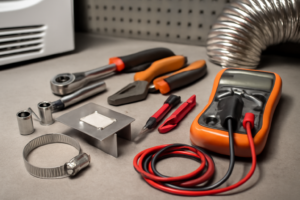
Tools & Parts Needed
Essential Tools
- Phillips #2 screwdriver
- ¼” nut driver
- Putty knife
- Multimeter
- Work gloves
Replacement Parts
- Heating element
- thermal fuse
- cycling thermostat
- multimeter
Step-by-Step Repair Instructions
Step 1
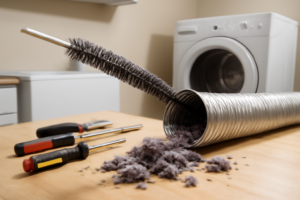
Unplug the dryer before doing anything else, then pull out the lint screen and inspect the exhaust duct all the way to the exterior vent — restricted airflow is the number-one cause of thermal fuse failure, and if you replace the fuse without clearing the blockage it will blow again immediately. Use a dryer vent brush kit to clear any lint buildup from the duct, and only proceed to component testing once you have confirmed unrestricted airflow. Pro tip: if the thermal fuse is the only failed part, a clogged duct is almost certainly why it failed.
Step 2
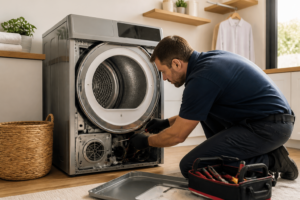
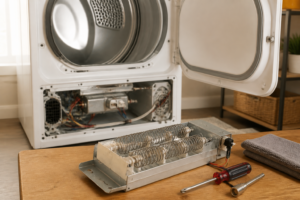
Remove the rear panel by taking out the five ¼-inch hex screws with a ¼-inch nut driver to access the heating element, which is a coiled resistance wire housed in a metal enclosure. Set your multimeter to Rx1 and probe both terminals of the element — a good element shows low resistance, while an open reading (no continuity) means the coil is broken and the element must be replaced. Handle the element carefully; the coil is fragile and even a small break in the wire will prevent any heat production.
Step 3
Locate the thermal fuse on the exhaust duct outlet inside the rear of the dryer — it has two wire terminals and is a one-shot safety device that permanently opens if the dryer overheats. Test it on Rx1; a healthy fuse shows continuity, and any open reading confirms it has blown and must be replaced with an exact amperage match. Never bypass the thermal fuse or substitute a different rating, as it is the last line of protection against a dryer fire.
Step 4
Find the cycling thermostat mounted on the heater housing and test it on Rx1 — at room temperature it should show continuity because its normal closed position is what allows the heating circuit to complete. An open reading at room temperature means it has failed in the open position and is preventing the element from receiving power, so replace it. This thermostat is responsible for turning heat on and off throughout the cycle to maintain the correct drum temperature, so a faulty one can cause either no heat or overheating.
Step 5
Locate the high-limit thermostat on the heater housing — it is a separate component from the cycling thermostat and acts as a secondary safety cutoff that opens permanently if temperatures reach a dangerous level. Test it on Rx1; it should show continuity at room temperature, and an open reading means it has tripped and must be replaced. Like the thermal fuse, a blown high-limit thermostat is often a symptom of restricted airflow rather than a random failure, so confirm the duct is clear before installing a new one.
Step 6
Reattach the rear panel and drive all five ¼-inch hex screws back in, then plug the dryer in. Run a 10-minute Air Fluff cycle first to confirm the motor and drum operate normally before introducing heat. Switch to a heat setting and observe through the door or listen for the element to engage — the heating element should begin glowing orange within three minutes, confirming a successful repair.
Where to Buy Replacement Parts
Find genuine OEM and aftermarket replacement parts for your LG DLE3400W (Electric) on Amazon:
- LG DLE3400W heating element 5301EL1001J replacement
- LG electric dryer thermal fuse 6931EL3003D
- LG dryer cycling thermostat 6931EL3003B
When to Call a Professional
If the issue persists after completing all steps above, the problem may involve the sealed refrigerant system, a failed main control board, or wiring that requires specialized diagnostic equipment. Contact a licensed appliance technician — attempting sealed-system repairs without EPA 608 certification is illegal and unsafe.
How Much Does This Repair Cost?
DIY parts for a not heating issue on the LG DLE3400W typically run between $15 and $80, depending on whether you’re replacing a heating element, thermal fuse, or thermostat. A professional service call for the same repair usually costs $150–$300 once you factor in labor. Doing it yourself can save you $100 or more.
Frequently Asked Questions
Why is my LG DLE3400W running but not producing heat?
The most common cause is a blown heating element or a tripped thermal fuse, both of which are inexpensive parts you can test with a multimeter. A faulty thermal fuse will show no continuity and must be replaced before the dryer will heat again.
Do I need to reset my circuit breaker before starting this repair?
Yes — electric dryers use a double-pole breaker, and one leg can trip while the other stays on, causing the drum to spin without heat. Reset both breakers fully before replacing any parts.
How long does this repair typically take for a homeowner?
Most homeowners complete this repair in one to two hours with basic tools like a screwdriver and multimeter. Having the replacement heating element or thermal fuse on hand before you begin will save a second trip to the parts store.
Recommended Products
These are the parts and tools we recommend for this repair, based on compatibility and customer reviews:
- Dryer Heating Element Kit for LG DLE2516W DLE4970W DLE7100W DLE7300VE DLE1310W DLEX3470V DLEX8000V DLE5977W DLE1501W DLE6100W DLE1101W DLE7300WE DLE5955W DLEX3700V DLEY1201V DLE1501W Dryers
- Semzohc Dryer Heating Element Kit Fit for L.G Dryer DLE5955W DLE2301R DLEX3370W DLEX3470V DLE1501W DLEX3070W DLE5977S DLE5977B DLE5955G DLE4970W DLEX3360W DLE2140W DLE0442W DLEX8100V DLEX8000W
- 2026 Upgraded 6931EL3003D Dryer Thermal Fuse 6931EL3001F Dryer Thermostat L125-31C Replacement Fit for KenM0re LG Replaces dle5955w dle2050w dle2301r AP5072172 AP4440975 PS3530482 PS3530485 by Romalon
As an Amazon Associate, I earn from qualifying purchases.