Lid hinge broken
This step-by-step repair guide walks you through fixing lid hinge broken on your Whirlpool WTW8120HW (Top Load). With the right tools and parts, most homeowners can complete this repair in 1–2 hours and avoid a costly service call.
🔨 Pro Tip from Dave
On the WTW8120HW, the lid hinge assembly uses part number W11130362 — and the most common mistake I see is techs forgetting to support the lid before removing the hinge screws, which can cause the lid to fall and crack the glass panel. Also watch for the small retaining clip inside the hinge channel; it’s easy to lose and you’ll need it for reinstallation.
Part of our Top 20 Washing machine Models & Common Repair Issues Guide. Browse all washing machine repair guides for related models and issues.
“`html
Common Symptoms & Causes
If your Whirlpool WTW8120HW has a broken lid hinge, you’ll likely notice one or more of these telltale signs before the washer stops working properly.
- The lid droops to one side and won’t sit flush when closed
- The washer displays an “Lid” error code and refuses to start a cycle
- The lid feels loose or wobbles when lifted, with visible cracking at the hinge point
- The lid falls open on its own instead of staying in the raised position
This issue is most commonly caused by metal fatigue or stress fractures in the hinge bracket from repeated use, or by plastic mounting tabs snapping off after prolonged wear over time.
“`
Safety First
- Unplug the washing machine from the power outlet before starting any repair — never work on a live appliance.
- Shut off the water supply valve before disconnecting any water lines or hoses.
- Wear work gloves when handling metal brackets, sheet metal edges, or sharp components.
- Take photos with your phone before disconnecting any wiring harnesses or connectors.
- Work in a well-lit area with enough floor space to lay removed panels flat.
Tools & Parts Needed
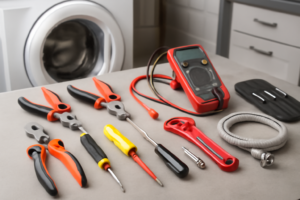
Essential Tools
- Phillips #2 screwdriver
- ¼” nut driver
- Torx T20 screwdriver
- Multimeter
- Bucket and towels
Replacement Parts
Step-by-Step Repair Instructions
Step 1
Unplug the washer before touching any components to eliminate shock risk from the lid lock solenoid circuit. Open the lid fully and inspect both rear hinges — each is held by two T20 Torx screws — looking for a cracked hinge arm or sheared pivot pin, either of which prevents the lid from supporting its own weight or sitting level. A damaged pivot pin is the most common cause of a lid that suddenly drops or sits at an angle, so confirm the failure mode before ordering parts.
Step 2
Remove the broken hinge by holding the lid open at 90° so it doesn’t swing and stress the opposite hinge during disassembly. Unscrew the two T20 Torx screws from the lid-side hinge plate, then the two T20 Torx screws from the cabinet hinge block, and lift the lid straight up and off. Pro tip: have a second person support the lid weight while you remove the final screws to avoid dropping it on the control panel.
Step 3
With the hinge removed, inspect the tension spring inside the hinge housing, because this spring is what holds the lid open at 90° rather than letting it fall back on you. A stretched or broken spring causes the lid to slam shut under its own weight or, conversely, to feel stiff and resist closing. Replace the spring any time you see coils separated beyond their normal spacing or a visible break in the wire.
Step 4
Install the new hinge by seating the cabinet hinge block first and driving both T20 Torx screws snug but not fully tight, then attaching the lid hinge plate with its two T20 Torx screws. Tighten all four screws fully once the lid is seated and hanging plumb, because final torque with the lid in place ensures the hinge isn’t stressed at an angle. A correctly installed hinge lets the lid swing through its full arc without binding or side-to-side wobble.
Step 5
After tightening the hinge, check that the lid strike lines up squarely with the lid lock sensor on the cabinet, because even a few millimeters of misalignment will prevent the washer from starting or trigger a lid-lock error code. If the strike is off to one side, loosen the hinge screws slightly, shift the lid laterally until the strike centers over the lock, then re-tighten. This alignment step is frequently skipped and is the most common reason a repair that looks correct still leaves the washer non-functional.
Step 6
Open and close the lid 10 times as a final functional check, confirming it swings smoothly to 90°, holds that position without drifting, and latches with a firm click each time it closes. Any grinding, side-to-side slop, or failure to hold the open position indicates a hinge not fully seated or a spring still needing replacement. Plug the washer back in only after all 10 cycles feel consistent.
Where to Buy Replacement Parts
Find genuine OEM and aftermarket replacement parts for your Whirlpool WTW8120HW (Top Load) on Amazon:
- Whirlpool WTW8120HW lid hinge kit W10404050 replacement
- Whirlpool top load washer lid spring replacement W11400231
- Whirlpool washer lid assembly replacement WTW8120HW
When to Call a Professional
If the issue persists after completing all steps above, the problem may involve the sealed refrigerant system, a failed main control board, or wiring that requires specialized diagnostic equipment. Contact a licensed appliance technician — attempting sealed-system repairs without EPA 608 certification is illegal and unsafe.
“`html
How Much Does This Repair Cost?
Replacing a broken lid hinge on the Whirlpool WTW8120HW typically costs $15–$50 in parts when doing it yourself. A professional repair, including the service call and labor, usually runs $150–$300. Tackling this repair DIY-style can save you over $100, making it a worthwhile fix for most homeowners.
“`
## Frequently Asked Questions
Can I still use my Whirlpool WTW8120HW if the lid hinge is broken?
It is not recommended, as a broken lid hinge can prevent the lid switch from engaging, stopping the machine from spinning or agitating. Running the washer in this condition may also worsen the damage or create a safety hazard.
How much does a replacement lid hinge cost for the Whirlpool WTW8120HW?
Replacement lid hinges for the WTW8120HW typically cost between $15 and $40 depending on the supplier. Purchasing an OEM part ensures the best fit and longevity.
Do I need any special tools to replace the lid hinge?
Most lid hinge replacements only require a Phillips-head screwdriver and a putty knife to release the cabinet clips. No advanced tools or technical experience are typically needed for this repair.
Recommended Products
These are the parts and tools we recommend for this repair, based on compatibility and customer reviews:
- Upgraded W11130236 Washer Lid Assembly Compatible With Whirlpool XL Bravos Washer Parts WTW7500GC2 WTW7500GC0,W11038208 Whirlpool Front Washing Machine Parts WTW7500GW0 WTW7500GW2 WTW7500GC3
- Upgraded MVWB765FW3 Lid Replacement, W11259006 Washer Lid Assembly Compatible with Whirlpool & Maytag, Replaces Part Numbers W10714900 and W10843976, Includes Left Hinge, Right Hinge and 4 Screws
- UPGRADED W11101504 Washer Lid Assembly Replacement Compatible With Maytag Washer Lid, WP8563965 Left Lid Hinge & WP8572974 Right Lid Hinge & 4 Screws W11404293, Replaces W11256781 W10843975 W11082611
- Whirlpool W11551369 OEM Top Load Washer Lid Hinge, Black
As an Amazon Associate, I earn from qualifying purchases.